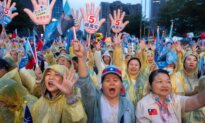

Taiwan’s ruling Democratic Progressive Party (DPP) appeared on track to gain ground in local elections on Saturday, though it fell short in the capital, where Mayor Chiang Wan-an held off a DPP challenger.
The elections have drawn China’s attention, with Beijing sending dozens of warplanes near the self-governing island.
The elections will determine mayors, council members, and other local leaders across 22 cities and counties in what Taiwan calls its “nine-in-one” elections. Polling stations were open from 8 a.m. to 4 p.m. local time, with results expected later in the day.
While voting was underway, Taiwan’s Defense Ministry said in an update on X that it detected 33 Chinese military aircraft, eight warships, and four official vessels around the island.
The ministry said 27 of the aircraft crossed the Taiwan Strait’s median line and entered Taiwan’s air defense identification zone (ADIZ). In response, Taiwan’s military deployed aircraft, vessels, and coastal missile systems to monitor the Chinese military’s movement.
The Chinese Communist Party (CCP) claims Taiwan as its territory despite never having ruled the island and has not ruled out the use of military force to bring it under its control.
Initial vote counts showed the DPP and the main opposition party Kuomintang (KMT) appeared headed to an even split in Taiwan’s six largest cities. The ruling party appeared on track to reclaim Taichung, the island’s second most populous city.
One of the most closely watched contests is in Taipei, Taiwan’s capital, where incumbent Mayor Chiang Wan-an of the opposition Kuomintang (KMT) is competing against DPP candidate Puma Shen.
Chiang won a second term on Saturday, defeating Shen by roughly 54 percent to 46 percent.
Shen, who was labeled a separatist by Beijing, conceded after the loss.
“I know there’s many people crying here,” Shen said in a speech after his loss. “I want to thank every person who voted for me.”
Chiang has advocated continued dialogue with Shanghai to reduce tensions, while Shen has questioned the effectiveness of the cities’ exchange forum and warned that it could give the CCP an opening for infiltration.
Shen is wanted by police in the Chinese city of Chongqing, which launched a probe into him last year over separatism charges. He told Reuters earlier this month that the police there had never tried to contact him.
Another closely watched race is in New Taipei, Taiwan’s most populous city and a stronghold of the main opposition party. Local news outlets reported Saturday that KMT candidate Lee Shu-chuan was leading against DPP candidate Su Chiao-hui in the mayoral race.
Beijing views Taiwan’s local elections as an early indication of the island’s political direction ahead of the 2028 presidential election, according to Emma Y. Liu and Edgard D. Kagan of the Center for Strategic and International Studies (CSIS) on Nov. 25.
Taiwan’s major cities have historically produced national leaders. Four of its five directly elected presidents previously served as mayors.
Lee Teng-hui, Chen Shui-bian, and Ma Ying-jeou led Taipei, the capital city, while incumbent President Lai Ching-te was mayor of Tainan.
Ahead of the elections, Taiwanese Premier Cho Jung-tai has warned local authorities of potential cyberattacks and called for coordinated efforts to protect the integrity of the vote, a local news agency reported on Nov. 26, citing cabinet spokesperson Michelle Lee.
Lee said the premier had also directed local election commissions to ensure timely ballot deliveries to polling stations and called on government agencies to ensure candidates’ personal safety and protect public security.
Arthur Zhang, Jacki Thrapp, and Reuters contributed to this report.