


After the fall of the Berlin Wall on Nov. 9, 1989, staff at the U.S. Embassy in East Germany uncovered a damaging breach inside their own walls: An American secretary had been passing classified embassy secrets to her East German boyfriend.
“She had been knowingly giving him secret information. The reason she did it is because she thought he was in love with her. He wasn’t,” recalled Thomas Lee Boam, a U.S. diplomat stationed in East Germany at the time. The secretary went to prison and has since been released.
In intelligence parlance, the tactic has an enduring name: the “honey trap”—known in Chinese as the “beauty trap.”
“Oh, that happens all the time,” Boam told The Epoch Times. “The government sends a very attractive person, male or female depending on the American [target], to engage in a relationship with that person. And it’s so common, it has a name. You’ve been honey-trapped.”
 A woman identified as Alice Huang at a dinner with Nvidia CEO Jensen Huang (in black) at a restaurant in Taipei, Taiwan, on May 22, 2025, in a screengrab from Chung T’ien Television video footage. (CTI via Reuters)
Boam, who spent 26 years in the U.S. Foreign Service across West Germany, East Germany, Canada, Hong Kong, and Beijing—where he served as minister-counselor for commercial affairs at the U.S. Embassy from 2000 to 2004—is now a professor at the University of Utah’s David Eccles School of Business.
Speaking with The Epoch Times for roughly 90 minutes the day before Huang’s resignation, Boam emphasized that his views are strictly personal and do not represent the University of Utah. “I’m just reporting historical facts. I don’t know how the U.S. government sees it today,” he said. “I’ve been gone for 20 years.”
Diplomatic Rules Against ‘Honey Traps’
For American diplomats posted to China, guarding against romantic entrapment began with blunt internal rules: U.S. personnel were barred from forming long-term relationships with Chinese citizens.
“I could talk to my staff, but if I had any kind of personal relationship with somebody outside of the embassy, I had to report it. Because they were probably a spy,” Boam said.
With plenty of single diplomats eager to socialize, embassy rules drew a bright line against emotional attachment. “You can have one date. That’s OK. And you can have a very intimate date, and that’s OK. But you can’t have 10 dates. You can’t have a relationship. You can have a one-night stand, but you can’t have a relationship. Because they were spies,” he said. “If they’re going out with Americans, they were probably assigned.”
As the East German embassy case proved, foreign intelligence services specifically task operatives to win a target’s trust until affection overrides judgment. “These are people who have been assigned by the foreign government to gain trust of the person that they’re assigned to in order to get secret information out of them,” Boam explained. “And when the person that they’re assigned to falls in love with them, then they’re starting to say, ‘OK, well, you know, now I’m going to do what you want me to do because I love you so much.’ It works.”
That vigilance applied far beyond romance. “So relationships with locals were very suspect,” Boam said. “Not just romantic relationships. Anytime somebody came to you and wanted to be your friend, then you had to ask why.”
Living Under Constant Surveillance
Outside the embassy gates in Beijing, state surveillance was simply part of daily life. Asked if he was ever watched or followed, Boam answered in one word: “Always.”
Paradoxically, the constant tail made him feel secure. “We knew the state security was always following us and everybody else did too. That means nobody would have ever tried to do anything to us. No muggers, nothing. Very safe,” he said.
His home was bugged, and his internet and email traffic were closely monitored. Rather than fight it, Boam turned the surveillance into a practical tool. “Sometimes there were so many people monitoring the email that it slowed it down,” he recalled. “So while I was sitting in front of my computer, I’d say to my wife, ‘These guys are on the internet again and they’re making it so slow I can’t communicate.’ And suddenly the internet would speed back up again.”
When diplomatic protocol barred him from voicing blunt criticisms directly, Boam turned the bugs in his home into a backchannel. “There were things that I couldn’t say to a Chinese government official’s face—criticism,” he said. “But if I said it to the microphone in my house, it was OK because it was not face-to-face. So I would deliver messages to government officials by just discussing things at home.”
In his words, it was simply “spy versus spy.” “You just live with it. You know it’s there, so you adjust accordingly,” he said.
Inside Boam’s commercial section in Beijing, Chinese regulations also shaped the local workforce. Because foreign embassies are barred from hiring Chinese citizens directly on the open market, local staff are vetted, assigned, and administered through a state-run diplomatic service agency tied to China’s security apparatus.
“I had about 100 Chinese nationals,” Boam said. “Our staff members, for example, were all assigned to us by State Security. We couldn’t hire anybody on our own. And State Security would take 30 percent of their pay. So they knew who they were working for, there was no question.”
Those employees were required to report what they saw and heard to Chinese security authorities. Yet in day-to-day life, Boam noted, many of the younger staffers seemed far less guarded than Americans might expect.
“Many of them were surprised when they found out my residence had been bugged,” Boam said, noting that unless citizens crossed the regime on sensitive issues such as Falun Gong, daily life after the 1989 Tiananmen crackdown felt far less visibly intrusive and increasingly consumer-driven. “They wanted to buy a car; the capitalist model had really become important in their lives. They wanted stuff, they wanted things that their parents never had.”
‘Visa Lunches’ and Officials’ Two Worlds
Alongside covert intelligence gathering, Boam spent years navigating China’s culture of “guanxi”—a Chinese term he has since become fluent in, referring to the cultivation of personal connections for favors. Nearly every meal invitation from local businesspeople came with an ulterior motive.
“Every time I had contact with people in the business community, they’d say, ‘We want to invite you to lunch.’ In every case, it was a visa,” Boam said. Eventually, he drew a firm boundary: “I will not do visa lunches. If somebody is going to invite me to lunch, I need to know the agenda and if it’s a visa, I’m not going to do it.”
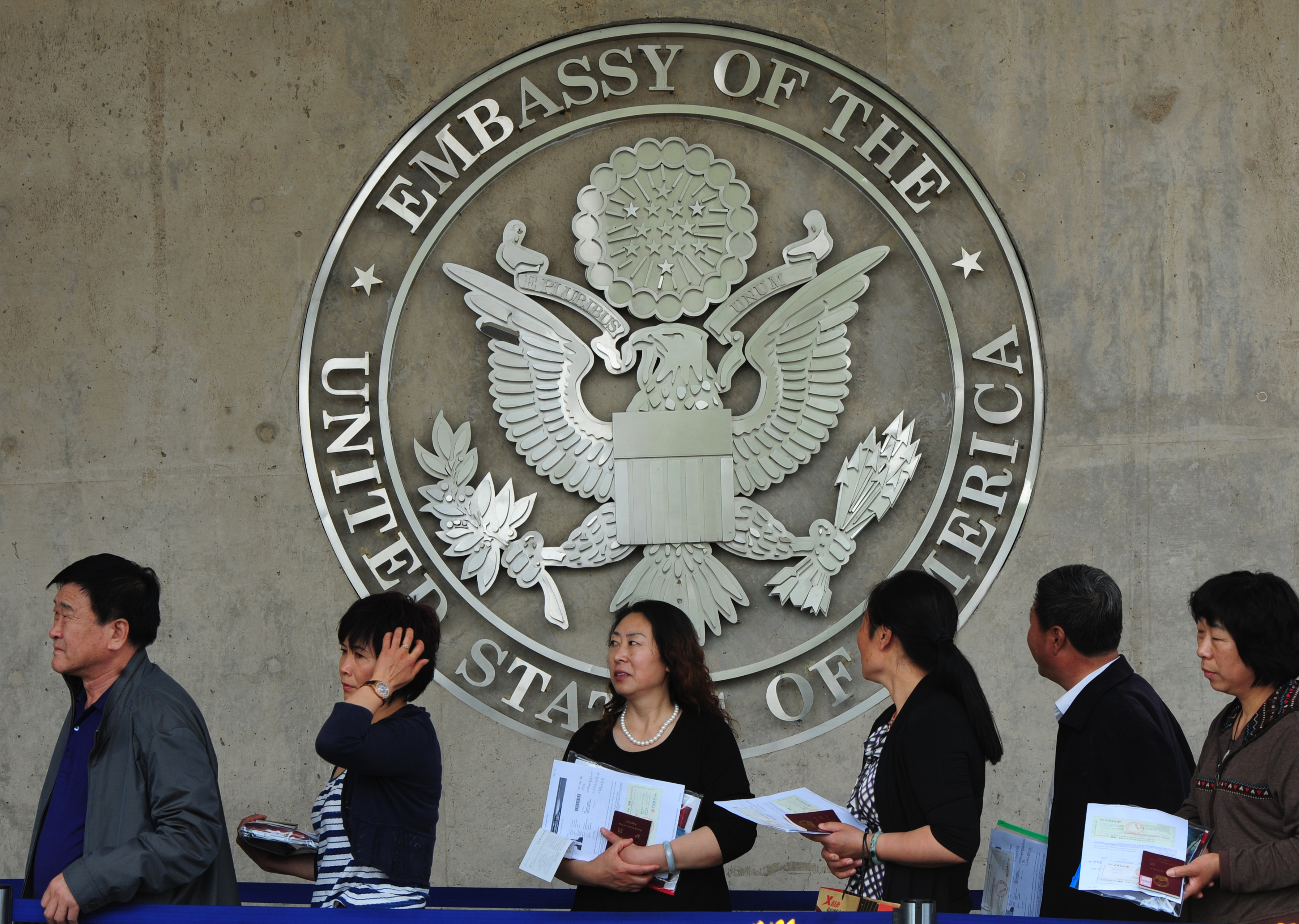 Chinese citizens wait to submit their visa applications at the U.S. Embassy in Beijing on May 2, 2012. (Mark Ralston/AFP/GettyImages)
“I would have Chinese government officials come to me and say, ‘We will not be intimidated by capitalist hegemonies,'” he recalled. “And then they would turn around in the next sentence and say, ‘Can you help me get my son into university in the United States?’ It was like there were two worlds going on at the same time.”
Even at the top of the party hierarchy, private enthusiasm for American culture surfaced. “One of the top leaders of the Chinese government told me how happy he was when he could take his granddaughter to McDonald’s to have a hamburger,” Boam said, referring to China’s second-highest-ranking official at the time.
Official diplomacy, meanwhile, played out like scripted theater. Whenever Boam served as acting ambassador, the Chinese Foreign Ministry summoned him nearly every day to issue formal reprimands—over U.S. newspapers describing Taiwan as an independent country, or over Falun Gong demonstrations in the United States. Boam would cite America’s constitutional protections for speech and assembly, listen to the obligatory line about refusing to be intimidated by capitalist hegemons, and hold firm.
“And then the foreign minister would turn to me and say, ‘How’s the family? Where are you going on vacation? Why don’t you come over to dinner?’ This whole thing was just form,” Boam said.
$9 Billion in Disputes—and Basic Due-Diligence Failures
As America’s senior commercial diplomat in Beijing, Boam had little interaction with ordinary Chinese citizens outside official channels—except when confronting local businesses over misconduct toward U.S. partners.
“Product piracy, counterfeiting, contract violations, lying to their partners, stealing their money, everything you can think of. Corruption,” Boam said. “I spent 80 percent of my time on that kind of stuff.”
Because of the 12-hour time difference with Washington, phone calls routinely woke him at 3 a.m. with callers opening briskly with “Good afternoon.” By the time he left Beijing, Boam said, he had “$9 billion of trade disputes on my desk—American companies that got themselves in trouble and wanted me to get them out of trouble.”
In written follow-up remarks after Jensen Huang’s resignation, Boam noted that a glaring weakness he witnessed two decades ago still plagues American companies today: Too many firms fail to verify even the most basic facts about their Chinese counterparties, such as confirming whether a listed business address houses an actual operating office. More than once during his posting, Boam personally checked an address at a U.S. company’s request only to find nothing there at all.
Recent developments suggest that blind spot has not disappeared, with Treasury Secretary Scott Bessent warning this month that U.S. tech firms face scrutiny over whether restricted Nvidia chips have been sold to pass-through shell companies.
For Boam, the demanding years in Beijing fostered a lasting appreciation for clear-eyed vigilance. He called his Foreign Service years in China “challenging, fascinating, and tiring” and said he wouldn’t trade the experience.
He noted that while diplomats operate under strict reporting rules, corporate executives navigating Beijing’s orbit rarely do. His rule of thumb remains unchanged in both worlds: Know who is across the table, verify what is behind the façade, and never take sudden friendship at face value.