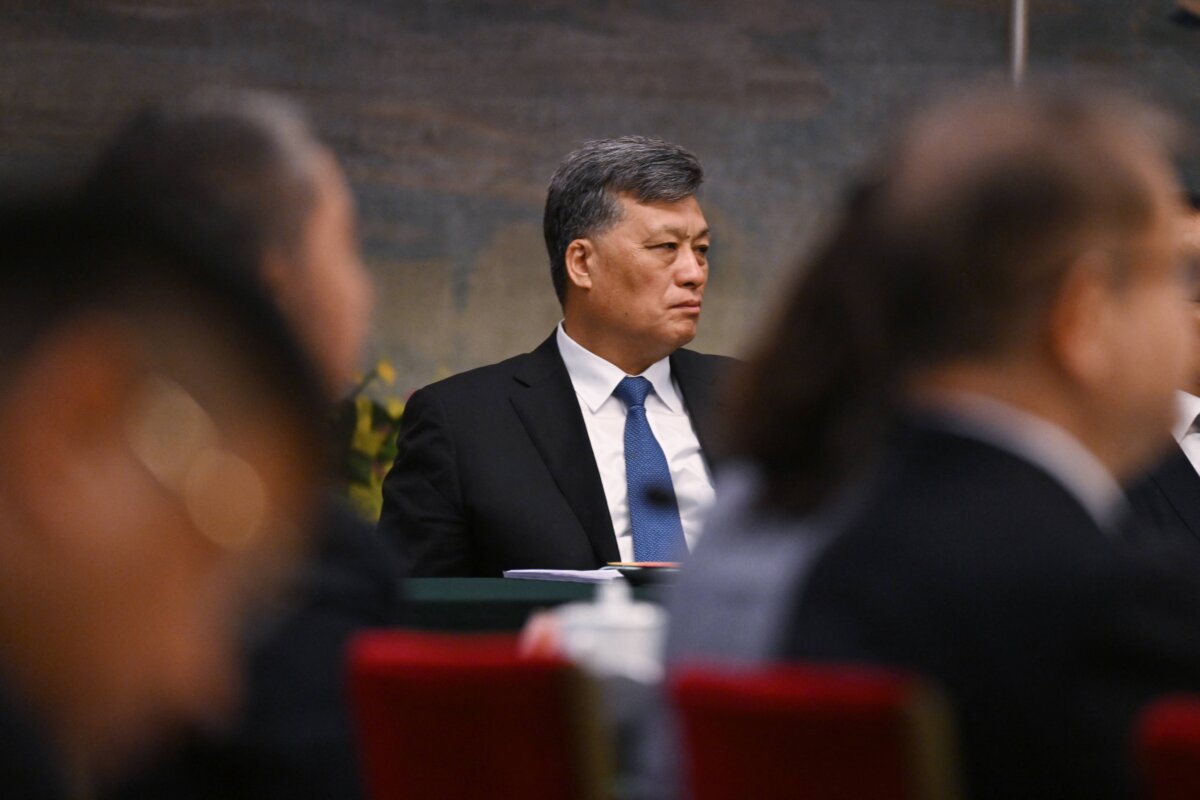
The indictment of former Chinese Communist Party (CCP) Politburo member Ma Xingrui has highlighted the depth of corruption investigations within China’s military-industrial complex, with analysts saying the cases expose systemic weaknesses in the defense sector and growing political pressures on Chinese leader Xi Jinping.
Ma was formally indicted on bribery charges on Nov. 5. According to the official announcement, his alleged corruption spanned more than 25 years, beginning when he was deputy general manager of China Aerospace Science and Technology Corporation (CASC), a major state-owned defense contractor.
Mark Cao, a U.S.-based military tech analyst, former materials engineer, and host of Chinese-language military news YouTube channel Mark Space, told The Epoch Times that Ma’s case was closely connected to the broader wave of investigations into military-industrial officials.
“I believe that during the investigations, they implicated one another, and Ma Xingrui was also named,” Cao said.
Su Tzu-yun, a research fellow at Taiwan’s Institute for National Defense and Security Research, told The Epoch Times that the fact that Ma’s alleged corruption dated back to his aerospace career demonstrated the close connection between his case and the wider purge of defense industry officials.
Ma held senior positions at CASC before moving into government in 2013. He subsequently served as vice minister of industry and information technology, director of the China National Space Administration, governor of Guangdong Province, and Party secretary of Xinjiang. He was placed under investigation in April 2026.
Xi’s Political Responsibility
Su said Ma’s downfall was particularly damaging to Xi because Ma was among the officials promoted under his leadership.
“The official announcement amounts to acknowledging that he was a typical case of promoting someone despite knowing they had problems,” he said. “This is actually Xi Jinping’s biggest headache right now.”
Su suggested that the anti-corruption campaign could also reflect internal political struggles within the CCP, with opponents potentially using corruption investigations to challenge Xi’s authority.
Cao said the investigations appeared to involve interconnected networks of officials who may have exposed one another during questioning.
CASC has been a particular focus. According to an incomplete tally by The Epoch Times, several officials who previously worked alongside Ma have since been investigated or removed from their positions. They include former Industry and Information Technology Minister Jin Zhuanglong, former Hunan Party Secretary Xu Dazhe, former CASC Chairman Wu Yansheng, and former deputy director of the Central Commission for Military-Civil Fusion Development Office Lei Fanpei.
Systemic Corruption
The purge became more visible following the CCP’s Fifth Plenum in late October, when the Party announced the expulsion of 33 senior officials, including several military-industrial executives who had disappeared from public view after being removed from their positions.
Among them were Yuan Jie, former chairman of China Aerospace Science and Industry Corporation, who was dismissed in 2023, and Wen Gang, former chairman of China State Shipbuilding Corporation, who was removed in 2024.
Su said authorities may have initially sidelined the officials while investigating their cases and gathering evidence. Cao suggested that the delay reflected the complexity of investigating interconnected corruption networks.
“Corruption in the CCP is institutional corruption, systemic corruption,” Cao said. “When someone reaches the position of top leader, it is impossible not to be corrupt. The only question is how much they take.”
The investigations have also extended to China’s scientific establishment. At least 10 military-related academics have been removed from the Chinese academies of sciences and engineering over the past three years. Their fields include nuclear weapons, radar, missile guidance and control, and high-power microwave technology.
Cao argued that the cases reflected corruption throughout the defense research and procurement system, including academic appointments, research funding, and military equipment development.
He alleged that some military officers falsified ammunition consumption and vehicle mileage records during exercises to divert resources for personal gain. These claims cannot be independently verified by The Epoch Times.
Military Readiness and Taiwan
Su cautioned against interpreting the corruption investigations as evidence that China’s military capabilities were ineffective.
“Perhaps its performance indicators were originally 90 points, but after cutting corners, they might only achieve 80 points and still pass inspection,” he told The Epoch Times.
He said Xi’s purge would seriously disrupt the defense industry, potentially leaving a leadership vacuum. Although middle-ranking officials and engineers retained technical expertise, rebuilding the leadership structure could take three to five years.
The disruption could have implications for Taiwan’s security, but Su said the purge alone would not determine whether Beijing would use military force.
“Whether to attack or not mainly depends on Xi Jinping himself, and also on Taiwan’s own defense capabilities,” he said. “If Taiwan’s defense capabilities increase and Xi Jinping believes the risks are too high, naturally he will not attack Taiwan.”
Su added that the campaign could ultimately weaken Xi’s own position. The removal of officials he had personally promoted raised questions about his judgment, while repeated purges could undermine confidence and morale among officials.
Tang Bing and Luo Ya contributed to this report.