An internal assessment list exclusively obtained by The Epoch Times has identified nine potential candidates for the next Politburo Standing Committee of the Chinese Communist Party (CCP).
Recommendations for several of the senior officials involve Chinese leader Xi Jinping’s family members and close political allies.
The list, provided by a CCP insider in Beijing, names six primary candidates and three alternates for consideration ahead of the Party’s 21st National Congress, expected in the fall of 2027. It also identifies people who recommended several candidates for promotion to the Politburo in 2022.
The Epoch Times could not independently verify the list or determine whether the reported recommendations reflect formal Party procedures, informal lobbying, or discussions with Xi.
The list offers a glimpse into the opaque personnel decisions surrounding the next leadership reshuffle. They also raise questions about whether Xi, who secured an unprecedented third term as Party leader in 2022, will continue to prioritize personal loyalty when selecting senior officials and whether he intends to identify a successor.
Who’s on the List?
According to the CCP insider, apart from Xi and Chinese Premier Li Qiang on the list, six other officials are listed as primary candidates for assessment, including Ding Xuexiang, Chen Jining, Zhang Guoqing, Yin Li, Li Shulei, and Liu Guozhong.
Three alternates are named—Yuan Jiajun, Chen Min’er, and Chen Wenqing.
All nine potential candidates are members of the current Politburo, the Party’s roughly two-dozen-member central decision-making body.
The insider did not specify how many people would ultimately join the next seven-member Standing Committee or whether its size would change.
When the next Party congress is expected to convene, Li Qiang, 68, would reach the customary retirement threshold for senior leaders, making his potential continued membership an exception to established practice, according to the insider.
Under the informal “seven up, eight down” CCP convention, officials aged 67 or younger generally remain eligible for promotion or reappointment at a Party congress, while those aged 68 or older are expected to retire. Xi himself broke with the convention when he secured a third term at age 69 in 2022, but the rule has continued to shape expectations for other senior officials.
Ding, who will be 65 in 2027, is young enough to remain in office under the convention. Four other current Standing Committee members—Zhao Leji, Wang Huning, Cai Qi, and Li Xi—will be above the customary retirement age and are not named among the candidates.
U.S.-based China current affairs commentator Li Linyi told The Epoch Times that retaining Li Qiang would fit Xi’s political logic.
“Against the backdrop of continuous purges of senior Party, government, and military officials, Xi Jinping needs a chief administrator who is absolutely obedient and has no political ambitions to help stabilize the situation,” Li Linyi said.
He said that making Li Qiang the sole exception would underscore Xi’s authority, while the retirement convention could serve as a tool for reshaping the leadership.
The reported list resembles several names identified in an August 2026 analysis by the Jamestown Foundation, a Washington-based think tank. In “Purges, Aging Set Stage for 21st Party Congress Turnover,” China analyst Willy Wo-Lap Lam identified Chen Jining, Liu Guozhong, Zhang Guoqing, and Li Shulei as potential Standing Committee candidates.
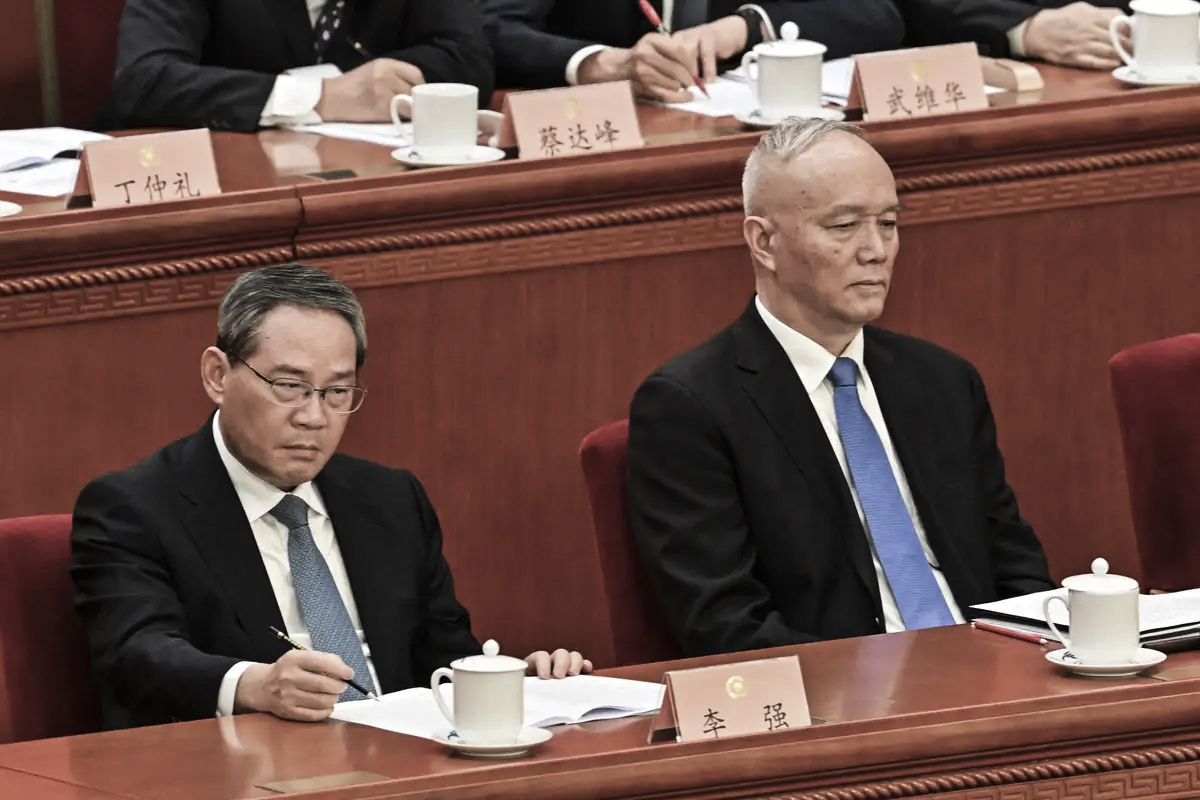 Chinese Premier Li Qiang (L) and Cai Qi, director of the Chinese Communist Party’s General Office, attend the opening session of the CCP’s National Committee of the Chinese People’s Political Consultative Conference at the Great Hall of the People in Beijing on March 4, 2025. (Adek Berry /AFP via Getty Images)
Xi’s Inner Circle
The CCP insider also provided purported recommendation relationships for five of the primary candidates.
According to the insider, Ding Xuexiang was recommended by Cai Qi and Chen Xi, Chen Jining by Qi Qiaoqiao and Chen Xi, Yin Li by Peng Liyuan, Li Shulei by Cai Qi and Shi Taifeng, and Liu Guozhong by Li Zhanshu. No recommender was identified for Zhang Guoqing.
The insider said these relationships concerned personnel arrangements for the previous Party Congress in 2022, including officials’ retention, promotion, and entry into the Politburo Standing Committee. They did not establish that the individuals named had formally nominated candidates for the 2027 Standing Committee.
The distinction is important because the CCP does not publicly disclose the full details of its highest-level personnel recommendations.
However, an official account published by state-run news agency Xinhua on Oct. 24, 2022, described consultations ahead of that year’s leadership reshuffle. According to the report on the formation of the new central leadership, Xi personally held discussions with 30 senior officials, while other Party leaders solicited views from 283 senior cadres. The military also consulted 35 senior officers.
The official account confirms that organized consultations formed part of the 2022 selection process. It does not confirm the specific recommendation relationships revealed by the insider.
Several of the purported recommenders have longstanding ties to Xi or extensive experience in Party personnel work.
Qi Qiaoqiao is Xi’s older sister, while Peng Liyuan is his wife.
Cai Qi, a current Standing Committee member and senior Party administrator, has worked closely with Xi for years.
Shi Taifeng, who became head of the Organization Department in April 2025, oversees a central institution responsible for Party organization and cadre management.
These overlapping professional relationships demonstrate the candidates’ connections to the Party’s senior leadership, but they do not establish that the officials form a coordinated faction controlling the next selection process.
The alleged involvement of Xi’s sister and wife is particularly difficult to assess. If accurate, their inclusion would suggest that personal relationships may have played a role in recommending officials who entered the Politburo in 2022. The available information does not establish the extent of their influence or whether Xi acted on their recommendations.
Former senior official Li Zhanshu, named as Liu Guozhong’s recommender, previously headed the Central Office before becoming a Politburo Standing Committee member and chairman of the National People’s Congress Standing Committee.
An analysis published by the International Institute for Strategic Studies after the 20th Party Congress noted the close working and political relationships between Xi and the new Standing Committee members, reflecting the diminished role of competing power centers in the top leadership.
 Peng Liyuan, wife of Chinese leader Xi Jinping, in Manchester, England, on Oct. 23, 2015, in this file photo. (Phil Noble /WPA Pool/Getty Images)
Succession Question
The leaked list contains no obvious candidate who fits the traditional profile of a designated successor.
By the time of the 22nd Party Congress, expected in about 2032, Chen Jining, Zhang Guoqing, and Li Shulei—the three youngest people named on the list—would all be 68 or older. That would make them relatively old to begin a new five-year term if the customary retirement convention remains in place.
By comparison, former Chinese leader Hu Jintao was 49 when he entered the Standing Committee, and Xi was 54 when he joined it in 2007.
The 2027 congress will provide a clearer indication of whether Xi intends to preserve the existing leadership-selection pattern, make exceptions to the retirement convention, or elevate a younger official who could eventually succeed him.
Leng Feng and Liu Yun contributed to this report.