
The U.S. economy expanded better than expected in the third quarter, with stronger private investment and consumer spending driving the upward adjustment.
The annualized GDP growth rate was 4.3 percent in the July–September period—marking the fastest expansion in three years—according to new Bureau of Economic Analysis data.
This is up sharply from the initial estimate of 3.4 percent released last month.
In an interview with Bloomberg Television, National Economic Council director Kevin Hassett said he expects more 4 percent quarters and more upward revisions moving forward.
“The data today were just astonishing,” Hassett said.
“We’re in a Goldilocks economy where we have high growth, low unemployment, and inflation heading back toward where it ought to be.”
Last quarter’s stronger-than-expected growth reflected upgrades to business investment and consumer spending.
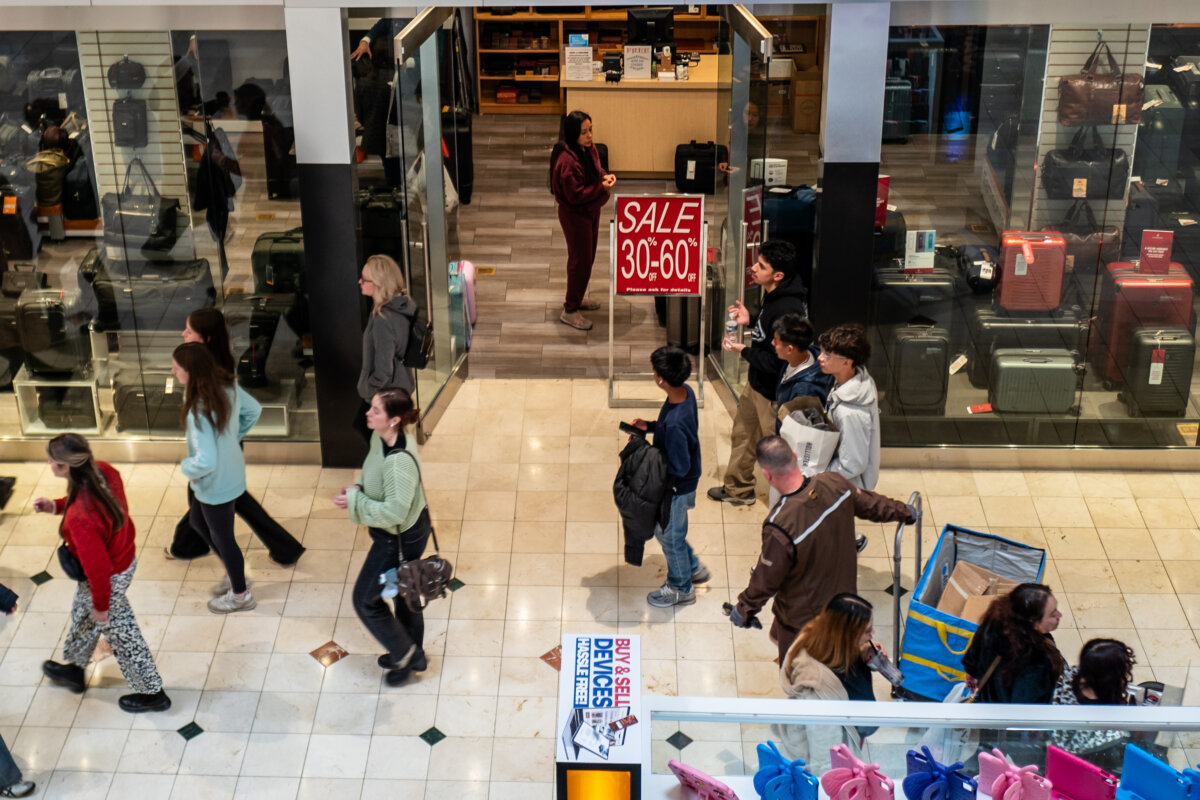
Consumer spending, which accounts for about two-thirds of the economy, surged 4.2 percent, up from the advance estimate of 3.8 percent.
Consumption was broad-based, with spending on goods surging almost 5 percent and services swelling nearly 4 percent.
Despite a weak economic outlook since the start of the war in Iran, consumers have remained resilient amid historically low layoffs and moderate hiring. Sentiment, meanwhile, has improved in recent weeks.
The Conference Board’s November Consumer Confidence Index advanced to its highest level in nearly two years.
This month’s improvement coincides with post-election political certainty and falling gasoline prices, says Jeffrey Roach, chief economist at LPL Financial.
“Although fuel accounts for a relatively small share of household spending, gasoline prices remain an important driver of consumers’ perceptions of the broader economy,” he said in a note emailed to The Epoch Times.
As of Nov. 25, the national average for a gallon of gasoline is $3.59, down about 16 percent from a month ago.
Business investment surged 16.1 percent last quarter, an upgrade from the initial report of almost 13 percent. This marked another quarter of solid growth, driven by the ongoing artificial intelligence (AI) infrastructure buildout—semiconductors, data centers, and compute—that has resulted in billions of dollars in capital expenditures.
Within this category, spending on equipment and intellectual property products climbed by 21.8 percent and 13.6 percent, respectively.
“There’s a ton of focus right now on how long this capex cycle can last and how much runway it has left,” John Belton, portfolio manager at Gabelli Funds, said in an emailed note to The Epoch Times.
Net exports subtracted from growth as shipments fell 5.4 percent and imports surged more than 19 percent. Despite the administration’s tariffs, U.S. firms have been purchasing foreign goods, with the data suggesting a large share ties into the AI boom.
Government outlays ballooned almost 6 percent, led by federal consumption expenditures and gross investment (16 percent).
Looking ahead to the fourth quarter, the U.S. economy is projected to grow 2.9 percent, according to the Atlanta Fed’s GDPNow Model estimate.
Implications for the Fed
Solid economic data could give the Federal Reserve further ammunition to tighten monetary policy.
The Fed’s go-to inflation measure—the Personal Consumption Expenditure (PCE) Price Index—accelerated in October. The 12-month rate rose to 3.8 percent, in line with the consensus estimate. Stripping out food and energy, the annual core PCE inflation rate jumped to 3.3 percent, above economists’ expectations.
Employment conditions also held steady last week, as unemployment claims plunged to 189,000—tying a July number that was the lowest since 1969, according to historical data from the Federal Reserve Bank of St. Louis. Recurring jobless claims—a measure of Americans currently receiving unemployment benefits—fell to below 1.7 million in the prior week.
With the U.S. economy in good shape, the central bank can concentrate on inflation, but some economic observers say the Fed’s rate hikes could backfire.
“This morning’s GDP revision was not a demand scare. It was a supply-side productivity story,” James Thorne, chief market strategist at Wellington Altus, said in a Nov. 25 post on X.
Under Fed Chairman Alan Greenspan in the 1990s, monetary policymakers purported that the figures “were understating gains from information technology,” Thorne said. Rather than raising rates to stop inflation, the Fed held off, and the “expansion ran on.”
“This Federal Reserve is doing the opposite,” he stated. “Potential output is rising, and labour costs per unit are falling. Greenspan trusted that. When will this Fed follow his lead?”
Investors overwhelmingly expect the Fed to raise the benchmark federal funds rate by a quarter point at the December meeting, according to the CME FedWatch Tool. Traders are divided on whether the Fed will pull the trigger on another rate increase in January.
The Fed will convene for its two-day Federal Open Market Committee meeting on Dec. 8.