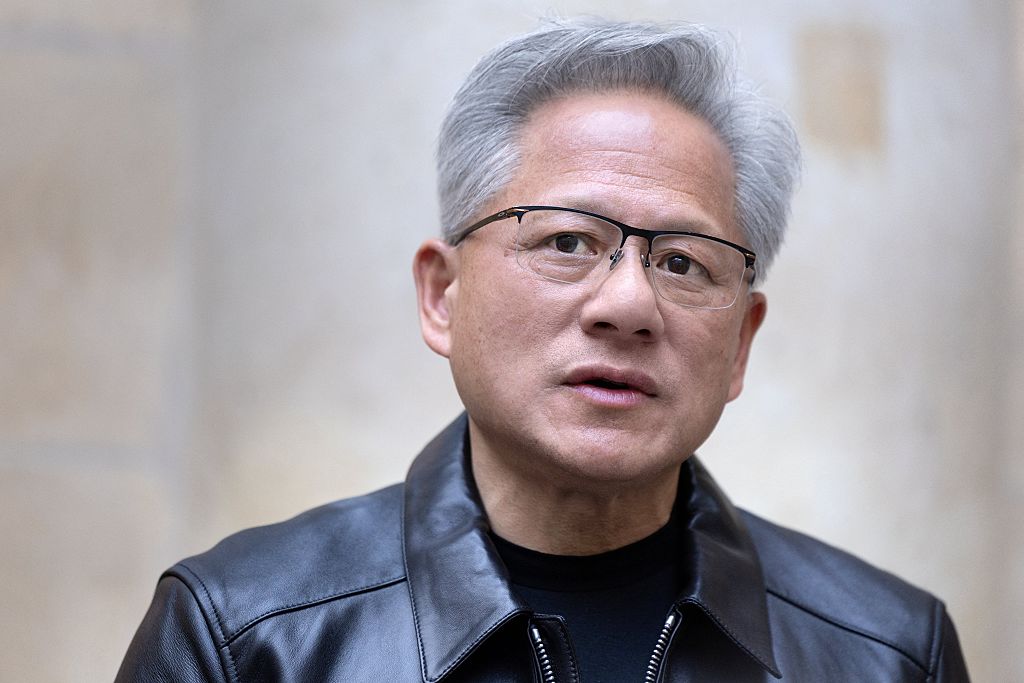

As artificial intelligence rapidly reshapes the global economy, it can be argued that no company has contributed to it more than Nvidia.
CEO Jensen Huang has long been considered one of the world’s leading voices on AI.
But his extramarital affair with a woman suspected of being a Chinese spy has potential implications for the broader economy, financial markets, and possibly national security.
The Backbone of America’s Chip Ecosystem
From a struggling graphics-chip startup founded in a Denny’s booth over three decades ago to a global juggernaut with a roughly $4 trillion market cap, Nvidia has moved to the center of the artificial intelligence (AI) boom.
After years of burning through cash and making bets on graphics hardware, Nvidia reached a pivotal moment in 1999 when it introduced the first Graphics Processing Unit, or GPU.
That same year, Nvidia made its Wall Street debut and garnered access to a new pool of capital.
By the 2000s, Nvidia became integral to PC gaming.
After raising $42 million from its initial public offering, the company used the cash to fund the production of its revolutionary GeForce 256, which provided video game developers and gamers a notable leap in PC 3D gaming performance.
A key moment occurred in 2006 with the launch of Compute Unified Device Architecture, better known as CUDA, a software platform that became crucial for tasks beyond graphics rendering. Rather than merely drawing video game images, Nvidia’s GPUs performed a massive number of calculations simultaneously for artificial intelligence, machine learning, and scientific simulations.
This eventually laid the groundwork for the AI boom.
Six years later, researchers discovered that Nvidia’s chips were suitable for training AI models.
By the time the AI boom took off with the launch of ChatGPT, Nvidia’s chips had become indispensable to the AI ecosystem, powering everything from cloud computing and data centers to autonomous vehicles.
National Security Leads to Export Controls
As Nvidia’s chips became essential to the global AI boom, the company found itself caught between commercial demand and national-security concerns.
Beyond commercial products, its lineup of chips—Blackwell and Hopper, for example—could provide the computing power needed to train and run advanced AI systems. Governments worldwide view AI as not only a technology to grow economies, but also as a cyber, intelligence, and military tool.
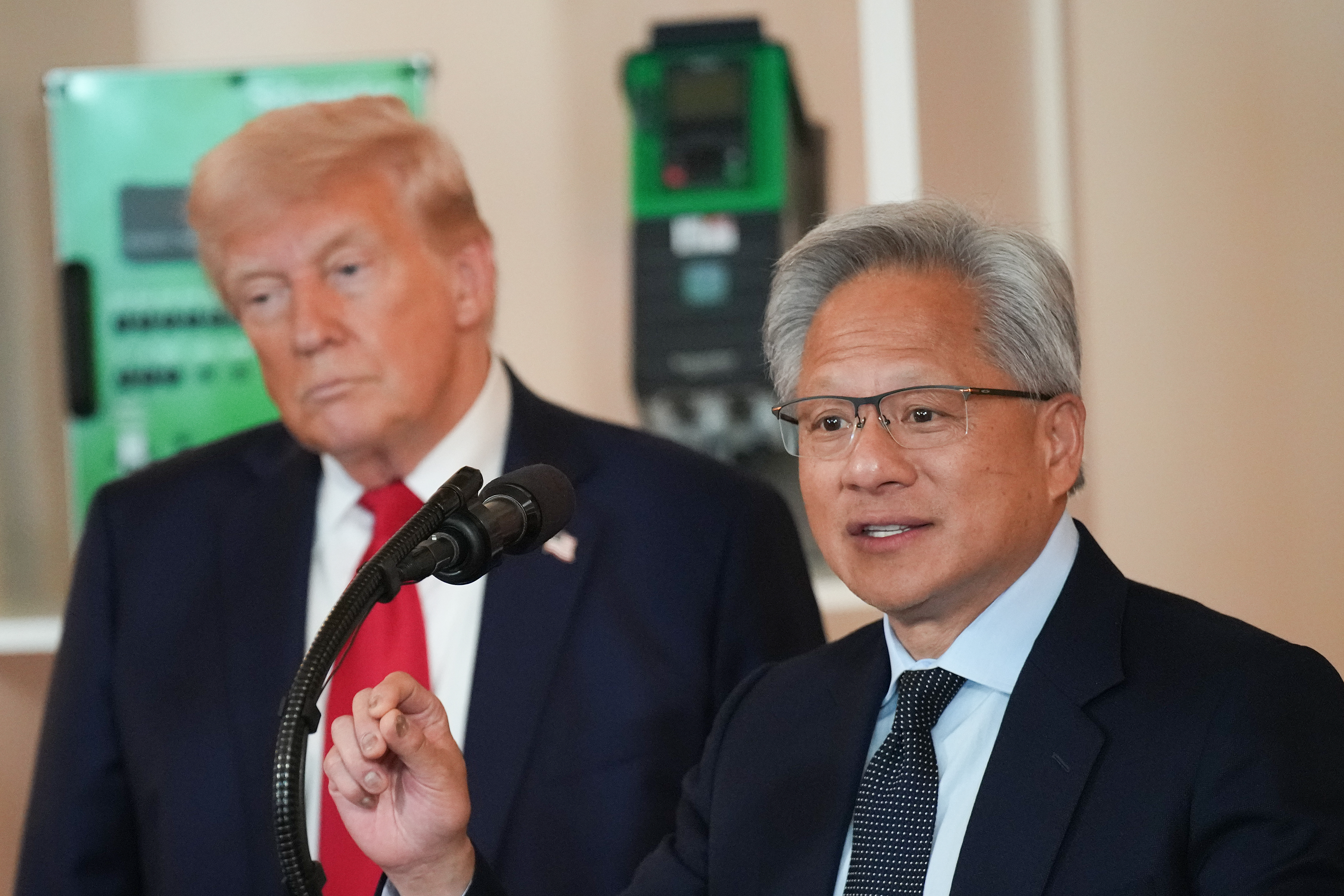 President Donald Trump (L) listens as Nvidia CEO Jensen Huang speaks in the Cross Hall of the White House during an event on “Investing in America” in Washington on April 30, 2025. (Andrew Harnik/Getty Images)
The United States has treated AI as the key to maintaining national security as well as a technological edge over geopolitical rivals like China. As a result, Washington has introduced export controls to achieve its dual objective: restrict China’s access to its powerful computing technology and maintain U.S. dominance in what has fast become an AI arms race.
The Biden administration’s 2022 export controls sought to curb China’s access to advanced AI semiconductors, placing Nvidia’s industry-leading products under heightened scrutiny.
U.S. officials later investigated whether Megaspeed—the Singapore-based firm connected to the affair that led to Jensen Huang’s resignation—helped facilitate the transfer of restricted processors to China. The probe also highlighted the use of Singapore-based entities by Chinese firms seeking continued access to foreign markets and sensitive technologies.
Lawmakers are now pressing ahead with legislation and are expected to include bills in the annual defense authorization act.
Treasury Secretary Scott Bessent has said new measures are unnecessary as he and others favor blacklisting Megaspeed.
“I think we have all the authorities that we need,” Bessent told CNBC’s “Squawk Box” on Nov. 13. “They just need to be implemented.”
Alice Huang and Megaspeed
Alice Huang, also known as Huang Le, built a career that included journalism, finance, and private equity before entering the technology sector.
According to Chinese financial outlet Caixin, she earned a master’s degree in media management from Hong Kong Baptist University and later worked in private banking at HSBC in Hong Kong and in securities finance at CITIC Securities, one of China’s largest brokerages.
She moved into private equity in 2015 and had earlier claimed work experience with Hunan Television, reported the publication.
Her path eventually led to the artificial intelligence industry.
In 2023, Alice Huang became involved with Megaspeed, a Singapore-based cloud-computing and data-center company that built business relationships within Nvidia’s AI ecosystem. Other reports suggest she regularly attended industry events with Nvidia executives and customers.
Through Megaspeed’s role as a Nvidia partner, she became connected to the fast-growing market for AI infrastructure and advanced semiconductor technology.
 A screengrab from CTI video footage obtained Nov. 9, 2026, shows a woman identified by Reuters as Alice Huang attending a dinner with Nvidia CEO Jensen Huang (in black) at a restaurant in Taipei, Taiwan, on May 22, 2025. (CTI via Reuters)
Citing unnamed intelligence officials, various media outlets reported that Alice Huang had ties to China’s Ministry of State Security, allegations that Beijing has denied.
The Future of Nvidia
Jensen Huang resigned as president, CEO, and board member on Nov. 11, with it being announced the following day. Colette Kress, Nvidia’s chief financial officer, was appointed as interim CEO.
What’s next for Nvidia is unclear, but President Donald Trump has floated Tim Cook as the former CEO’s replacement, and prediction markets are betting on Ian Buck.
No matter who is selected, Nvidia’s vision will remain intact, says Nancy Tengler, CEO and CIO at Laffer Tengler Investments.
“It is possible to replace an iconic CEO with a different kind of CEO,” Tengler said in a note emailed to The Epoch Times.
While some worry that Jensen Huang’s ousting could affect the broader AI boom, many market watchers say the fundamentals remain solid.
“As for the broader AI trade, we would view this primarily as a Nvidia-specific leadership issue rather than a fundamental change in the long-term AI investment thesis,” Ken Mahoney, president and CEO at Mahoney Asset Management, told The Epoch Times in an emailed note.
For now, this is a bumpy path for one of the world’s wealthiest companies.
Frank Fang, Troy Myers, and Michael Zhuang contributed to this report.







