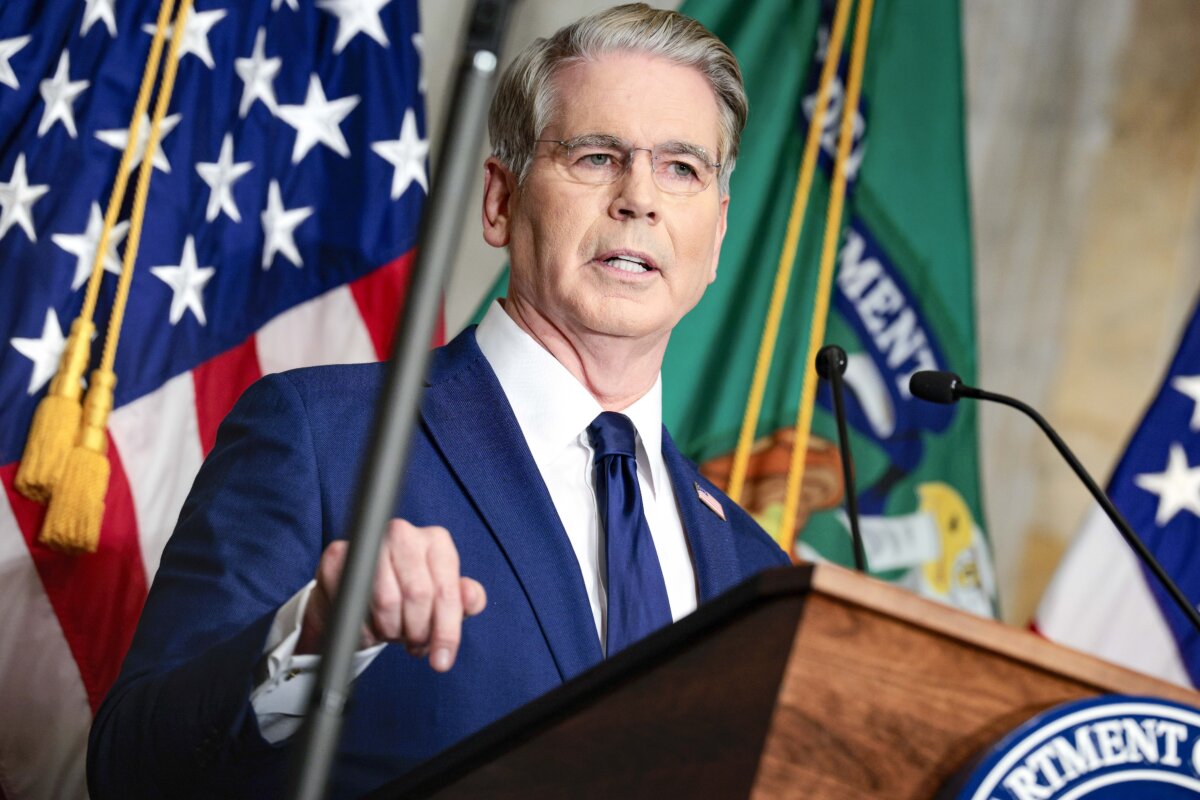

Treasury Secretary Scott Bessent blamed Secretary Howard Lutnick’s Department of Commerce for failing to restrict exports of Nvidia chips to Megaspeed, a Singapore-based company linked to an alleged Chinese spy.
In a Nov. 13 interview with CNBC, Bessent said the Treasury was one of several agencies that supported putting Megaspeed on the U.S. trade blacklist for months.
“But Commerce has the pen, and you will have to ask them about their internal process,” he said.
Asked whether he confronted Lutnick on the subject, Bessent replied, “We don’t repeat conversations in the Situation Room.”
“I am frustrated when President Trump made it very clear that China should not receive any Nvidia chips above H100s, and so any leakage is very frustrating because it hurts our great companies, and the AI race gives the Chinese an advantage,” Bessent said.
Nvidia’s H100s are graphics processing units—or GPUs—designed specifically for advanced artificial intelligence, large-scale data analytics, and high-performance computing.
Nvidia CEO Jensen Huang resigned on Nov. 13 amid mounting scrutiny over extramarital affairs, including a romantic relationship with Alice Huang, a business executive alleged to be a spy for Chinese intelligence operations.
Export Controls Tighten
Since 2022, Nvidia and the U.S. government have been locked in a tug-of-war over AI chip exports.
In October 2022, the Biden administration imposed sweeping export controls on advanced AI chips bound for China.
U.S. authorities also investigated allegations that Megaspeed, an Nvidia customer, helped China obtain advanced AI processors covered by U.S. export restrictions.
The probe comes amid a broader “Singapore washing” trend, in which some Chinese companies establish or domicile businesses in Singapore to reduce exposure to U.S.–China tensions and preserve access to global markets and technology.
Nvidia and Jensen Huang have been vocal in opposing the measures, noting these restrictions would affect its revenue and put the United States at a disadvantage.
In a podcast interview with Dwarkesh Patel this past spring, the Nvidia CEO defended shipping advanced chips to China, arguing that the United States and Nvidia should not be giving up on a major world market.
“We also need to make sure the United States is ahead,” Jensen Huang said in April, adding that half of the world’s AI developers are in China.
“China is the largest contributor to open source software in the world,” he added. He said China was also the largest contributor to open models and that, for now, those models were built on the American tech stack.
This year, the company lobbied on the Chip Security Act and the AI Overwatch Act, according to its federal lobbying disclosures. In July 2023, then-Sen. Marco Rubio (R-Fla.) said the heads of Intel, Nvidia, and Qualcomm were “lobbying against export controls designed to keep the Chinese Communist Party away from AI technology.” Both bills, along with the MATCH Act, were included in the Senate version of the annual defense authorization bill.
Still, Nvidia adapted to the regulatory landscape by producing scaled-down and export-compliant chips tailored for the Chinese market.
President Donald Trump permitted Nvidia to sell its powerful H200 chips—an upgrade to the H100—to approved Chinese customers. In exchange, the United States receives a percentage of the sales.
“It’s not the highest level, but it’s a pretty good level, and China wants them and other people want them and we’re going to be making 25 percent on the sale of those chips, basically,” Trump told reporters in January.
But the fallout from Jensen Huang’s affair with Alice Huang, and her alleged ties to Chinese intelligence, has pushed lawmakers to advance further chip-control measures—the Chip Security Act, the AI Overwatch Act, and the MATCH Act—aimed at limiting the flow of advanced chips to China and other American adversaries.
Prospective congressional action could affect the company and its new leadership, said Hendi Susanto, portfolio manager at Gabelli Funds.
“The next development may depend on what the investigations find, who becomes the permanent CEO, and how much scrutiny comes from Washington, especially on China and export controls,” Susanto told The Epoch Times in an emailed note.
Bessent, meanwhile, said he did not believe new authorities were necessary.
“I think we have all the authorities that we need. They just need to be implemented,” Bessent told CNBC.
So far, the scandal has been centered on Jensen Huang’s “personal foibles,” he said.
The real issue is whether Nvidia knew its end customers’ identities and took sufficient steps to ensure its products weren’t being funneled through apparent pass-through shell companies, Bessent added.
“I think it’s important that anyone at the company there be held accountable for that.”
Reuters contributed to this report.