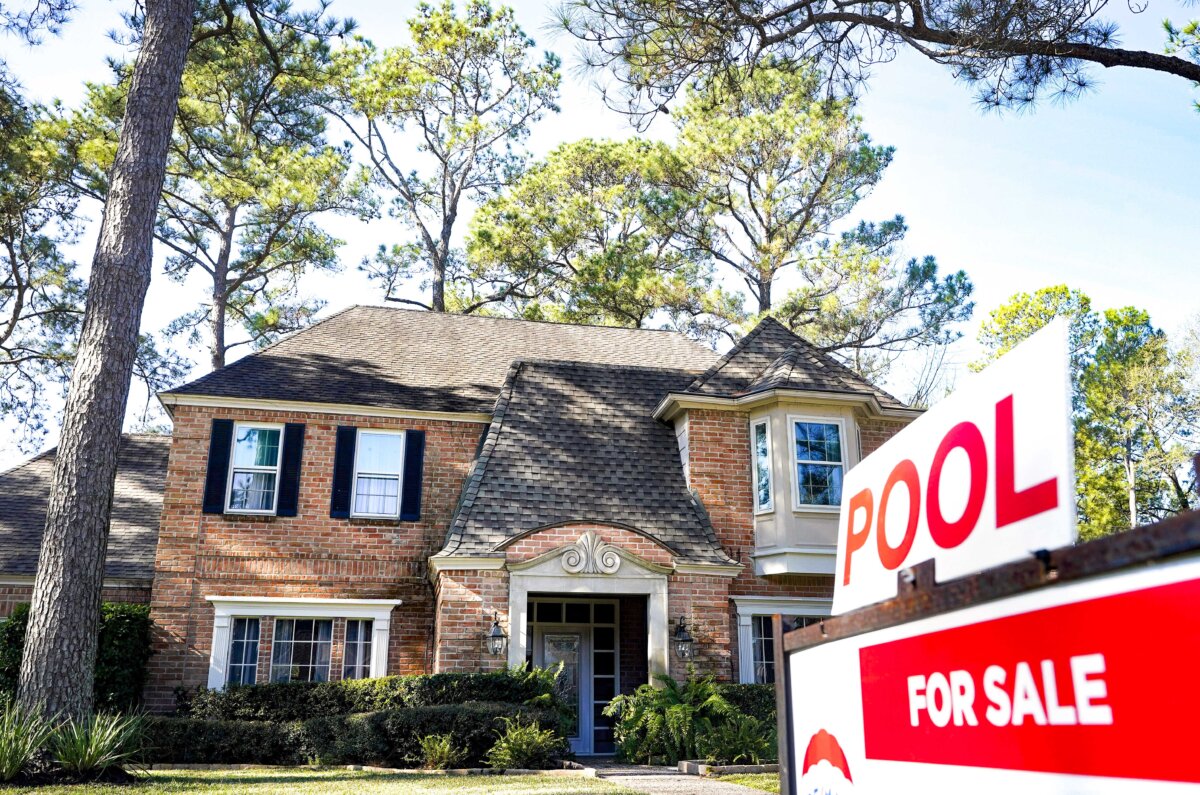

U.S. existing home sales fell in October to their lowest level in more than 16 years, according to new National Association of Realtors (NAR) data.
Home sales declined by 5.5 percent to a seasonally adjusted annual rate of 3.75 million units—the lowest since August 2010. This came in below economists’ expectations of about 3.85 million units.
Despite shrinking housing demand, the median existing-home price rose by 0.4 percent from a year ago to nearly $417,000 in October. This represents the 40th consecutive month of year-over-year price increases.
Across the past seven years, the average home has appreciated by $146,000, according to the NAR.
“Today’s existing home sales numbers are a wake-up call. Americans want to buy homes, but high mortgage rates and affordability challenges are keeping an entire generation of first-time buyers on the sideline,” Frank Cassidy, President Donald Trump’s former FHA Commissioner, told The Epoch Times.
Elevated mortgage rates have been a key factor behind slowing home sales this fall, according to Lawrence Yun, NAR’s chief economist.
“Home buying is difficult when mortgage rates have climbed to their highest levels since 2000, aside from a single month in 2023,” Yun said in a statement.
While borrowing costs have eased in recent weeks, they are still far higher than a year ago.
The Mortgage Bankers Association reported this week that the average rate on a 30-year fixed mortgage was 7.21 percent in the week ending Nov. 6, up about 120 basis points from 5.99 percent at the same time last year.
Rates have ticked up in recent days amid higher U.S. Treasury bond yields. As of Nov. 10, the 30-year fixed rate rose to 7.3 percent, according to Mortgage News Daily’s tracker.
Current conditions could keep prospective homebuyers on the sidelines, Yun said. But a reversal in interest rates could unlock substantial pent-up demand in the coming years.
First-time buyers accounted for 29 percent of transactions, down from 32 percent a year ago. According to NAR, first-time buyers have usually made up 40 percent of sales.
Individual investors or second-home buyers represented 20 percent of transactions, up from 16 percent last year. The share of cash transactions rose to 29 percent from 27 percent in September.
For now, Yun said, many of the nation’s homeowners are “largely in a comfortable financial position due to sizable housing wealth accumulation.”
The existing homes market has been frozen over the past several years.
The annualized rate of existing home sales has steadily fallen since early 2022, when it was above 6 million units.
The golden handcuffs effect stemming from COVID-19-pandemic-era ultra-low interest rates has strained the supply of existing homes as many homeowners decide to stay put.
“Rising interest rates in 2022 significantly increased moving costs for homeowners with low fixed-rate mortgages, leading to a sharp drop in mobility,” Federal Reserve economists wrote in a paper revised in May 2025.
But they also concluded that the price effects were due to pre-existing tight housing market conditions.
“We show that in a more balanced housing market as in 2019, the same lock-in shock would have had little to no impact on prices or tightness,” they wrote.
With affordability a top issue for U.S. voters, the current administration has the power to implement meaningful housing solutions, Cassidy said.
“We don’t need another study or another promise. We need action that puts the American Dream of homeownership back within reach,” he said.
The Mortgage Rate Path
In the near term, mortgage rates could continue edging higher as Treasury bond yields pick up steam.
The benchmark 10-year yield accelerated this week, returning above 5 percent from a recent low of below 4.9 percent.
Mortgage rates could improve heading into 2027, according to Jeff DerGurahian, head economist at loanDepot.
“The door is open for rates on a 30-year fixed mortgage to move into the high 6 percent range, but it will take several factors working together to push them through,” DerGurahian said in an emailed note to The Epoch Times.
Meanwhile, new data from real estate brokerage firm Redfin found that monthly housing payments declined to a six-week low.
The median monthly mortgage payment was $2,755 at a 7.18 percent rate—based on Freddie Mac’s number last week—down from $2,820 a month earlier.
The near-term catalyst for mortgage rates could be the Federal Reserve.
Investors are widely penciling in a quarter-point interest rate hike at next month’s policy meeting.
But a 50-basis-point increase could be in play after Fed board member Christopher Waller suggested that hot inflation could support a case for a jumbo-sized hike.
“The question now is whether they also support a 50 [basis-point] hike or if they would prefer to put a previously unanticipated January hike on the table instead,” Chen Zhao, head of economics research at Redfin, said in a Nov. 10 note.
“The latter may be preferable because going 50 [basis points] after skipping a hike at the October meeting may look unusual.”