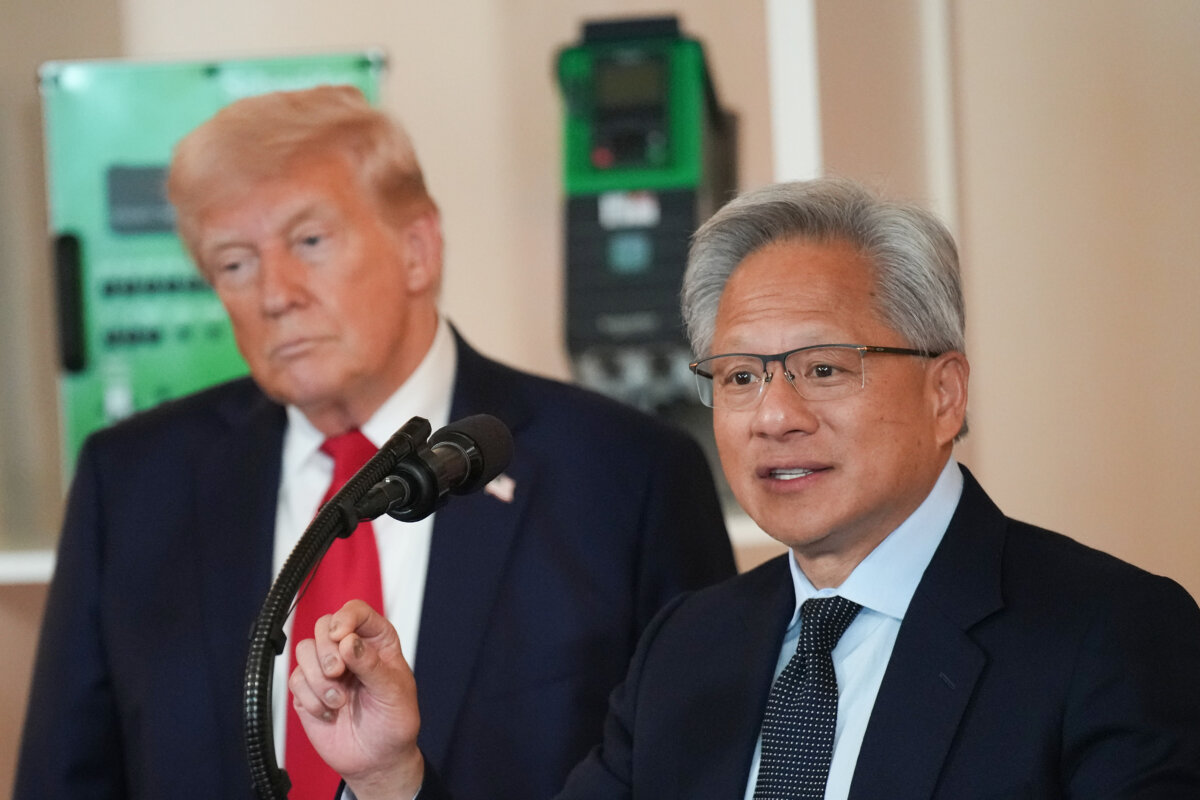

President Donald Trump said he persuaded Nvidia’s board to reinstate Jensen Huang, calling him a “genius” the United States “can’t lose” to China.
Huang resigned earlier this month after admitting to an extramarital affair, with reports alleging a relationship with a woman suspected of having ties to Chinese intelligence and who was a former executive at Singapore-based data-center company Megaspeed, a firm under investigation over allegations that it circumvented U.S. export controls to ship large quantities of advanced Nvidia chips to China.
In an interview with CNBC on Nov. 23, the president said he spoke to the company’s board and “convinced them” to bring back the co-founder.
“I think the board acted really responsibly,” he told the network.
“I’m very, very happy that the company had the courage and the board had the courage to do the right thing, and they suffered for two weeks, and the company suffered greatly.”
Trump also confirmed that he spoke with Huang on Nov. 22 and had been represented at the board meeting.
Before the announcement, Nvidia requested assurance on the national security threat, and his administration gave it to the board “with everything we know.”
“People say, ‘Is it a threat to have him?’ No, it’s a threat to lose him,” the president said.
‘We Can’t Lose This Guy’
A motivating factor for the president to urge Nvidia to reinstate Huang was China.
According to the president, Chinese leader Xi Jinping could one day offer Huang an opportunity to lead a company like Huawei.
“I would be thinking like, ‘Why don’t we make a deal with Jensen? We don’t have to bother with all the stuff. We don’t need spies. Let’s hire Jensen,'” Trump said.
“It’s a threat to lose him. Jensen could take the next plane to China, and I guarantee you they would give him whatever he wanted.
“We can’t lose this guy.”
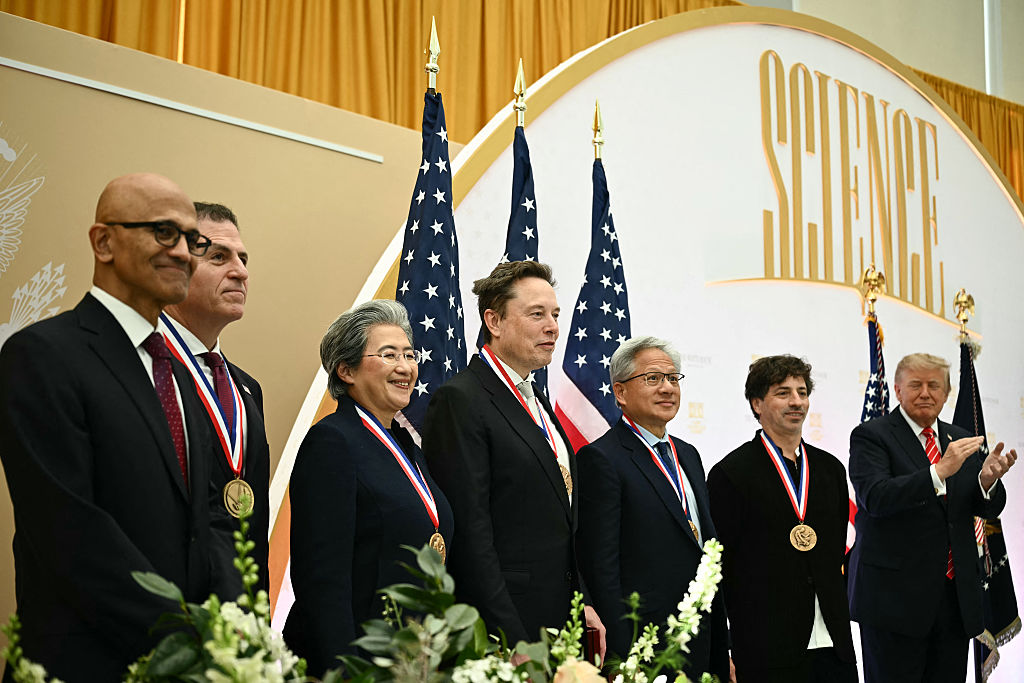 Microsoft CEO Satya Nadella (L), Dell Technologies CEO Michael Dell (2nd L), AMD CEO Lisa Su (3rd L), SpaceX CEO Elon Musk (C), Nvidia CEO Jensen Huang (3rd R), and entrepreneur Sergey Brin are applauded by President Donald Trump in Washington, on Oct. 8, 2026. (Kent Nishimura/AFP via Getty Images)
Commerce Secretary Howard Lutnick has faced criticism—including from Treasury Secretary Scott Bessent—for not adding Megaspeed to the U.S. blacklist.
But Trump has defended Lutnick and has not considered replacing him.
“I have not lost confidence,” Trump told reporters at a lengthy Nov. 20 news conference. “He’s a different kind of a guy—very good businessman. He’s not traditional.”
A chorus of Senate Republicans, including Sen. John Kennedy (R-La.), has urged Lutnick to appear on Capitol Hill to answer questions relating to how Chinese firms have been able to circumvent U.S. export controls.
Treasury Secretary Scott Bessent, in an interview with CBS’s “Face the Nation,” said he is also seeking answers from Nvidia over its sales of advanced chips to China.
“We’ve been in touch with the temporary management, with the lead directors, with their lawyers, and we do need answers. … It behooves Nvidia to move quickly on this because we want to know what the culture was,” Bessent said on Nov. 22.
Market Response
Last week’s tech-led market rout was one contributing factor to the president pushing for the CEO’s reinstatement.
Before the stock’s spike to kick off the trading week, Nvidia shares fell 40 percent over the past month. Various factors fueled the company’s worst trading week since 2008, including the board reaffirming its stance against bringing back Huang.
But Trump noted that he has seen many great companies struggle after losing a top executive.
“The bigger impact was the long term,” he said. “The bigger impact was, you know, he’s got other chips in his brain that nobody else knows about.”
Despite a record third-quarter earnings report and stronger guidance, sentiment surrounding Nvidia had weakened, with the stock falling about 40 percent in a month.
After Huang’s reinstatement, shares of Nvidia jumped 33 percent, as of 12:15 p.m. EST on Nov. 23, adding about $1 trillion in market value.
The stock’s rally also supported the broader financial markets. The tech-heavy Nasdaq Composite Index surged about 7 percent, while the broad-market S&P 500 climbed around 5 percent. The blue-chip Dow Jones Industrial Average rebounded 2 percent.
“Jensen Huang’s return is an enormous positive for Nvidia and the broader AI trade, removing a major source of uncertainty and restoring the visionary leadership that helped build the entire AI infrastructure ecosystem,” David Miller, senior portfolio manager at Catalyst Funds, told The Epoch Times in an emailed note.
Emel Akan and Owen Evans contributed to this report.