
Meta Platforms has unveiled plans to raise $95 billion through stock offerings to fund its artificial intelligence investments.
Leading AI hyperscalers—Alphabet, Amazon, Microsoft, and Oracle, for example—have been finding ways to raise capital to cover the costs of their expansive AI buildouts.
The social media giant said it will raise $35 billion through public offerings and $60 billion through ongoing share sales.
Proceeds will support “emerging AI opportunities,” including applications, data centers, and its AI agent Muse, the company said in an Oct. 26 statement. Like other tech giants, Meta plans to fund these investments through a mix of cash reserves, debt, equity, and partnerships.
Shares of Meta were little changed following the announcement.
Meta is among the many hyperscalers pouring massive sums of cash into AI infrastructure.
In last week’s third-quarter earnings results, Meta projected that its full-year capital expenditures (capex) will range from $135 billion to $145 billion.
Goldman Sachs estimates that global companies will collectively spend $7.6 trillion on computers, data centers, and power between 2026 and 2031.
The company also reported better-than-expected revenue and earnings per share, but they were not enough to offset weaker investor sentiment.
“After a tremendous run-up into results and on the heels of its Muse release, shares faltered despite strong numbers. Fears of a continued capex spend and free cash flow going negative outweighed any positive feelings,” Jay Woods, chief market strategist at Freedom Capital Markets, told The Epoch Times in an emailed note.
Watching the Capex Boom
Wall Street has become increasingly hesitant about the running tab of these investments.
The latest hiccup is in neoclouds—cloud computing services for AI firms—which are struggling to attract capital. Nvidia CEO Jensen Huang and SpaceX CEO Elon Musk have highlighted the industry’s challenges.
While demand for neoclouds is “off the charts,” the difficulty has been the “scarcity of capital,” Huang told CNBC this past week.
“What is missing in the middle is the working capital to fuel that growth … because there’s just so much demand across so many sectors of AI, there’s a scarcity of capital,” Huang said.
“The demand of the capital is much greater than the availability of the capital. That’s going to get solved.”
Musk, in an Oct. 25 post on X, noted that debt markets have closed their doors to companies that do not have “substantial revenue independent of AI data centers.”
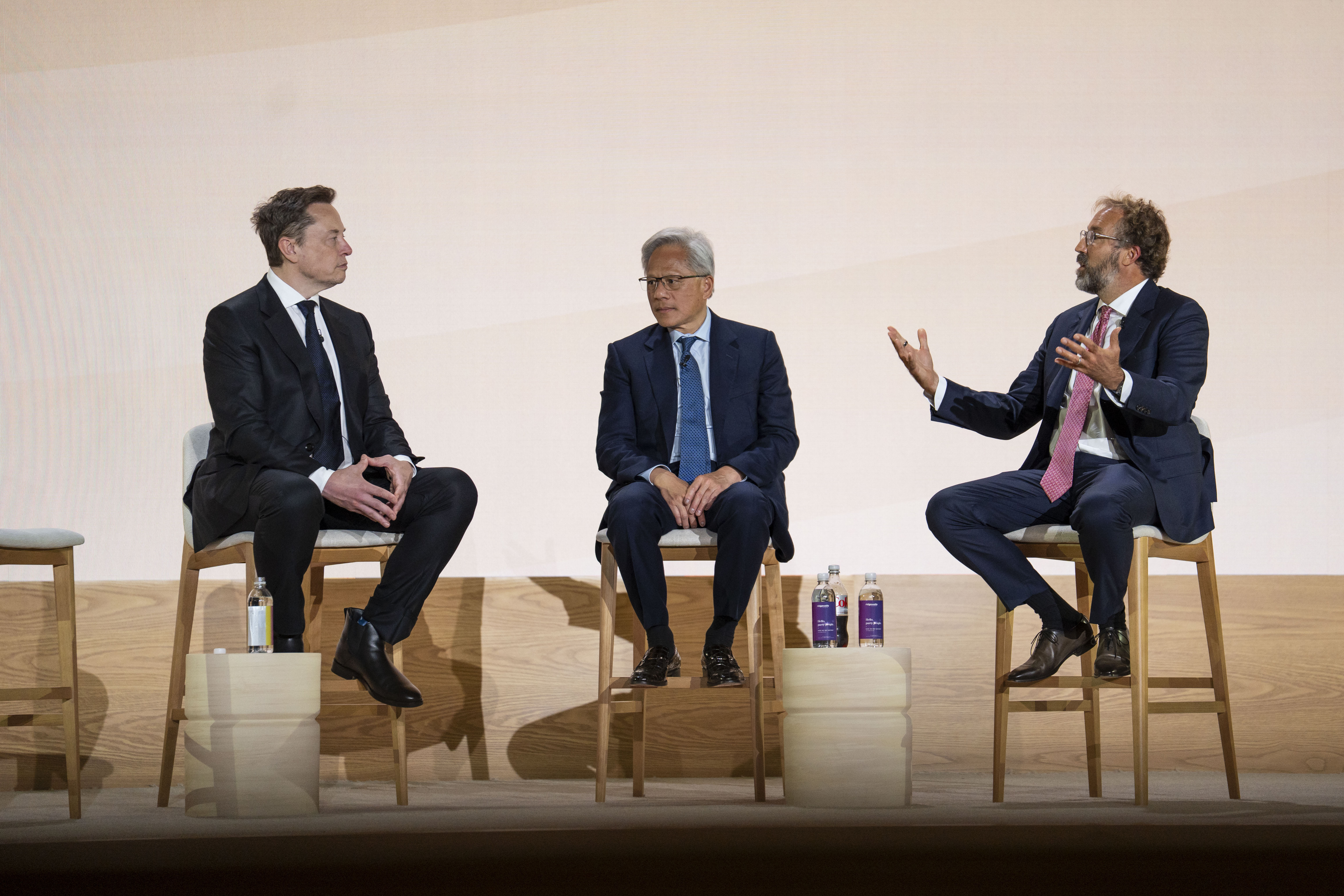 (L–R) SpaceX CEO Elon Musk, Nvidia President and CEO Jensen Huang, and Gavin Baker, managing partner and chief investment officer of Atreides Management LP, speak during the America.gov launch event in Washington on Sept. 29, 2026. (Madalina Kilroy/The Epoch Times)
A growing concern among investors is the lack of AI-driven returns outside the technology sector.
Profit margins and revenue per worker for companies outside the Magnificent Seven—Apple, Alphabet, Amazon, Meta, Microsoft, Nvidia, and Tesla—are flat, according to data gathered by Torsten Slok, chief economist at Apollo.
“The bottom line is that the AI story will be decided in the S&P 493, not the [Magnificent Seven], and so far, there is no evidence that revenue growth or margins are improving outside the tech sector,” Slok said in a note emailed to The Epoch Times.
Meanwhile, Big Tech is still pursuing various avenues to raise money.
Anthropic filed its initial public offering on Oct. 26 and could debut on Wall Street as early as next month.
SpaceX recently secured a $40 billion debt financing arrangement with Apollo Global Management to buy graphics processing units. Google’s parent company, Alphabet, said in June that it wants to raise $85 billion. Nvidia raised $25 billion from bond sales in June.
Despite the latest market volatility and headlines, the long-term case for AI “is still intact,” said Baadal Chaudhary, equity research analyst at Thornburg Investment Management.
“Hyperscaler and neocloud cash flows have also been improving,” Chaudhary said in a note emailed to The Epoch Times.
“Next year should bring a more visible flush of cash flow as revenue keeps compounding against a cost base that’s no longer playing catch-up.”