SEARCH


With the emergence of the modern guitar in the 18th century, concertos—solo works with orchestral accompaniment—began to be written for it.
Antonio Vivaldi had composed many concertos for the guitar’s most illustrious predecessor, the lute, and these were adapted for the new instrument. The first concertos written expressly for the guitar came from the pens of now-forgotten composers of the late 18th century, Charles Doisy and B. Vidal.
However, there was a challenge writing a concerto for the guitar. The volume of the “acoustic” guitar was relatively soft compared to an orchestra of strings, woodwinds, and brass. Improvement in the instrument made it possible to increase the guitar’s dynamic potential until, finally, in the 20th century, there could be a real repertoire of guitar concertos.
Two composers wrote guitar concertos in the same year—1939—that were destined to be the two most popular in the repertoire: Italian Mario Castelnuovo-Tedesco ‘s Guitar Concerto No. 1 in D major, and the “Concierto de Aranjuez” by Spaniard Joaquin Rodrigo (1901–1999).
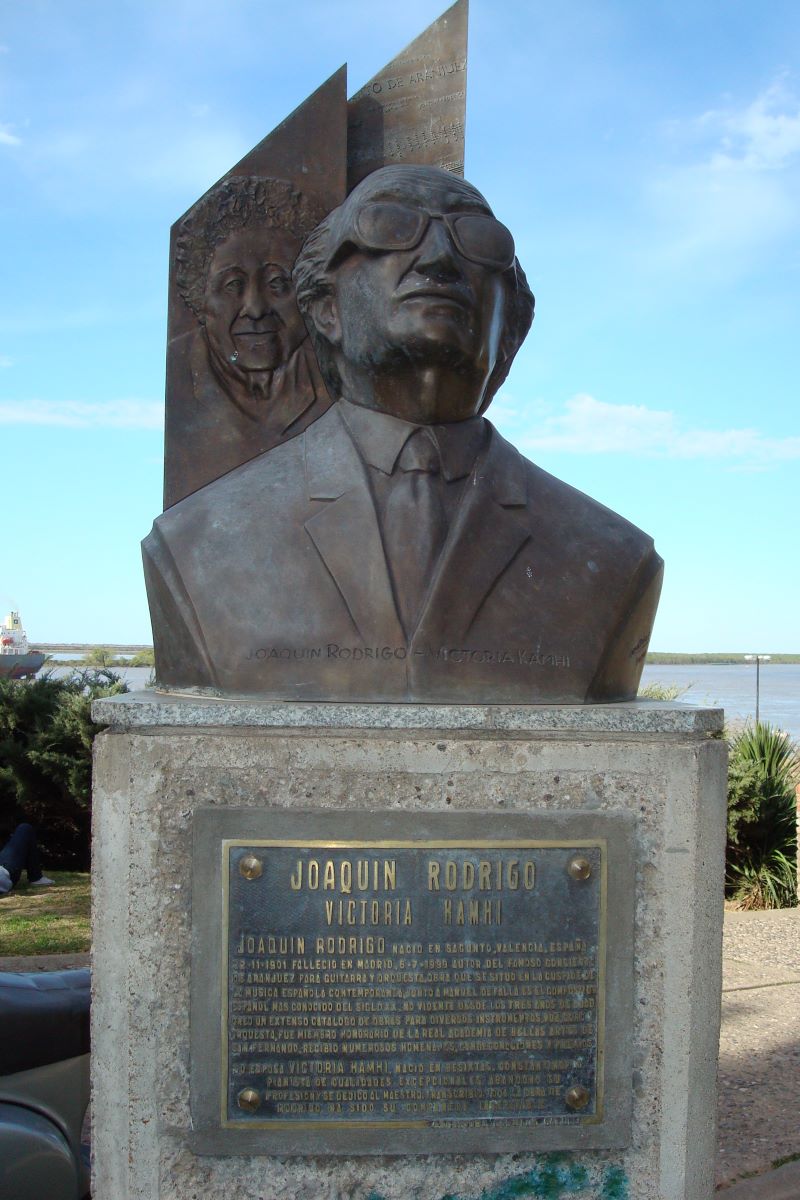
Rodrigo received musical training in his native Valencia and later studied composition with Paul Dukas (“The Sorcerer’s Apprentice”) in Paris. Blind from the age of 3 after a bout of diphtheria, Rodrigo wrote and read music using Braille throughout his life. He achieved the status of a virtuoso pianist, something of an irony for a composer whose claim to fame was tied to the guitar, an instrument he did not master.
Rodrigo composed the “Concierto de Aranjuez” in 1939 for the guitarist Regino Sainz de la Maza. The title refers to a district within Madrid. It immediately became an audiences favorite worldwide and is today considered to be by far the most popular guitar concerto ever written.
Rodrigo went on to compose many works for solo and multiple guitars with orchestra, but none achieved the status of “Concierto de Aranjuez.”
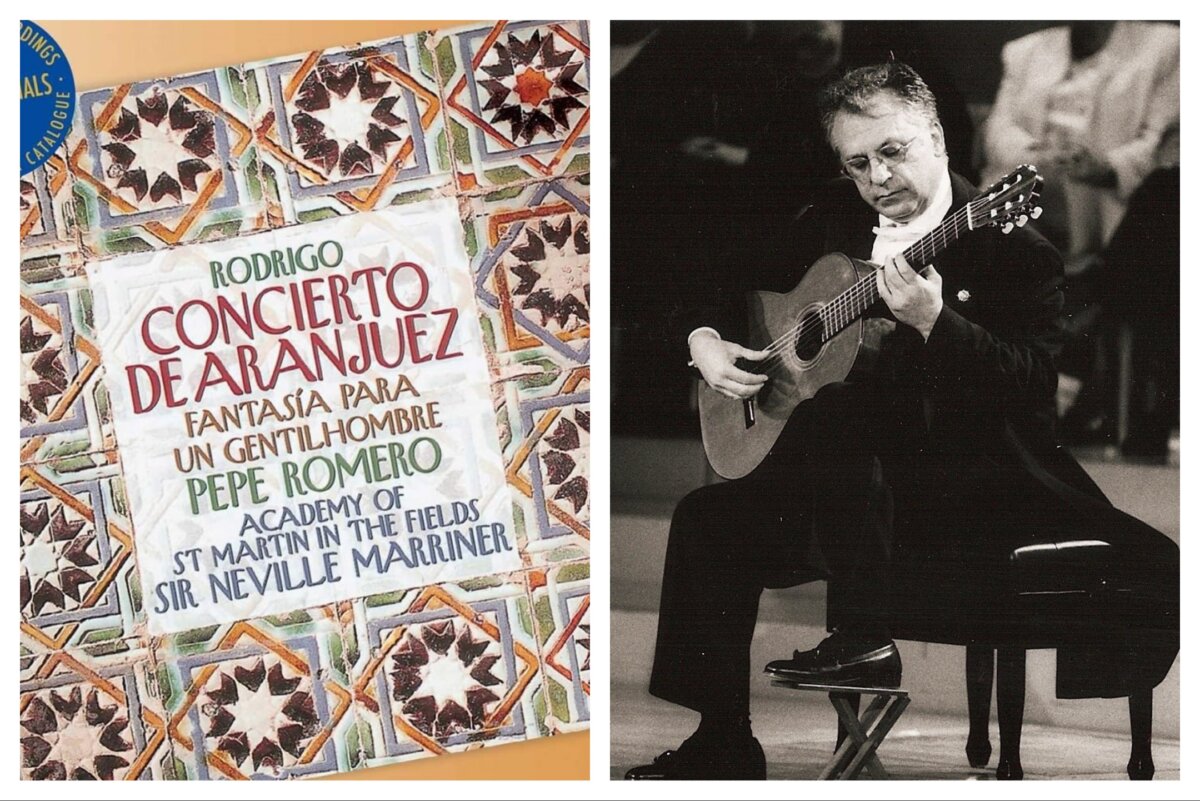
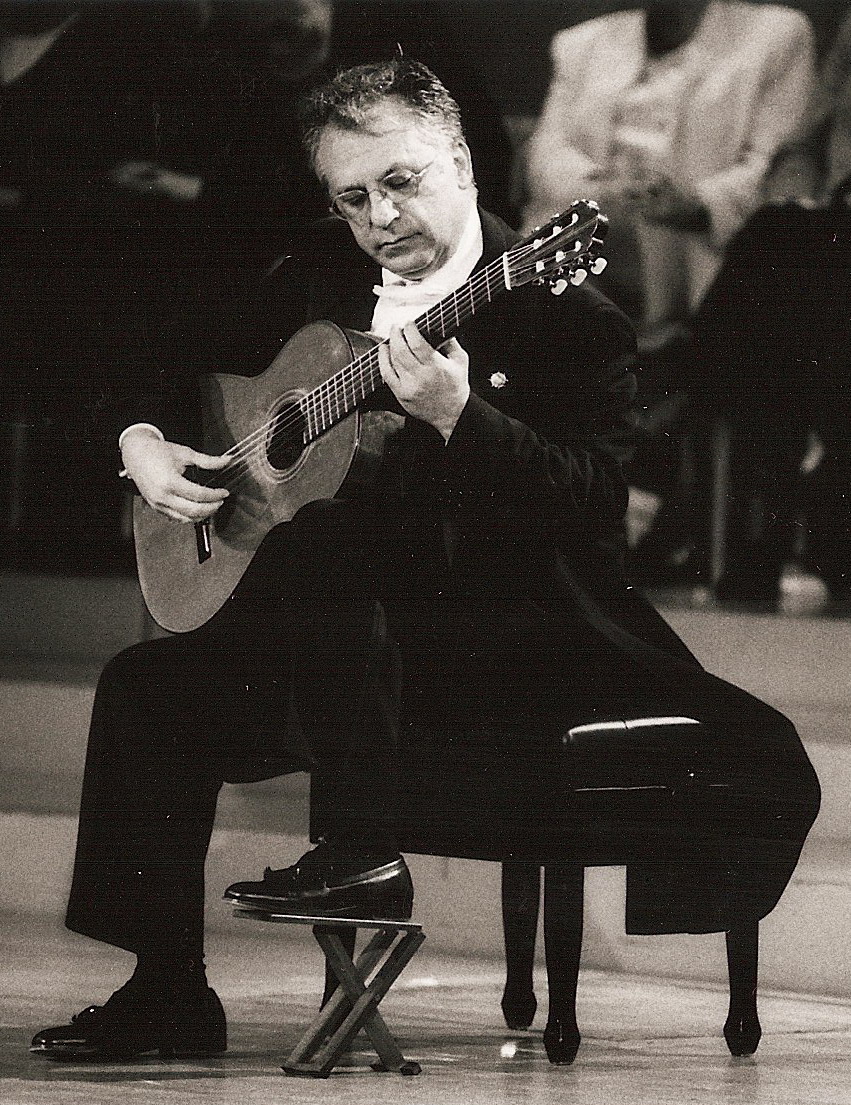
Our video is of the guitar virtuoso Pepe Romero with the Danish National Symphony Orchestra, conducted by Rafael de Burgos. (Listen)
The concerto begins, tempo Allegro con spirito, by establishing a rhythmic pattern known as hemiola. In hemiola, a bar of six beats (usually 6/8 meter, and generally at fast tempo) is heard with the first and fourth beats accented, creating the feeling of two counts: ONE-two-three-FOUR-five -six.
This is followed immediately by a second bar of six beats, this time with the accents on one, three, and five, creating a sense of three counts: ONE-two-THREE-four-FIVE-six. The overall effect is of acceleration.
The guitar intones aggressive hemiola chords in a three-measure pattern with increasing volume and intensity, and at 0:36 flutes and oboes enter with a simple commentary, followed at 0:47 with the lower strings picking up the theme.
Then, suddenly, at 1:14, the violins burst out with a soaring melody above the rhythmic theme, which is now revealed to have been a rhythmic bed patiently waiting for the lyric theme.
At 1:39, the focus returns to the solo guitar who embellishes the theme and at 2:13 offers a beautifully piquant passage that offsets the otherwise assertive music of the rhythmic bed and its tune.
Virtuoso fingerwork by the guitarist follows and the lyric theme is, at one point, intoned by the principal cello. The interplay of the rhythmic bed, the lyric theme, and the piquant theme opens into a celebratory movement of unabashed vigor and color.
The second movement, Adagio, starts at 6:59 with softly strummed chords from the soloist, followed by the English horn’s announcement of a theme so noble in its shape, yet so vulnerable in its sense of loss and longing that it has become one of those melodies everyone knows without knowing whence it came. It is this theme that speaks of a personal event from this time in the composer’s life: the miscarriage of his and his wife’s first child.
The guitar picks up the melody heavily embroidered with additional notes for the very good reason that unamplified guitar cannot sustain effectively the long-held notes that the tune demands. Just before 10:00, the guitar inserts a new idea, but the grave beauty of the main theme is such that it comes rushing back in the orchestra.
At 11:21, the soloists repeats the main theme on its lowest, most resonant strings, with minimal-to-no accompaniment. At 13:39, the soloist begins a bravura cadenza that includes ideas from both movements, until, at 15:59, the orchestra floods the space with a bold reprise of the Adagio main theme.
The Adagio theme has become a favorite not only of guitarists but of other instrumental musicians. In particular, trumpet soloists championed it after jazz artist Miles Davis featured the theme on his studio album, “Sketches of Spain.”
At 18:32, the final movement, Allegro gentile, arrives with a breezy little melody in a three-beat meter. From there on, we are led through playful dance-like measures that do everything they can to dispel the plangency of what has gone before. The concerto concludes quietly, and indeed, gently.
What arts and culture topics would you like us to cover? Please email ideas or feedback to features@epochtimes.nyc.