SEARCH


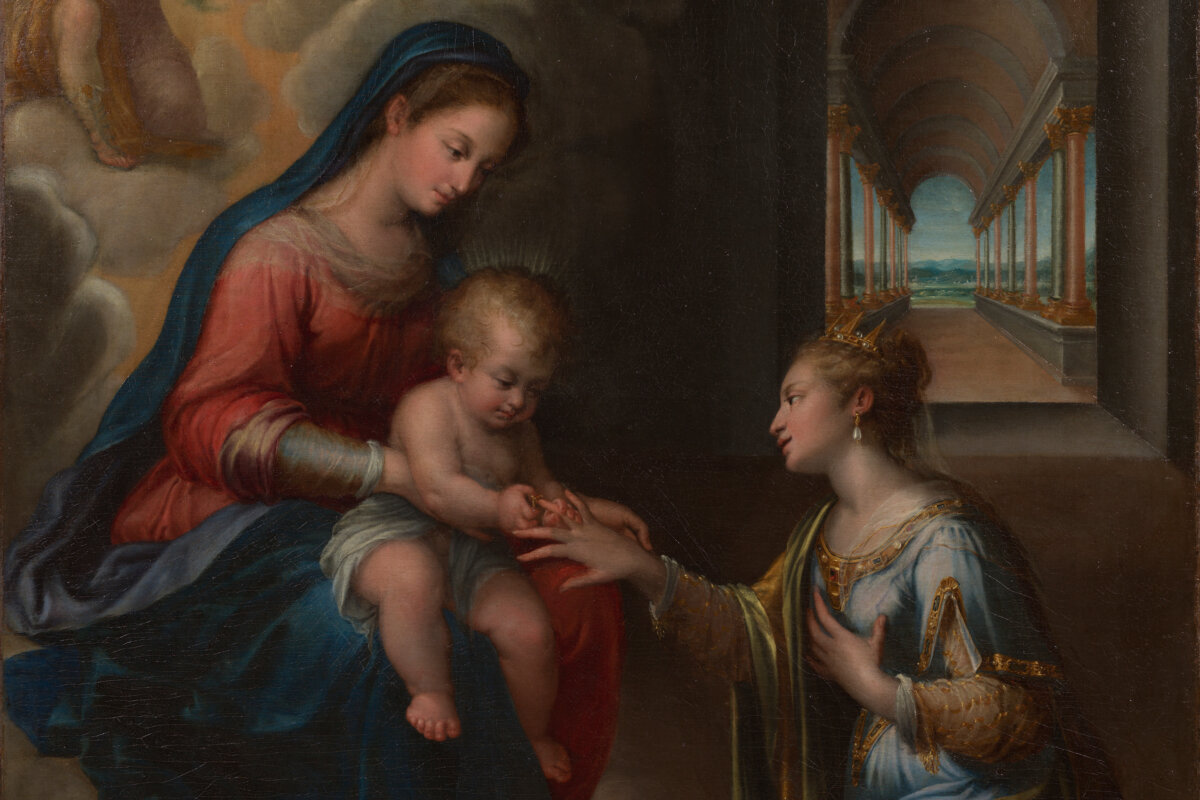
Lavinia Fontana (1552–1614) was a pioneering painter of the late 16th and early 17th centuries. She was among the most in-demand Italian artists of her day. Fontana’s surviving oeuvre is the largest of any woman artist working before 1700.
In August 2026, the Nationalmuseum in Stockholm announced that it had purchased a previously unknown Fontana work, the 1607 oil on canvas altarpiece “The Mystic Marriage of Saint Catherine of Alexandria.”
St. Catherine (circa 287–circa 305) was the subject of multiple Fontana paintings. Two examples, “Mystic Marriage of Saint Catherine” and “The Holy Family With Saint Catherine of Alexandria,” are also 21st-century museum acquisitions, residing in the National Gallery of Victoria (NGV), Melbourne, and the Los Angeles County Museum (LACMA) respectively.
Born in Bologna to a prominent painter, Fontana received artistic instruction from her father. Her independent professional career did not end upon her 1577 marriage to the minor nobleman and painter Gian Paolo Zappi. Instead, he became her manager, as married women were not allowed to sign financial contracts, and Fontana continued to paint to support her husband, their eventual 11 children, and her elderly father. In total, her career lasted almost 40 years.
Portraiture was considered an appropriate genre for women artists. Fontana’s exquisitely observed portraits were in high demand by scholars and nobility. In addition to portraits and small-scale devotional works, her practice included large-scale biblical, mythological, and historical paintings. This was unprecedented, since these genres, which were considered more prestigious and masculine.
Around 1590, Fontana received her first commission from the pope, and in 1603 she moved with her family to Rome for more work opportunities. Her success continued, and she was accepted to the city’s Accademia di San Luca.
St. Catherine in Focus
Laurie Benson, curator at the NVG, writes:
“Fontana painted at least three versions of the Mystic marriage of St Catherine before she married. As an unmarried pioneering woman artist … Fontana expressed her virtue through her art by often painting Saint Catherine who was primarily recognised for her purity and devotion as a Bride of Christ.”
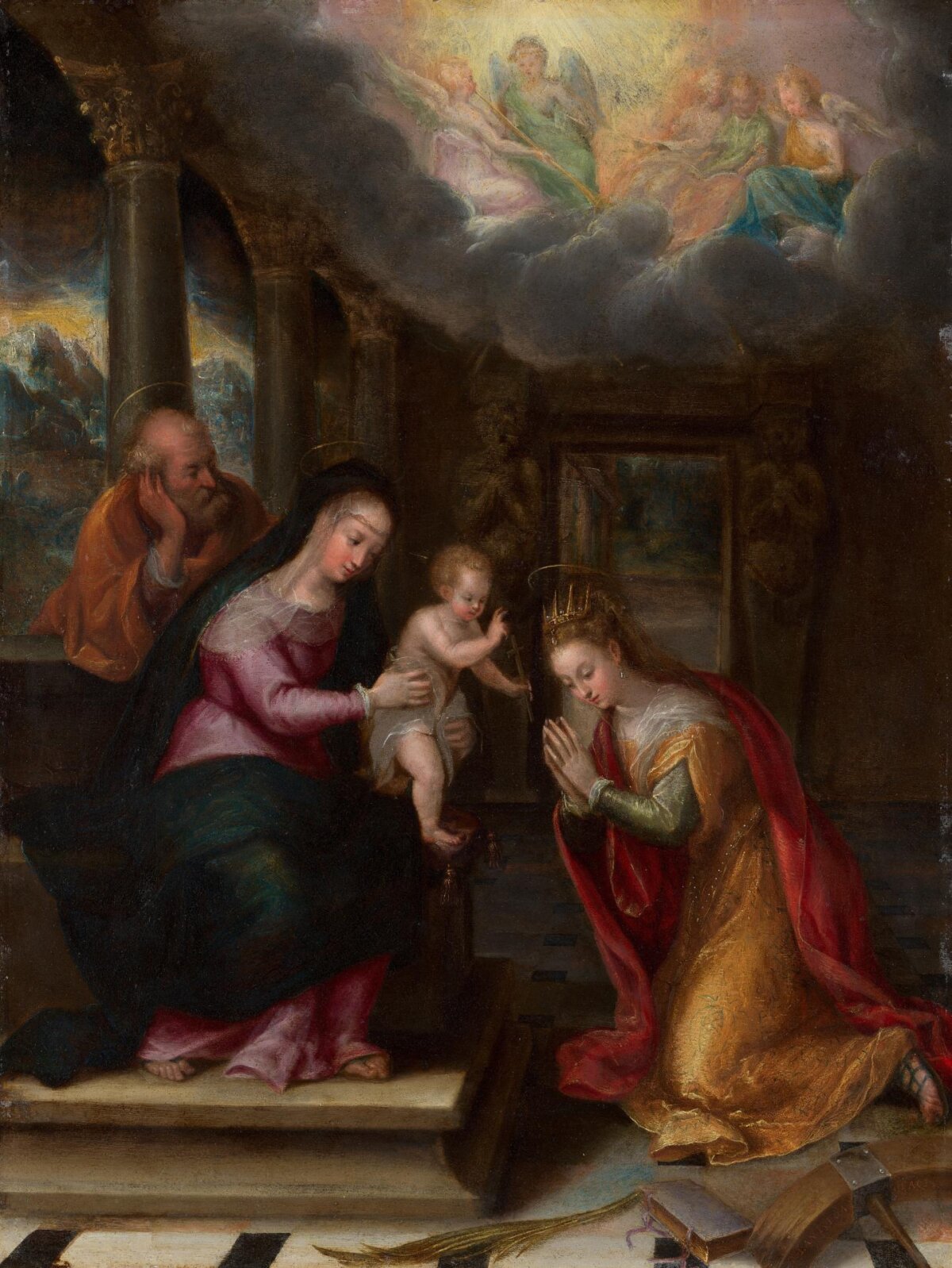
The NVG’s Fontana painting of St. Catherine, received as a bequest in 2021, is an oil on copper from 1574 to 1577. For her private devotional works, Fontana used frequently a copper support. This unusual choice may have been influenced by the work of Flemish painter Denys Calvaert, who studied with her father. He was the first artist in Bologna to paint on copper.
This picture is perhaps the second earliest surviving Fontana painting. It depicts the saint’s vision of a mystical marriage with Christ. Here, this event is witnessed by the Madonna, St. Joseph, and music-playing angels. Emblems of Catherine’s martyrdom (she was executed by the Romans for refusing to deny her Catholic faith) are included in the scene: a martyr’s palm, a book that is probably the Bible, and a broken wheel. Fontana’s command of conveying details, especially textiles and jewelry, are already visible at this early stage.

Meticulous renderings of adornments are also a highlight of LACMA’s oil on canvas “The Holy Family With Saint Catherine of Alexandria” from 1581. It was gifted to the museum in 2011. This work was likely made for a private chapel. An impressively painted translucent veil is draped around the Virgin Mary and over the Christ Child’s thigh. The kneeling St. Catherine wears a bejeweled gold crown that is attached to a similar fabric. It is pinned to her shoulder by a floral brooch. Her third jewel is a ring on her right hand, symbolizing her mystical marriage to Christ. This hand clasps the spiked wheel of her martyrdom.
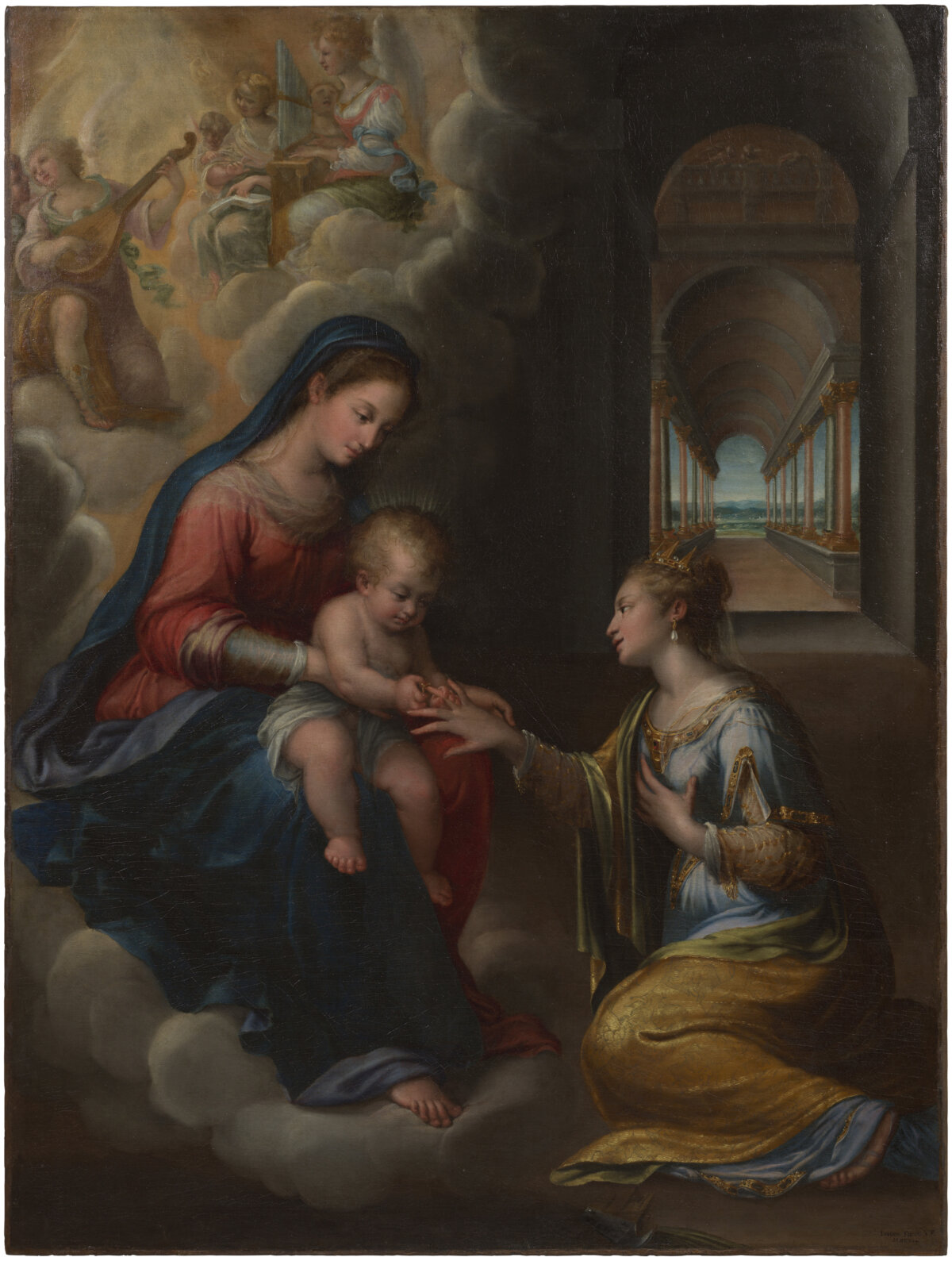
The Nationalmuseum’s new acquisition was painted in 1607, at the height of Fontana’s career. It was one of her most ambitious religious artworks, reflecting mastery of form and color. The museum’s press release heralds that this rare artwork “exemplifies Fontana’s late style with its harmonious colour relationships and soft transitions between light and shadow.” This composition balances beauty and naturalism. Catherine is stylishly dressed and elegantly posed as the Christ Child, featuring a naturalistic expression, places a ring on her finger. They, along with the Virgin, are set in a palatial interior.
In recent years, Fontana art works are among the most sought-after by museums. In addition to these St. Catherine paintings, acquisitions have been made by the likes of the Getty Museum, Virginia Museum of Fine Arts, Fine Arts Museums of San Francisco, National Gallery of Art, and Montreal Museum of Fine Arts.
What arts and culture topics would you like us to cover? Please email ideas or feedback to features@epochtimes.nyc