SEARCH


American painter Thomas Moran (1837–1926) saw the importance of painting the country’s landscape:
“Before America can pretend to a position in the world of art it will have to prove it through a characteristic nationality in its art, and our artists can only do this by painting their own country, making use of all the technical skill and knowledge they may have acquired in the schools of Europe and the study of the past.”
Autumn in Pennsylvania
Moran’s painting style first reflected Thomas Cole’s Hudson River School, especially in his earlier works such as autumn scenes of Pennsylvania. Moran lauded one of those scenes, “Autumn Afternoon, the Wissahickon” in northwest Philadelphia, as “decidedly my best picture up to this time,” according to the Terra Foundation of American Art.
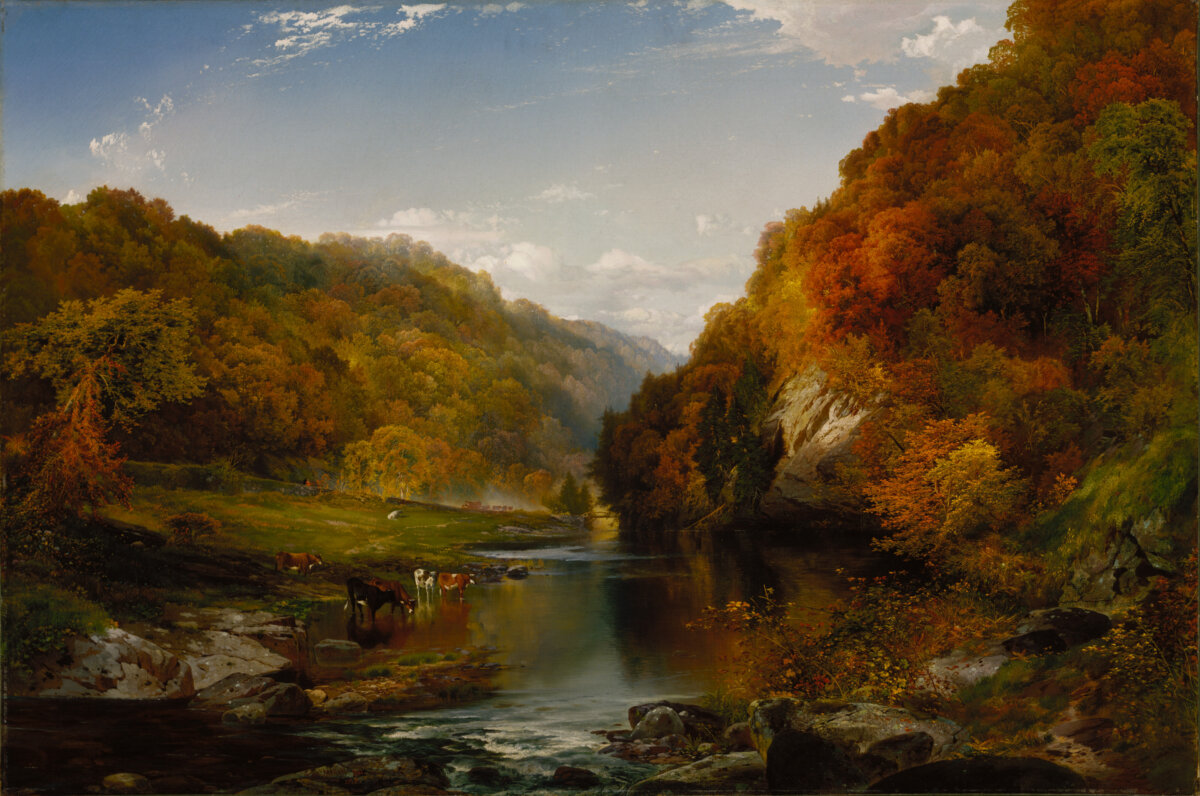
In “Autumn Afternoon, the Wissahickon,” a peaceful pastoral scene plays out. Autumn trees and a rocky crag tower over the valley as cattle quench their thirst in the creek, and a wagon disappears into a distant cloud of dust.
An Artist’s Autumn
Nearly 40 years after that autumn afternoon, Moran reached the autumn of his life. The 66-year-old artist reflected the heart of his art practice and his passion for developing American art in his 1903 essay “Knowledge a Prime Requisite in Art,” published in the American art journal “Brush and Pencil.”
Moran frowned upon imitating art and nature per se; the artist’s mission was more subtle, almost spiritual. “An artist’s business is to produce for the spectator of his pictures the impression produced by nature on himself.” For Moran, that meant immersing himself in nature.
“I must know the geology. I must know the rocks and the trees and the atmosphere and the mountain torrents and the birds that fly in the blue ether above me.” But he wasn’t referring to cerebral knowing. Moran strove “to delve into the depths and mysteries of nature, and from her hear the callings of the fields, the clouds, the mountains, and dales.”
Moran’s reverent approach to landscape painting had a long-term impact on America, its art, and its land. He was best known as the first painter to capture the sublime in the canyons, geysers, and hot springs of Yellowstone, which ultimately helped protect the region as the nation’s first national park.
Moran championed America to fellow artists: “We have every phase of landscape and subject here at home. America is richer in material for the true artist working along the lines of individual development than any country in the world.”
What arts and culture topics would you like us to cover? Please email ideas or feedback to features@epochtimes.nyc.