SEARCH


TORONTO—When I was 9 my mother took me to see Philip Glass’s “Koyaanisqatsi.” I lasted 10 minutes before slumber overtook me. I thought, being as how I am all grown up now, that I was ready for my second try at large-scale minimalism.
But alas, the effect was downright soporific. And just like Peter Rabbit, I would doze off, not to be awakened by an angry farmer but by some violent scene or a fear-inducing aria. It’s not my fault! It was the arpeggios, like ladders leading to nowhere, that went on and on until “bang”—some sudden shift indicated that we must pay attention to whichever fascist was singing. It was like being lulled into a nightmare.
John Adams’ “Nixon in China” explores Richard Nixon’s 1972 visit to Maoist China. In the first act, Nixon, his wife, Pat, and Henry Kissinger are wined and dined by Prime Minister Zhou Enlai. Just like today’s Western officials, they are dazzled.
The second act introduces us to Jiang Ching, the wife of Mao Zedong, and her terrifying ballet “The Red Detachment of Women,” one of the “eight model plays” that were the only plays, ballets, or operas allowed in China during the Cultural Revolution.
Jiang’s tasteless creative machinations end in a disturbing scene that horrifies the Nixons. But as the woman behind me commented during intermission, “Kissinger fit right in.” In a departure from history, and an analogy that ultimately fails, Kissinger plays Nanbatian in “The Red Detachment.” Unaided by his gang of fattened “capitalist” puppets, Kissinger/Nanbaitan is eventually shot dead by young girls dressed in rags dancing on pointe.
It is at this point that Pat Nixon realizes what many Western politicians still have not: Western dirty politicians can’t compare to those of the Chinese Communist Party because we can eventually kick them out, or at least embarrass them publicly. The Epoch Times recently published an article about Mao's Great Famine, the largest manmade disaster in human history during which 2.5 million people died. That just might get you voted out of office here.
By the third act I was emotionally exhausted and in need of a shoulder to cry on and chicken soup. It was just so historically accurate.
Don’t get me wrong. It was the best direction and set design I’ve seen by the COC. Not because it was beautiful. It was horrifying. But because the use of historical footage and the set’s movable parts served the story so well.
Adams’ work is challenging, fascinating, and awesome sometimes; at its best it is big like Wagner but not corny. Our young conductor Pablo Heras-Casado did an admirable job controlling the large forces and difficult rhythms of this work.
Do I want to talk about the principals? Not really. No one is admitting that the $181 million Four Seasons Centre needs some covering over the orchestra pit so the orchestra doesn’t consistently drown out the singers. The only voice that was truly clear was Adrian Thompson in the role of Mao.
What led me to finally put this thought in writing was the wonderful balance between singers and orchestra that was struck during “The Magic Flute.” Mozart, being a classical composer, called for fewer accompanying instruments.
I loved many parts of this production of “The Magic Flute.” Papageno, everyone’s favourite character, is played by Rodion Pogossov, who alone is worth the price of admission. Fantastic comedic timing, spot on singing, he warmed the cockles and more. Canadian tenor Michael Schade’s clear and limber voice had just enough beef to project a manly and regal Tamino.
Canadian Aline Kutan was crisp and articulate as Queen of the Night. She has sung the role many times and has it down pat—I just wish she was louder, but we talked about that already.
Please, Isabelle Bayrakdarian, sing all the right notes. Everyone says you are a super-genius in recital and maybe I’m just an opinionated dilettante, but interpretation probably shouldn’t extend to rhythmic values in this instance.
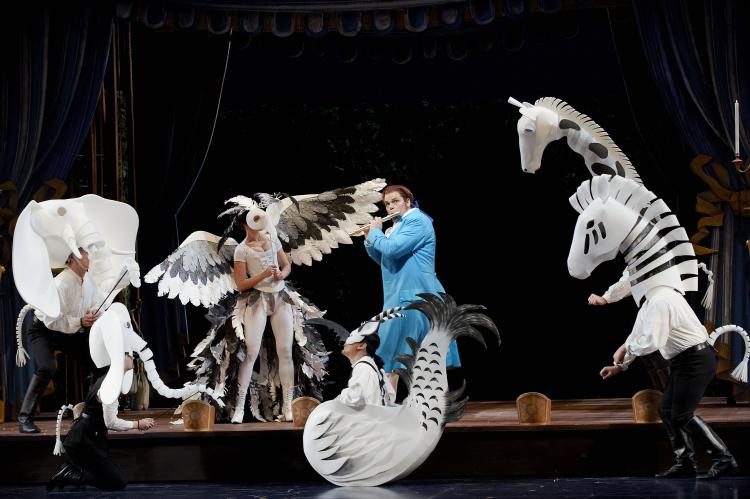
Set designer Myung Hee Cho’s creative animals and hedge mazes were lovely. The play within a play idea, possibly borrowed from Igmar Bergman’s 1975 film “The Magic Flute,” didn’t quite make sense in the second act, but oh well, the plot has never made sense.
Still, these criticisms are unimportant compared to the wonderfulness that is “The Magic Flute.” It is a must see, and this is a wonderful production.
If you go to both, I hope you notice the interesting similarities between “Flute” and “Nixon”—the shrieking scary coloraturas; the Queen of the Night and Madame Mao; the Queen of the Night’s ladies in waiting and Mao’s secretaries; the hero and anti-hero Tamino and Nixon; the benevolent and genuine dictators Sorastro and Mao; and finally, the good girls who’ve judged character poorly, Pamina and Pat Nixon.
At times Adams’ clever and interlocking ensemble writing reminded me of Mozart. If I had Adams’s number I would call him and ask him if Nixon is his anti-flute. I became his Facebook friend and wrote the question on his wall. I’ll let you know if I get an answer.
"Nixon in China" and "The Magic Flute" are performing at the Four Seasons Centre in Toronto until Feb. 26 and Feb. 25 respectively.