SEARCH


In the fall of 1948, political pundits and voters largely agreed on one thing: Harry Truman had no chance of winning the presidency.
Though Vice President Truman had taken up the reins of the presidency after Franklin Roosevelt’s death and successfully overseen an end to the war with Japan, Americans in general were weary of the reforms of the New Deal era and ready to move in a different direction. Even many Democrats believed Truman incapable of defeating the Republicans. In vain, they tried first to recruit Dwight Eisenhower and then Supreme Court Justice William O. Douglas to run on the Democrat ticket, but in the end it was Truman against New York’s Republican Governor, Thomas Dewey.
Yet on election day, Truman proved the prognosticators wrong. With its usual precision, the Encyclopedia Britannica sums up his battle for the White House this way:
“He launched a cross-country whistle-stop campaign, railing against the ‘do-nothing, good-for-nothing Republican Congress.’ In more than 300 speeches in more than 250 cities and covering some 21,000 miles (34,000 km), Truman hammered away at Republican support for the antilabor Taft-Hartley Act (passed over Truman’s veto) and other conservative policies as crowds responded with ‘Give ’em hell, Harry!’ … The excitement generated by Truman’s vigorous campaigning contrasted sharply with Dewey’s lackluster speeches.”
 In the radio broadcast of his farewell address on Jan. 15, 1953, President Harry S. Truman warned against the evil of communism. He is shown here giving a broadcast in 1952. (AL MUTO/AFP via Getty Images)
Both before that campaign and afterwards, Truman revealed himself as a plainspoken, independent thinker who didn’t buckle under pressure. He shouldered responsibility for dropping the atomic bomb on Japan and ending the war. He pushed the Marshall Plan, providing economic relief to war-torn Europe, through Congress. Opposed by many in the federal government and worldwide, including his own Department of State, he followed his conscience and supported the statehood of Israel. Though he had often made racial jokes and called Martin Luther King a troublemaker, he again changed direction as president and, to the surprise of many, ended racial segregation in the U.S. military.
A Test of Wills
Truman popularized the phrase, “If you can’t stand the heat, get out of the kitchen.” In 1951, he faced some of the greatest heat of his political life when he relieved Gen. Douglas MacArthur of his command in the middle of the Korean War.
After North Korean communists invaded South Korea on June 25, 1950, MacArthur was placed in charge of U.S. and United Nations forces battling the attackers. Though the defenders of South Korea were initially overrun and driven down the peninsula, MacArthur’s plan to attack the enemy’s rear by sea at Inchon worked brilliantly. Cut off from their supplies and threatened with annihilation, the communist troops fled north.
Their near-defeat and the impending loss of North Korea led the Chinese to send hundreds of thousands of troops south to fight MacArthur’s forces. This invasion not only jeopardized MacArthur’s forces, but became the issue that incited disagreements between the general and the president. MacArthur wanted to bomb parts of China and its military facilities, even suggesting at one point the use of nuclear weapons, options to which Truman, fearing a broader war, had become adamantly opposed.
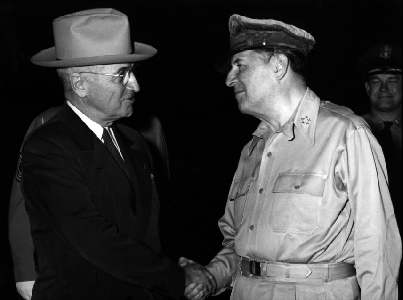
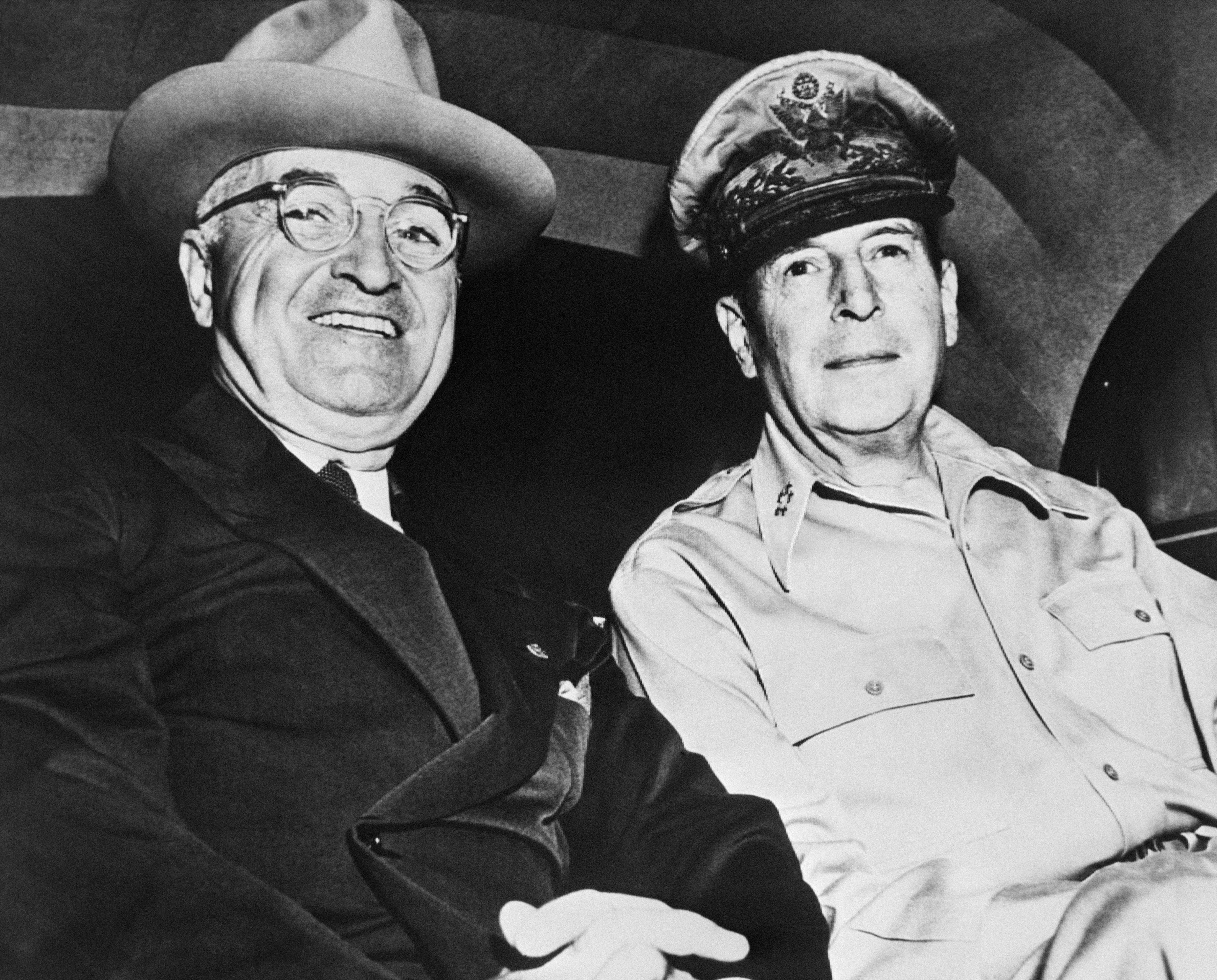 Undated picture of President Harry Truman (L) and Gen. Douglas MacArthur during a meeting. Commander-in-Chief of the United Nations forces in Korea, Gen. MacArthur came into conflict with President Truman in 1951 over the attitude to adopt towards China. (AFP via Getty Images)
Other differences between these two men also drove them apart. MacArthur was a military hero to the American people, aristocratic in appearance and demeanor, though his critics deemed him a preening peacock of a man. Truman was short, practically blind without his glasses, and though blessed with more humility than the general, could be petty and coarse in his judgment of others.
It was MacArthur who brought matters to a head. He became more open in his campaign for achieving victory against China, which meant attacking the president, his commander-in-chief. On April 11, 1951, after consulting with officials like the Joint Chiefs, his vice president, members of Congress, and even the Chief Justice of the Supreme Court, Truman accused MacArthur of insubordination and fired him.
Responsibility Means Accepting Consequences
The outpouring of public adulation for the general was immediate. The White House received thousands of telegrams denouncing Truman’s decision. When MacArthur returned to the states, cheering crowds greeted him everywhere he went. Over 7 million people, a record-breaking number, cheered him at his ticker-tape parade in New York City. His speech to Congress was publicly broadcast and created even more sympathy for him.
Truman expected this turn of events. On the very night he relieved MacArthur of command, he wrote in his diary, “Quite an explosion. Was expected but I had to act. Telegrams and letters of abuse by the dozens.”
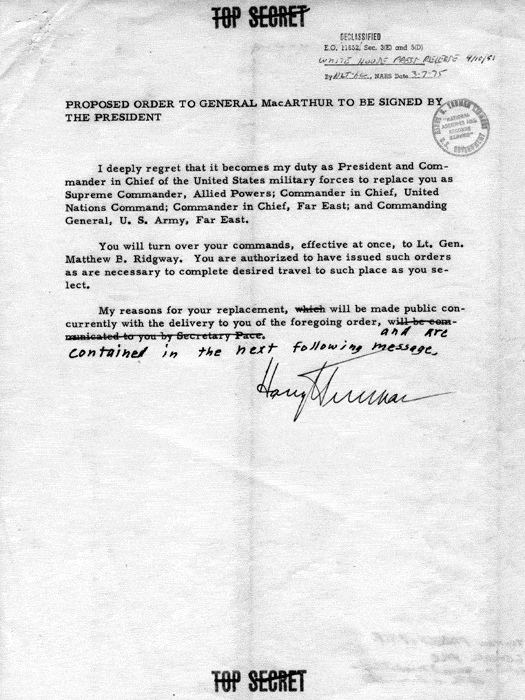 The papers detailing the dismissal of Gen. Douglas MacArthur in 1951. (Public Domain)
Although a better understanding of the clash and the constitutional issues between MacArthur and Truman eventually cooled some of this animosity, Truman declined to run for a second full term as president. He left office with his popularity shattered and was regarded by many as one of the worst presidents in U.S. history.
While in the White House, Truman’s desk sported a plaque that read “The buck stops here.” A bedrock feature of character is the acceptance of responsibility for one’s actions. During his time in office, whether the issue was dropping the bomb, deciding to stay the course and run for the presidency, or sacking a belligerent general, Truman stuck to the hard decisions circumstances required of him.
Consequently, opinion among historians judging his performance gradually shifted more and more in his favor. Truman now stands in that select company of presidents who made tough and often unpopular decisions, and assumed the burdens and penalties for having done so.
What arts and culture topics would you like us to cover? Please email ideas or feedback to features@epochtimes.nyc