SEARCH


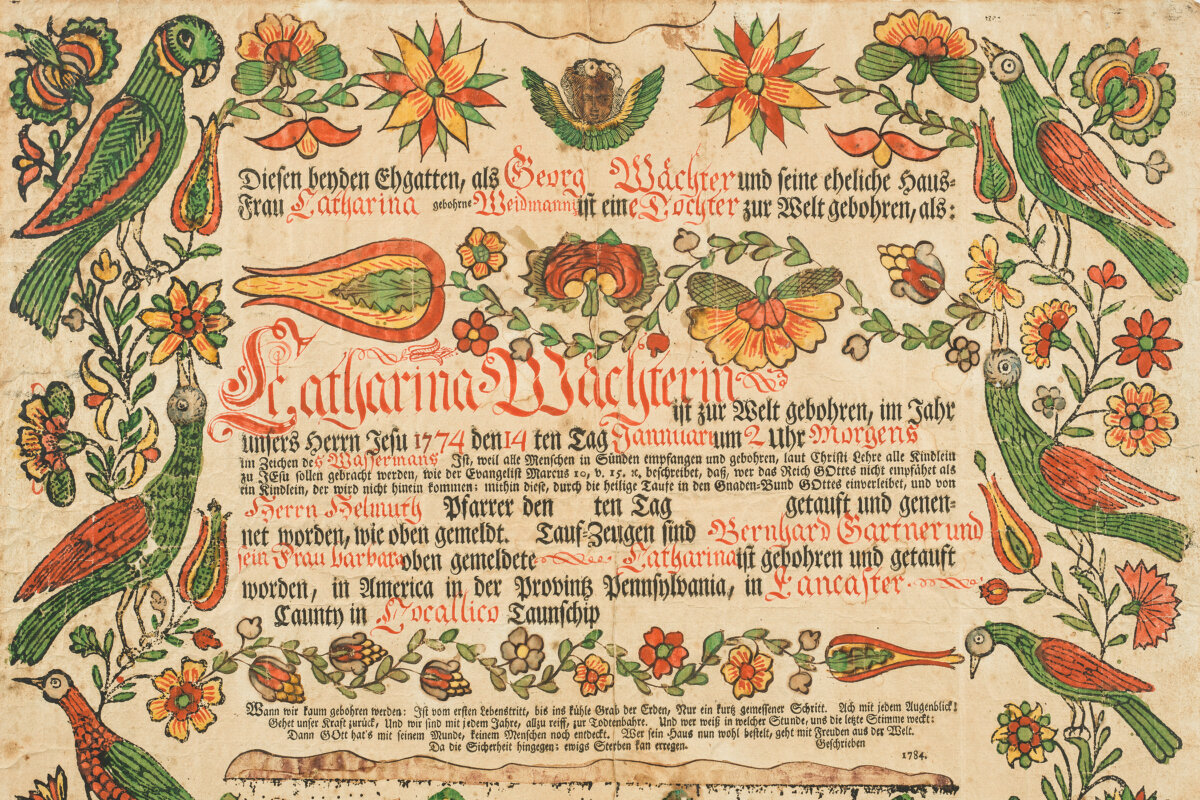
At first glance, the colorful birds, flowers, and ornate lettering of fraktur might call to mind the illuminated manuscripts of medieval Europe. Yet these works were created in early America, where German-speaking immigrants developed a distinctive folk art form that combined decorative calligraphy with hand-painted imagery.
More than attractive historical documents, these pieces offer a glimpse into the daily lives, religious beliefs, and cultural traditions of early American communities.
European Roots, American Traditions
European immigrants began arriving in substantial numbers in the late 17th century. Many came from the Rhineland and from Switzerland, seeking religious freedom, economic opportunity, and land. With them, they brought established traditions of decorative writing and illuminated manuscripts. As with many art forms carried to a new country, those traditions gradually evolved into something distinctly American.
The earliest American examples appeared around the 1740s, particularly at the Ephrata Cloister in Lancaster County, a religious community founded by German immigrants. Its members produced elaborate devotional texts and decorative documents inspired by European manuscript traditions, making Ephrata an important center of production.
From the mid-18th century into the early 19th century, fraktur flourished throughout Pennsylvania Dutch communities, where families maintained their German heritage customs. The term “Pennsylvania Dutch” is often misunderstood, as it derives from “Deutsch,” the German word for “German,” rather than referring to the Netherlands.
Produced primarily by local artisans, fraktur documented births and baptisms, celebrated academic achievements, and preserved family histories. Although its makers often worked outside the established art world, their imaginative compositions and intricate designs demonstrate considerable artistic skill.
The Birth of a Child, Preserved in Art
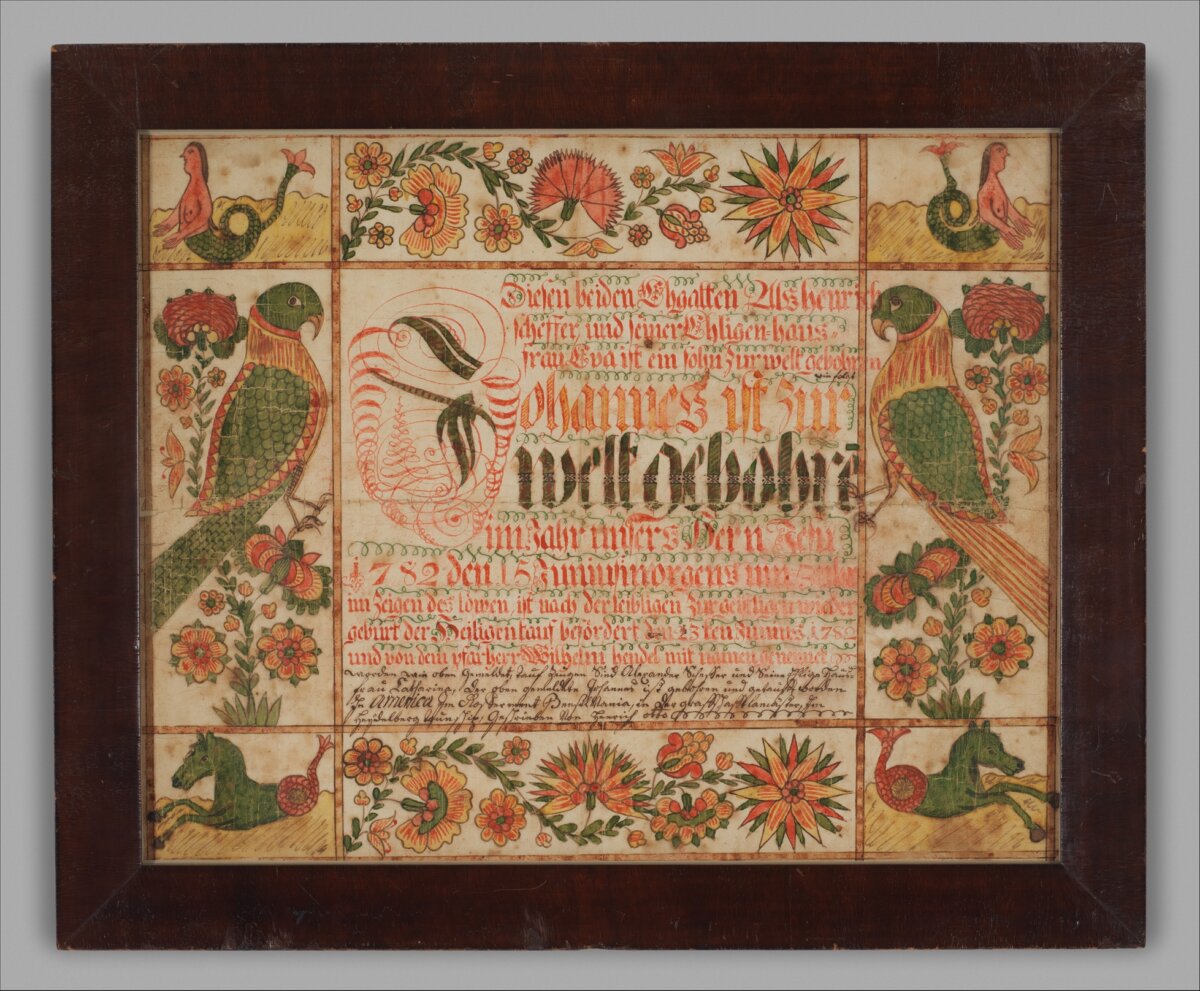
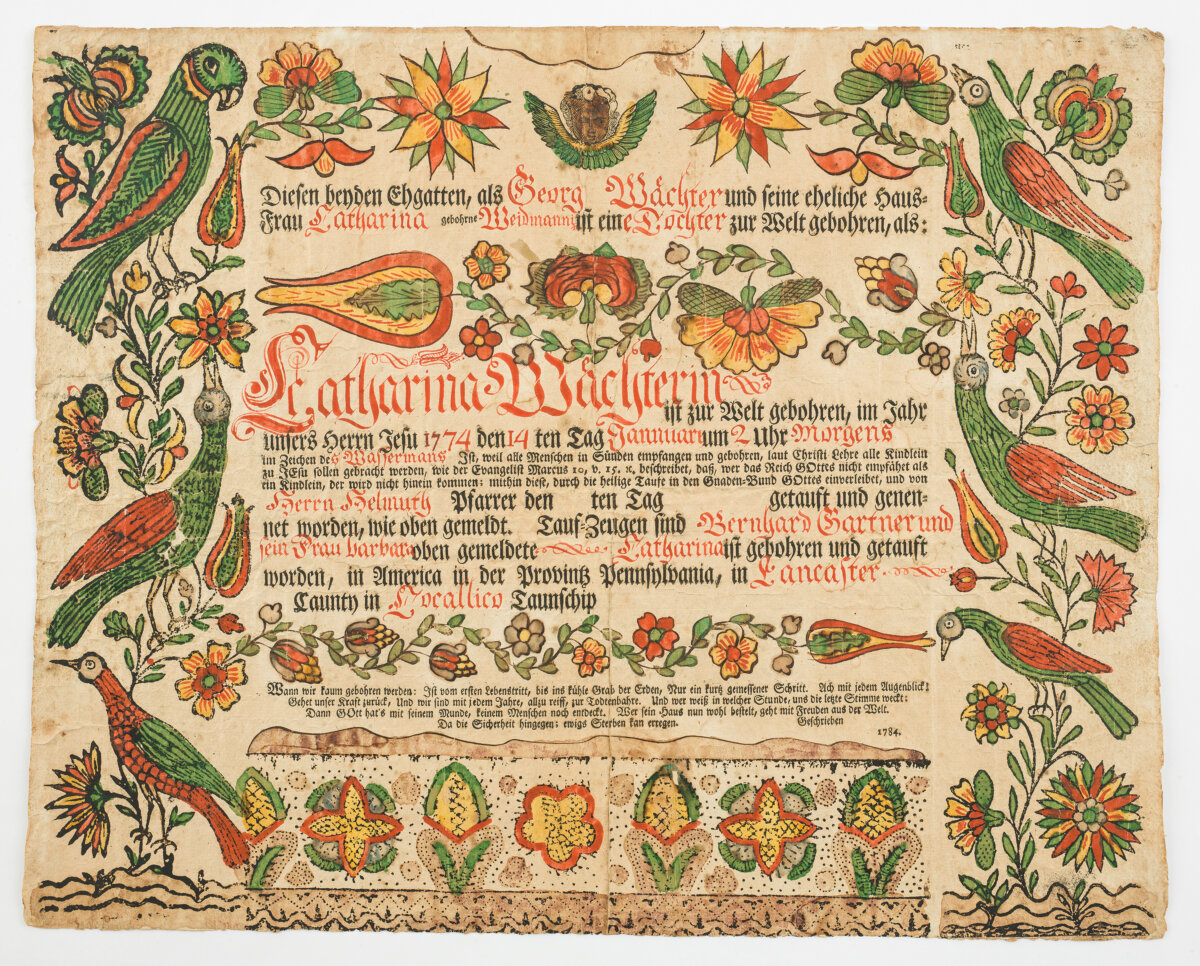
Fraktur appeared in many forms, including writing samples, merit rewards, house blessings, hymnals, and love tokens. The most recognizable, however, is the birth and baptismal certificate, or “Taufschein.” Lutheran and Reformed traditions placed particular emphasis on infant baptism, which made these certificates deeply meaningful keepsakes. They marked a child’s entrance into the religious community and preserved information that could be passed down through generations.
Unlike an ordinary handwritten record, a Taufschein turned personal information into a decorative composition. The text might sit at the center of the page, framed by borders, flowers, birds, or angels. Some certificates featured large ornamental lettering, while others arranged hearts, geometric patterns, and foliage in careful symmetry.
One of the best-known fraktur artists, Johann Heinrich Otto, excelled at these documents. Born in Germany, Otto immigrated to Pennsylvania in 1753 and worked as a weaver, schoolmaster, and artist. Beginning in the 1760s, he produced elaborate certificates filled with colorful illustrations, especially birds, which influenced other Fraktur artists. He also made religious broadsides, spiritual mazes, bookplates, and presentation pieces, and his legacy continued through his four sons, who also became Fraktur artists.
Birds, Flowers, and the Language of Decoration
One of Fraktur’s most appealing qualities is its imaginative use of natural imagery. Birds, flowers, vines, and hearts appear throughout the tradition, rendered in vivid colors and stylized forms.
Birds were especially popular. Some resemble familiar songbirds, while others have exaggerated proportions, lavish plumage, or unusually long necks. The distelfink, a stylized goldfinch, became one of the most recognizable motifs in Pennsylvania German decorative art. Other works feature parrots, paired birds, and birds perched among flowering branches.
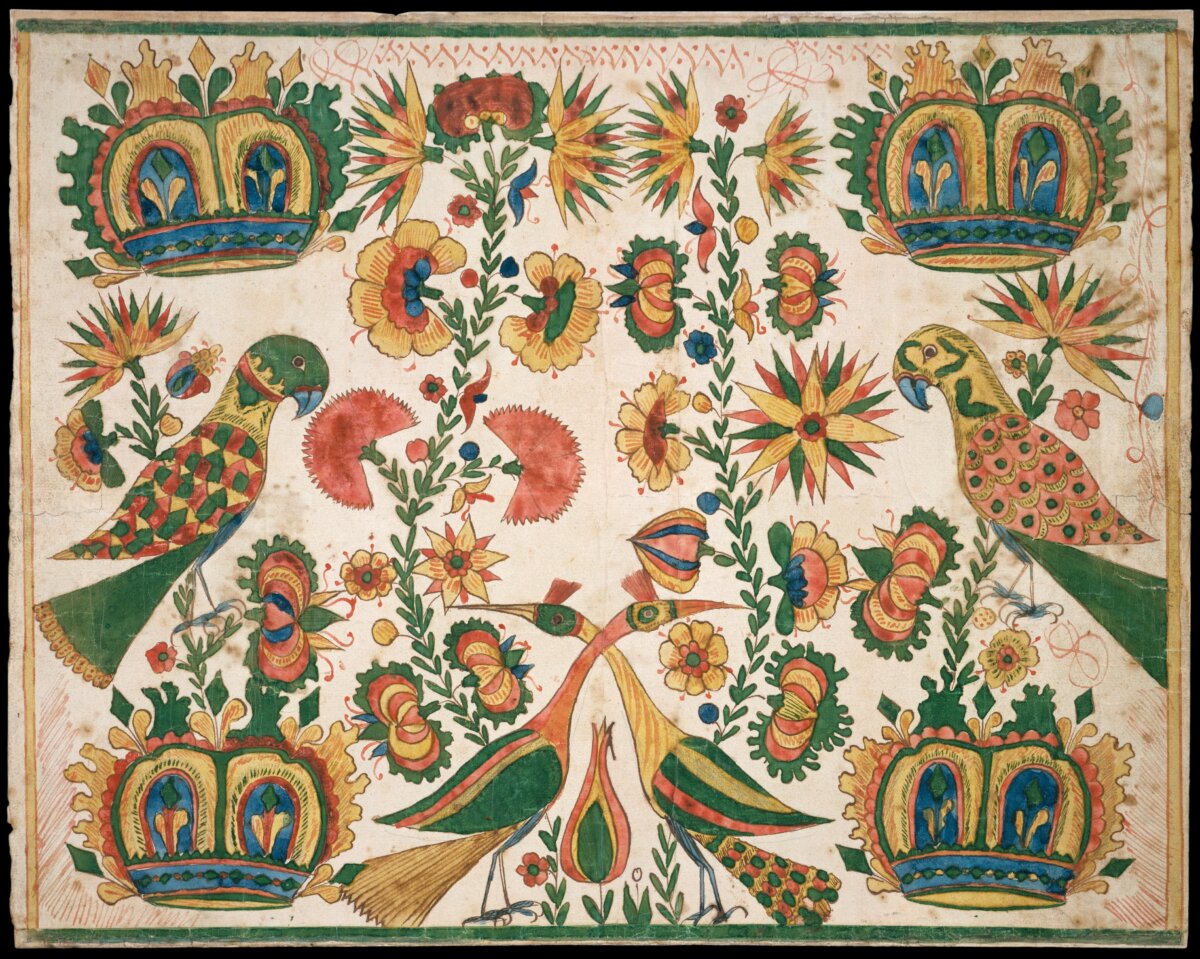
Flowers were equally important. Tulips, roses, and other blossoms appear in elaborate arrangements, sometimes rising from symmetrical stems or forming part of a larger geometric design. Hearts often frame inscriptions or sit beside flowers and birds, balancing natural forms with decorative patterns. Angels also recur, appearing as small winged figures above the text or within larger religious scenes. Biblical imagery, meanwhile, links many of these documents to their owner’s spiritual lives.
It is tempting to assign a symbolic meaning to every bird, flower, and heart, but the evidence does not support it. Imagery varied considerably among artists and communities, and not every motif carried a fixed interpretation. Some decorations had religious or cultural associations. Many were whimsical: Fraktur birds and flowers are rarely naturalistic.
Schoolmasters as Artists
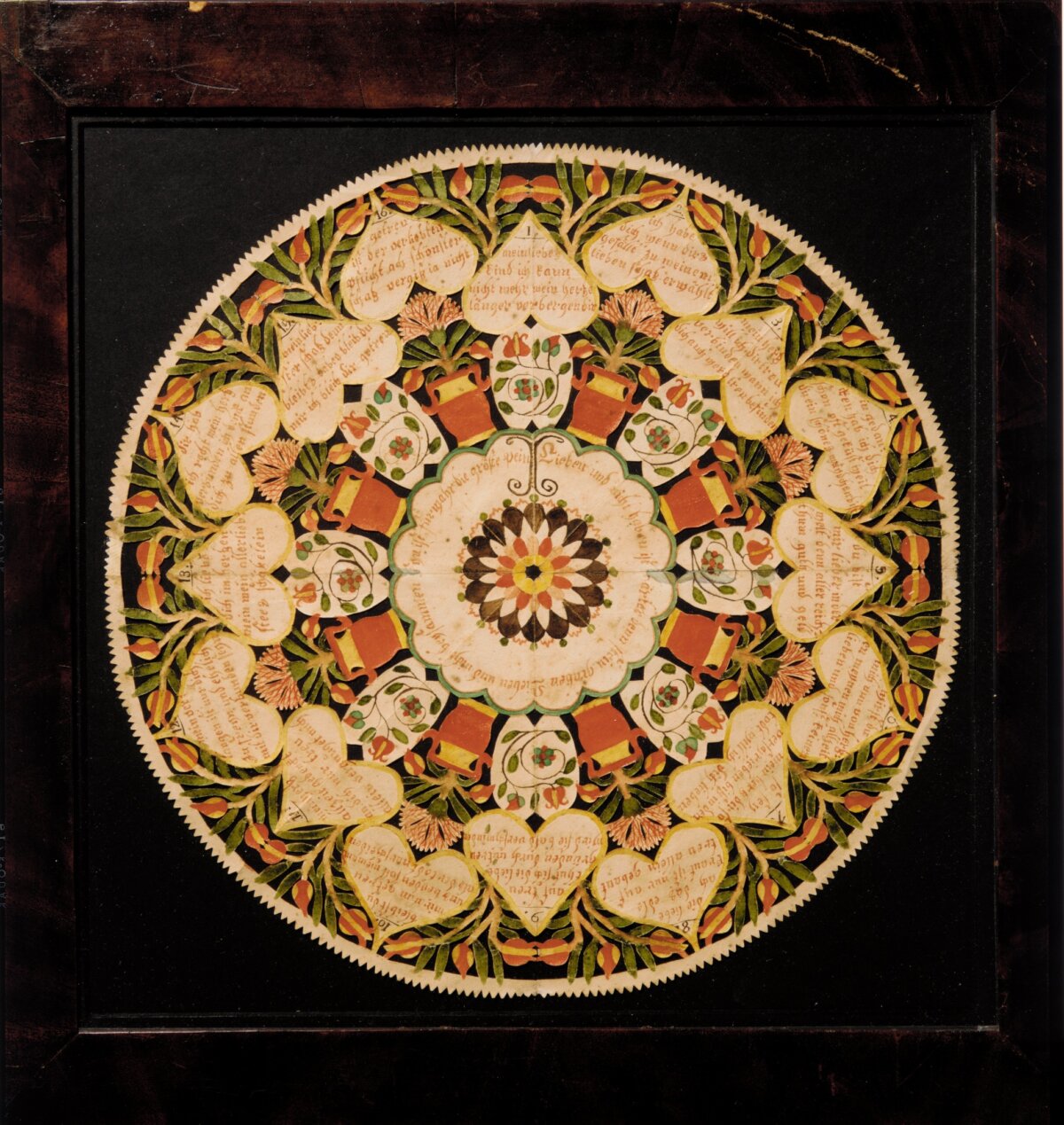
Fraktur was not the product of a single artistic school or a circle of professional painters. It grew out of the work of schoolmasters, ministers, printers, and itinerant artists who made documents for local families. Some makers became recognizable through their distinctive lettering, characteristic birds, or favorite floral designs, though many remain anonymous.
Many were schoolteachers. In rural Pennsylvania, the schoolmaster was often best equipped to produce fine lettering and decorative illustration. His duties extended beyond teaching to creating certificates, religious texts, and other personalized objects. A handsomely lettered certificate could acknowledge a student’s achievement and show how closely decorative art and education were linked. Schoolmasters also created writing exemplars to teach students proper penmanship. Called “Vorschriften,” these models sometimes featured elaborate alphabets, ornamental flourishes, and illustrations. They show that fraktur did more than commemorate family events. It also helped pass literacy and artistic skills from one generation to the next.
Other practitioners included ministers and professional calligraphers, sometimes called scriveners, who made documents for families across the region. Itinerant artists traveled between communities, producing certificates and personalized manuscripts for those who wished to mark important occasions.
The work demanded patience and technical ability. Artists used ink and watercolor on paper, often combining freehand drawing with carefully planned lettering. Some documents were made entirely by hand, while others began as printed designs that artists personalized with handwritten details and added color. As demand grew, printing became an important part of the tradition. Printed certificates let printers and artists produce more examples while leaving room for individual embellishment, blending mechanical reproduction with handmade decoration.
Family History and Cultural Preservation
Although fraktur is often admired for its decorative illustrations, these documents served a broader purpose, ultimately preserving family histories and religious traditions for future generations. In some cases, they also proved useful in unexpected ways. After the American Revolution, veterans and the widows of those who died in service could apply for government pensions, and applicants needed evidence to support their claims. Anna Margaretha Kolb, wife of Revolutionary War veteran Philip Frey, submitted her own birth and baptismal certificate in support of her application. Written in German Fraktur script and adorned with hand-colored birds, it documented her identity and family ties. Frey had served from 1776 to 1778, fighting at Long Island, White Plains, and Germantown before his discharge at Valley Forge. In March 1839, Anna began receiving a monthly pension.

The certificate also reflects the continued use of German in Pennsylvania communities well into the 19th century. What began as a personal record of birth and baptism became supporting evidence in a federal pension file, and its survival in an archival collection now lets researchers study both an artistic tradition and the story of one household in the Revolutionary era.
However, fraktur was rarely intended to serve as an official government document. Families kept these manuscripts as personal records and treasured possessions, folding them into family Bibles, tucking them into storage chests, or keeping them among other household papers. These intimate domestic settings help explain why so many examples have survived. For families maintaining German traditions in an increasingly English-speaking society, fraktur preserved a connection to their European heritage while reflecting their evolving American identity.
A Distinctive Art Form Finds Its Place
Fraktur declined gradually in the mid-19th century for several reasons. English steadily replaced German as the language of public education, and German-language schools became less common. Changing religious practices reduced demand for certain kinds of baptismal certificates. At the same time, industrialization and new printing technologies transformed the making of decorative objects, and the handmade character of traditional fraktur gave way to changing tastes and more standardized printed materials.
Yet the tradition never vanished entirely. Collectors, historians, and museums recognized the artistic and historical value of these documents and preserved examples that might otherwise have been lost. Important collections are now held by institutions including the Metropolitan Museum of Art, the Philadelphia Museum of Art, the American Folk Art Museum, and the Library of Congress.
Fraktur also challenges traditional definitions of American art. Created by schoolteachers, ministers, and local artisans rather than celebrated academic painters, these works show that artistic innovation was not confined to major cities or established institutions. Together, fraktur reflects a community determined to preserve its traditions, celebrate its families, and create beauty in the documents that marked life’s most important moments.
What arts and culture topics would you like us to cover? Please email ideas or feedback to features@epochtimes.nyc.