SEARCH


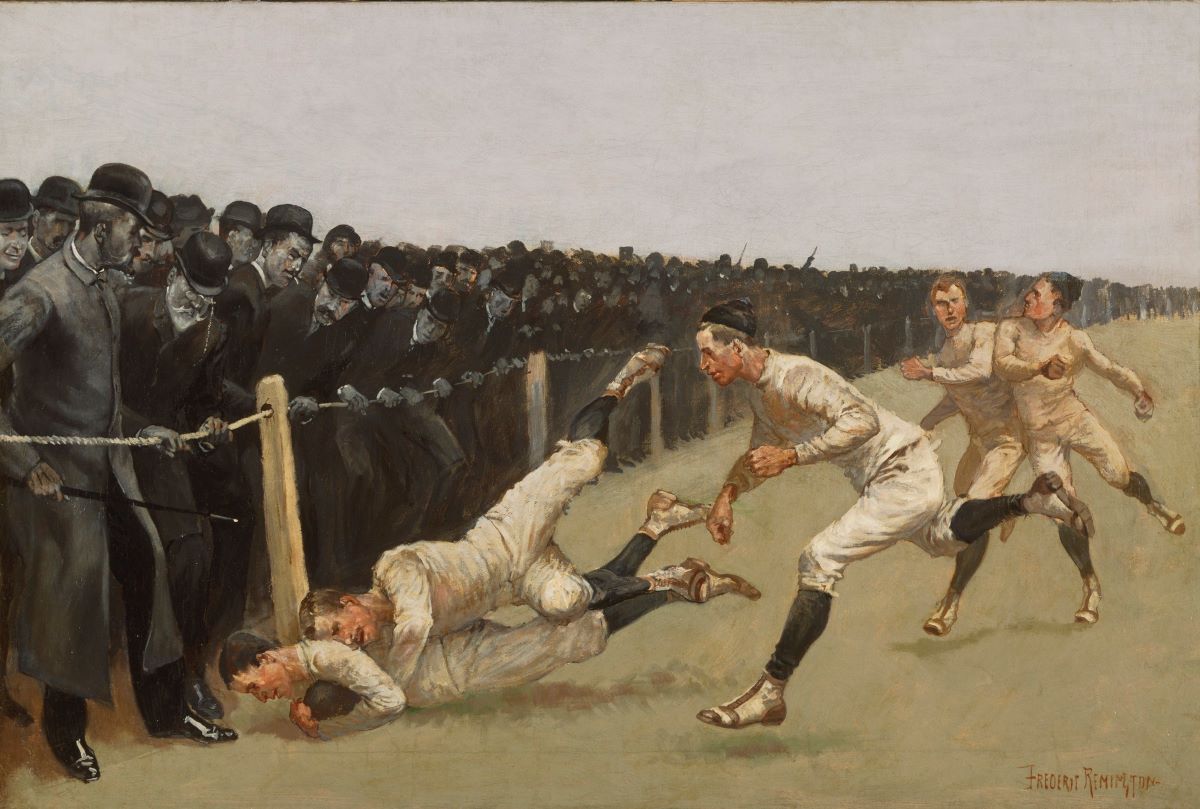
On Nov. 6, 1869, about 50 young, strapping men gathered on a large pitch in New Brunswick, New Jersey. Half of the men tied scarlet scarves around their heads to distinguish themselves from the others. The scarf-clad men were from Rutgers College (now Rutgers University), while the other half represented the College of New Jersey (now Princeton University). With a goal post at each end of the pitch, the battle began over a circular ball with the objective of placing the ball through the opposing team’s goal.
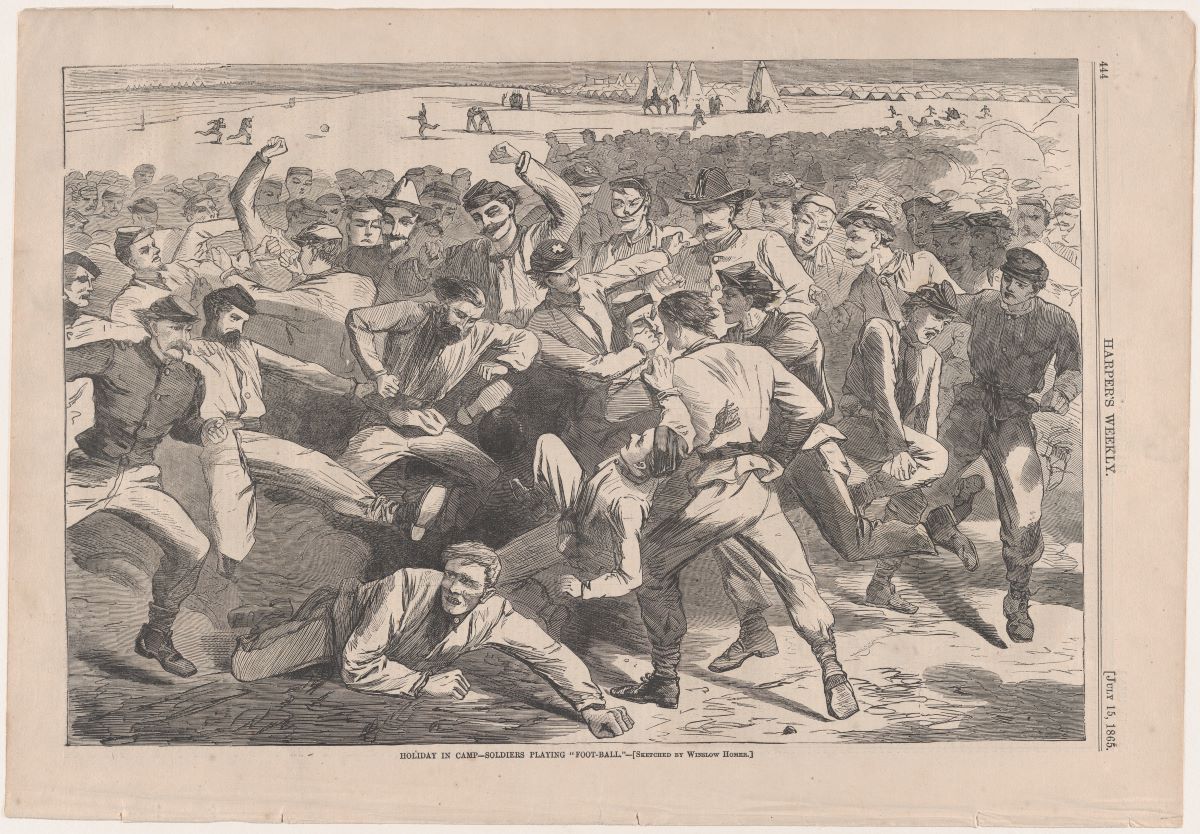
The game was called foot-ball and was similar to soccer. The ball could only be moved by hitting it, whether with a player’s feet, hands, head, or their body. It could not be carried or thrown. Winslow Homer provided a visual of the game’s unruliness in 1865 with a sketch called “Holiday in Camp—Soldiers Playing ‘Foot-Ball,’” in which men are seen kicking, punching, falling, and doing their all to move the ball.
Games were played to an accumulated 10 points with each goal counting one point. With approximately 50 men on the field there was a constant and violent scrum for the ball. On this November day, the two college teams were cheered on by about 100 spectators lined around the pitch. Rutgers defeated Princeton 6-4 in what is considered the first intercollegiate football game.
Establishing the Rules
Teams in New Jersey continued to play along these soccer-style rules for the next several years. Other colleges, like Columbia in 1870 and Yale in 1872, fielded similar-sized teams to compete against a growing number of clubs.
Further north in Massachusetts at Harvard, the game of foot-ball had fallen out of favor during the 1860s. In 1871, the game came back, but with a major difference. Instead of the version common in New Jersey, the Harvardians created a hybrid sport from soccer and rugby. Also, there were fewer players, typically around 11 or 15.
In October 1873, the Yale club sent a letter to the clubs of Princeton, Columbia, Rutgers, and Harvard, inviting their club delegates to meet in New York to discuss and agree on specific rules. Although Harvard declined the invitation, the other club delegates met and established the Intercollegiate Football Association (IFA).
Harvard’s Game
Collegiately, at least in America, Harvard had its own sport for several years where it played intramurally. By 1874, the club began seeking other college clubs willing to play their style of game. Instead of looking south, Harvard looked north into Canada.
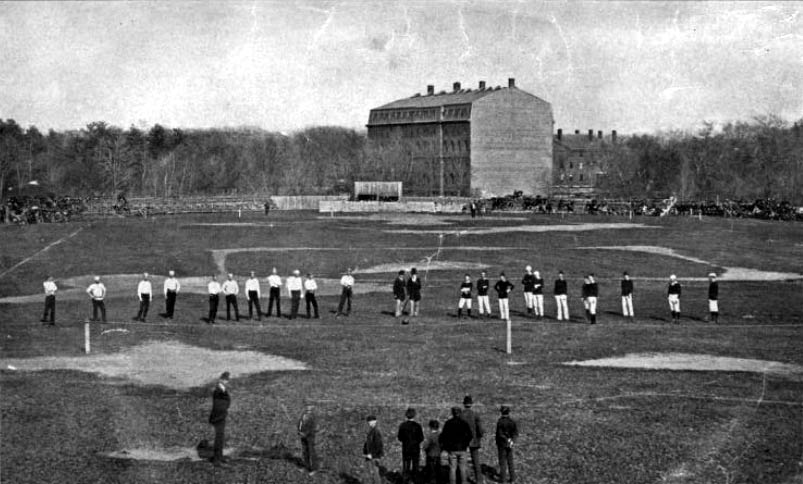
Harvard and the rugby club at McGill University in Montreal agreed to play two matches on May 14 and 15—the first would be played by Harvard’s hybrid rules and the second by rugby rules. Over the two days at Harvard’s Jarvis Field, about 500 spectators came out, paying 50 cents to attend the event. Harvard defeated McGill in the Harvard-hybrid version and ended the rugby game in a scoreless tie.
Morton Henry Prince, an 1875 Harvard graduate and the secretary of the Harvard Club at the time, recalled how the two games had raised a couple hundred dollars. The team decided to spoil their traveling opponents.
“[We] did all that we could to give them a good time and make them feel the spirit of good-fellowship. And, indeed, we found them a set of as good fellows and sportsmen as ever punted a football,” Prince wrote. “We blew them off a banquet at Parker’s in Boston, and saw to it that the champagne flowed as it will never do again.”
Caught Between Two Games
Harvard looked to find American college clubs to compete against and found a willing club in Yale. In 1875, the two clubs hashed out the rules for their new game, which combined Harvard’s version with Princeton’s version. On Nov. 13, 1875, the two clubs competed against each other for the first time.
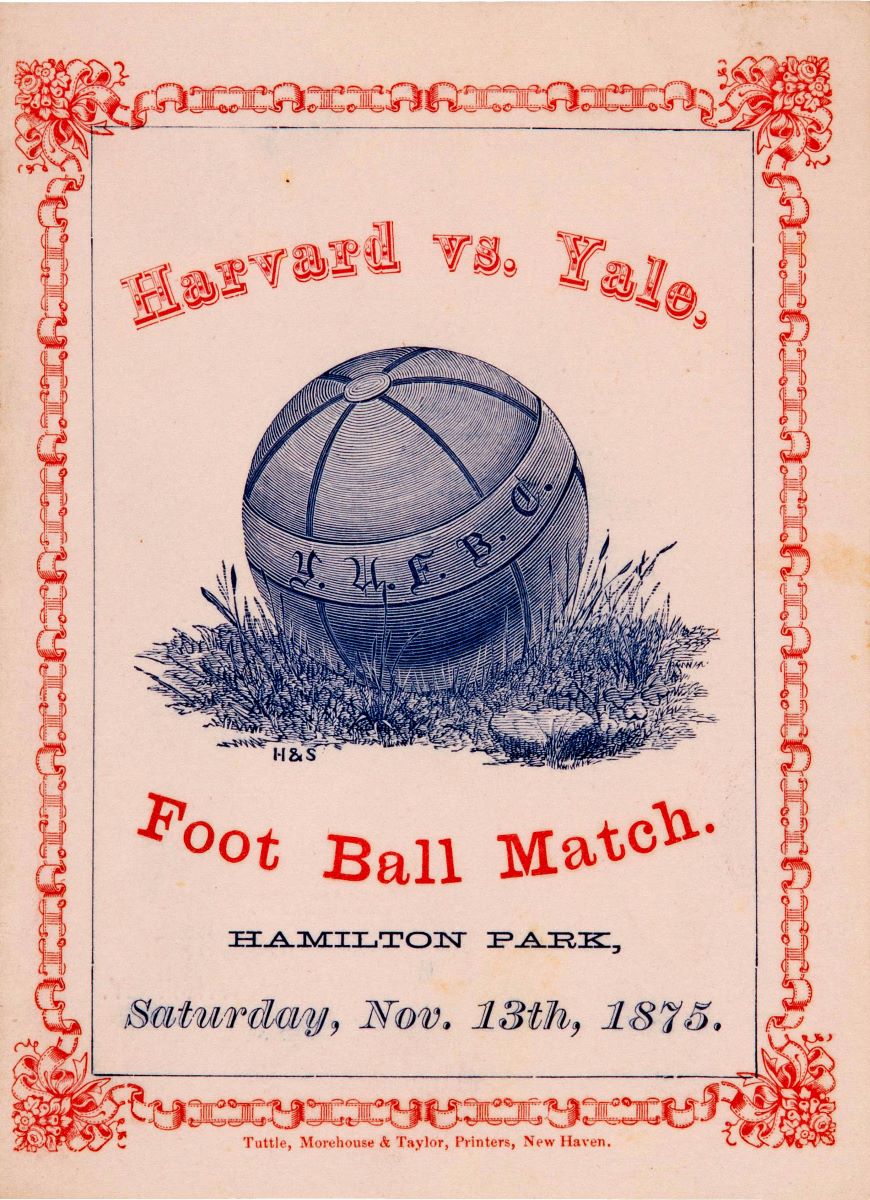
The match was not only momentous because of its inaugural matchup, but also because it was the first time two college clubs wore specific foot-ball uniforms. Yale players wore blue jerseys and dark pants, along with yellow hats, while Harvard’s stockings, breeches and shirts were all crimson.
Princeton continued playing soccer that year, but when Yale announced they preferred Harvard’s version of foot-ball, it presented the Princeton club with a dilemma. The Princetonians were not so much drawn to an unfamiliar game but were drawn to the competition against a familiar elite opponent as well as the possibility of taking on Harvard.
A meeting of Princeton students was called on Nov. 2, 1876. Gathering inside the Geological Hall, the students chose the game based on the Harvard rules. The school was still much divided. Students writing for the school’s publication, Nassau Literary Review, advocated for the “genteel game under the rules of 1873” over “Harvard’s rough and tumble scrimmages.”
The college’s Princetonian, first published on June 14, 1876, advocated that Princeton play according to both sets of rules depending upon what club they played, especially since Princeton had been a dominant club in the soccer style.
“[L]et not Rugby do away with our old game of twenty, in which we have so easily held the championship. The success of our twenty, on the 11th inst[ance], with the University of Pennsylvania, is ample proof of the kind of a game we are able to give on short notice, at any time, under the old rules,” The Princetonian stated. “Let both the eleven and the twenty practice every day, and we will prophesy brilliant victories for both.”
Princeton’s Historic First Game
Despite the arguments, it appeared the decision had been made. In late November, club delegates from Princeton, Harvard, Yale, and Columbia met to agree and implement new rules for the Intercollegiate Football Association. Though an original member of the IFA from 1873, Princeton, in many ways, was new. In fact, the changes were agreed to after the start of the foot-ball season in which Princeton was undefeated in three games.
Before the month was over, the club would compete for the first time according to the new rules. If the student newspapers were any indication, there was concern about how they would perform. “Since the inauguration of the Association Rules [1873], we have easily retained the championship of the Colleges,” the Princetonian stated. “On Thanksgiving Day, we are to measure our strength against Yale, under the new system of rules, with the double disadvantage of short practice and superficial acquaintance with the Rugby game.”
The meeting between the two teams did not simply hold historical significance for Princeton and Yale or for the inauguration of the new IFA rules, but, more importantly, the day chosen—Thanksgiving Day—began an American tradition.
It was during this week in history—150 years ago—on Nov. 30, 1876, that Princeton and Yale squared off in Hoboken, New Jersey. Yale played in their blue shirts and skullcaps. The Princeton players, sporting new uniforms, arrived in dark pants and jerseys with an orange P on the front.
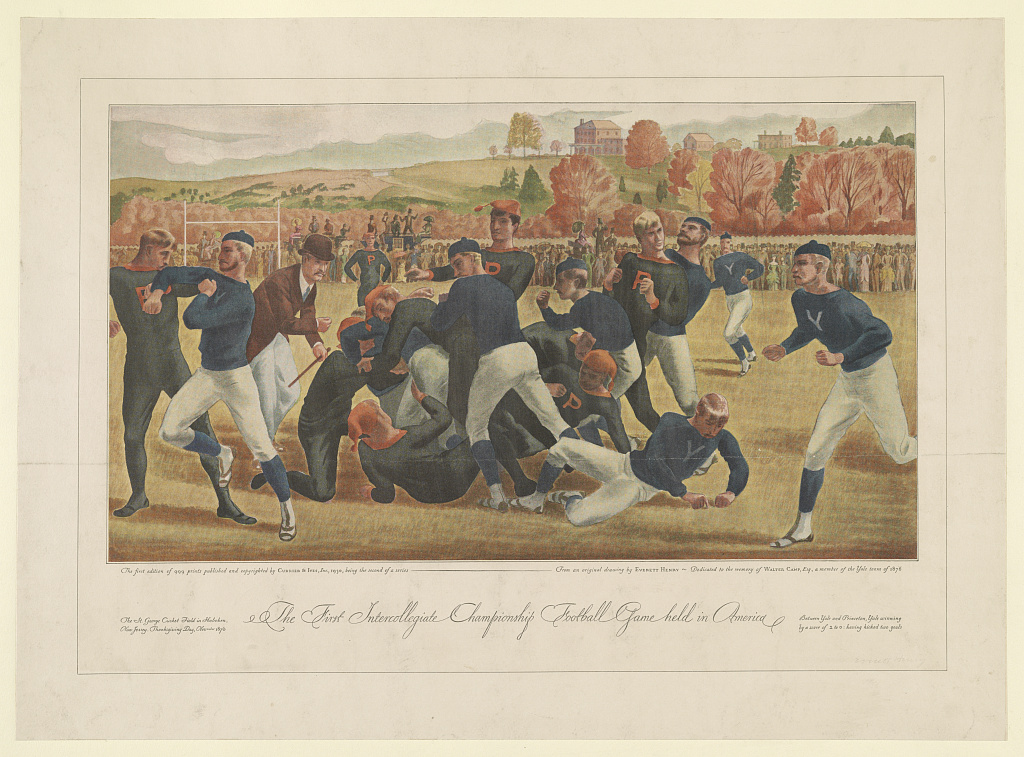
To demonstrate just how new the game was to the Princeton players, the club had ordered balls from Canada after the IFA meeting, but they were sent round balls instead of oval rugby-style balls. They did not receive the right type of ball until the day before the game when Harvard lent them one, and they did not understand precisely how to kick it until the day of the game, while watching the Yale players warm up.
Despite these setbacks, Princeton kept the score close, only losing 2-0 before a crowd of nearly 1,000. The Princetonian suggested there were other problems their club had to face, specifically the refereeing. The student newspaper complained that far more fouls were called on Princeton than Yale and that the referee missed two costly errors. The reason for these officiating problems was clear: “The referee was a Yale man.”
A Growing Holiday Tradition
The Thanksgiving Day game between Princeton and Yale became an annual event, and was soon played in New York’s Manhattan Field. Thousands arrived to cheer on their team.
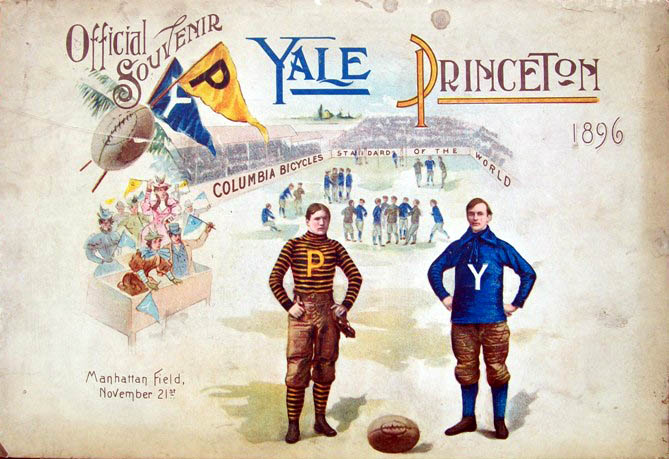
The event brought a slew of business to local merchants. Ministers moved their holiday service hours up an hour to ensure parishioners were in the pews.
For the 1893 Thanksgiving Day game, approximately 40,000 fans attended. Richard Harding Davis, writing for Harper’s Weekly, described the event’s growth. Davis wrote:
“Ten years ago the game was a sporting event, and nothing more, of interest to but a few thousand faithful ones, and to others a public and private nuisance, because for them it disturbed the peace of Broadway at night, and left a vacant chair at the dinner table of every family in which there was a boy worthy the name,” “Today the sporting character of the event has been overwhelmed by the social interest it has aroused in itself, and which has enveloped it and made it more of a spectacle than an athletic contest. … But it is still the greatest sporting event and spectacle combined that this country has to show.”
Over the past 150 years, football has become the biggest sport in America—both collegiately and professionally. Every year, the National Football League (and sometimes college football) celebrates the holiday with one of its most treasured events: the Thanksgiving Day game.
Never miss a This Week in History story! Sign up for the American History newsletter here.
What arts and culture topics would you like us to cover? Please email ideas or feedback to features@epochtimes.nyc.