SEARCH


During the Golden Era of Hollywood, Metro-Goldwyn-Mayer (MGM) prided itself on having a wide variety of movie stars. MGM’s mogul, Louis B. Mayer, famously said that the studio had “more stars than there are in heaven” in their stable of talent.
To keep their cinematic firmament shining brightly, MGM had to feature its stars in showcases which were elaborate and varied enough to keep the public coming back again and again. Oftentimes, films would pair performers who might seem like an unlikely couple because of different talents and styles.
For instance, MGM paired Esther Williams and Howard Keel in three feature films. It’s apparent right away they’re a surprising movie couple. Esther Williams was an award-winning swimmer. She swam her way from a high-profile aquacade to a film contract when World War II sank her chances of competing in the 1940 Summer Olympics.
Trained in acting, singing, and dancing for nine months, Esther became a swimming movie star, appearing in elaborate aquatic musicals opposite the studio’s top male stars.
Howard Keel was a trained singer with a rich bass-baritone voice and imposing figure to match. After finding success in lead roles in London’s West End and on Broadway, he became a popular leading man in some of MGM’s top-earning movie musicals.
Keel and Williams appeared opposite each other in three musicals made over three years. The settings of their movies included a tropical island, a Texas hotel, and ancient Rome.
‘Pagan Love Song’ (1951)
‘Pagan Love Song’ is the story of an American who goes to a tropical island and falls in love with not just the scenery but one beautiful native. Set in modern-day Tahiti, the story begins with the arrival of Hap Endicott (Keel), a Yankee school teacher who trades the stress of civilization for the hammock lifestyle when his uncle leaves him a small plantation on the island. It turns out that even beachcombers need money, and Hap’s new home is in need of repair.
A friendly pair of native siblings (Charles Mauu and Rita Moreno) inform him that his land is rich with coconut palms, which produce a valuable harvest. Hap knows nothing about the crop, so he must rely on his friends. Meanwhile, Hap takes a liking right off to Tahitian girl Mimi (Williams), who is half French and eager to leave the island. However, getting to know Hap makes Mimi wonder whether Tahiti might have something for her after all. Will Hap’s Yankee business spirit keep him from being a true Tahitian?
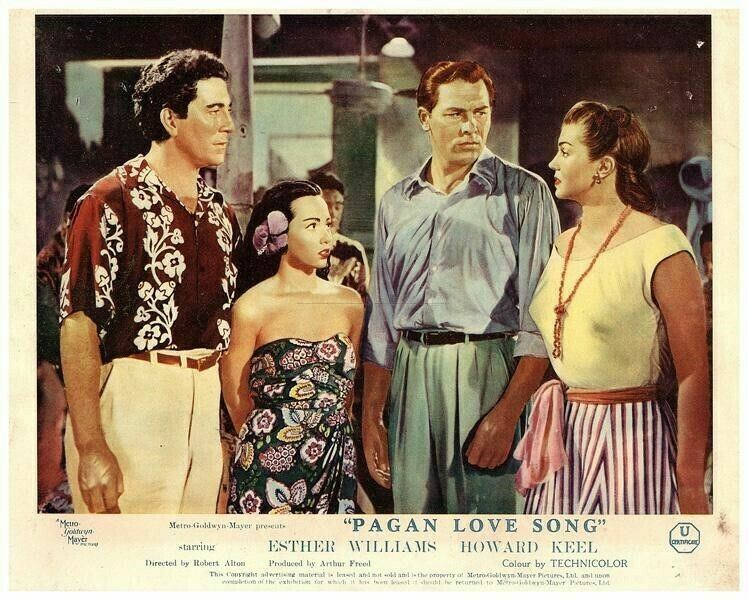
The soundtrack features a catchy catalog of original songs by Arthur Freed and Harry Warren. Keel performs several solos, which he sings while riding a bicycle, surveying his new home, getting ready for the day, and teaching three native children manners. His most melodious moment is the title song, written in 1929 by Freed and Nacio Herb Brown, which he reprises in a dream sequence.
Working swimming routines into this movie was quite natural, given its tropical island setting. Much of the swimming occurs in real ocean water with only above-surface footage. One obligatory fantasy aquacade was worked in through a dream sequence. After Mimi and Hap quarrel, we see Hap sitting on his front porch in the tropical moonlight, daydreaming about the girl he may have lost. While ethereal voices sing the title song, Williams and several other lovely swimming chorus girls perch on a magical island, wearing glamorous bathing attire. Elaborate Hollywood tanks are utilized in this number to show the swimming star floating gracefully underwater from various impressive angles.
‘Texas Carnival’ (1952)
This movie is about two carnival workers who find unexpected fame and love through a strange case of mistaken identity. At a Texas carnival, barker Cornie (Red Skelton) and his business partner Debbie (Williams) are barely making ends meet with their booth. Everything changes when a drunken Texas cattleman, Dan Sabinas (Keenan Wynn), befriends Cornie and makes him promise to bring him his car. Cornie and Debbie drive the flashy convertible to an expensive hotel where Sabinas told him to go. Little do they know that he impulsively went to Mexico City instead, so when Cornie pulls up in Sabinas’s car, everyone assumes that he is Dan Sabinas.
Cornie and Debbie reluctantly continue to pose as Dan and his sister, Marilla, since they are too hungry and strapped for funds to protest. Things grow more complicated when they meet the Sabinases’ ranch foreman, handsome cowboy Slim (Keel). Although he claims to have never met his employers before, he quickly takes a shine to Debbie. She shares his feelings but is riddled with guilt for deceiving him. As the accidental phonies rack up thousands of dollars in debt, they know the jig will soon be up when the real Sabinas arrives.
Keel plays the singing cowboy in this movie, and the original score by Harry Warren and Dorothy Fields gives him a couple of vocal features. While leading a group of horseback riders, he serenades his horse in “Whoa, Emma!” Later, he sings the beautiful love ballad “Young Folks Should Get Married” to Williams.
A Western is not the most likely setting for an aquatic musical. Opening with the sideshow attraction was a good way to get Williams in a bathing suit, although the tiny tank wasn’t big enough for swimming. She drives to the hotel in that same bathing suit, so she’s forced to spend her first hours at the hotel by or in the pool.
The film managed some swimming with that ever-useful device, the dream sequence. Through an impressive use of double exposure, Williams appears to swim through the air right before Keel’s eyes, using support beams in his hotel room as props for her underwater choreography. The blue coloring and some occasional bubbles reveal that this was filmed underwater, but she really looks like she’s flying through the air.
‘Jupiter’s Darling’ (1955)
In ancient Rome, Fabius (George Sanders) becomes a dictator, yet his political victory is marred by the absence of his headstrong fiancée, Amytis (Williams), who is only marrying him to avoid becoming a Vestal Virgin. Amytis hears that the dreaded conqueror Hannibal the Barbarian (Keel) is camping outside Rome while planning to siege the city. She and her slave girl, Meta (Marge Champion), sneak out to catch a glimpse. They are quickly captured and brought to Hannibal’s tent.
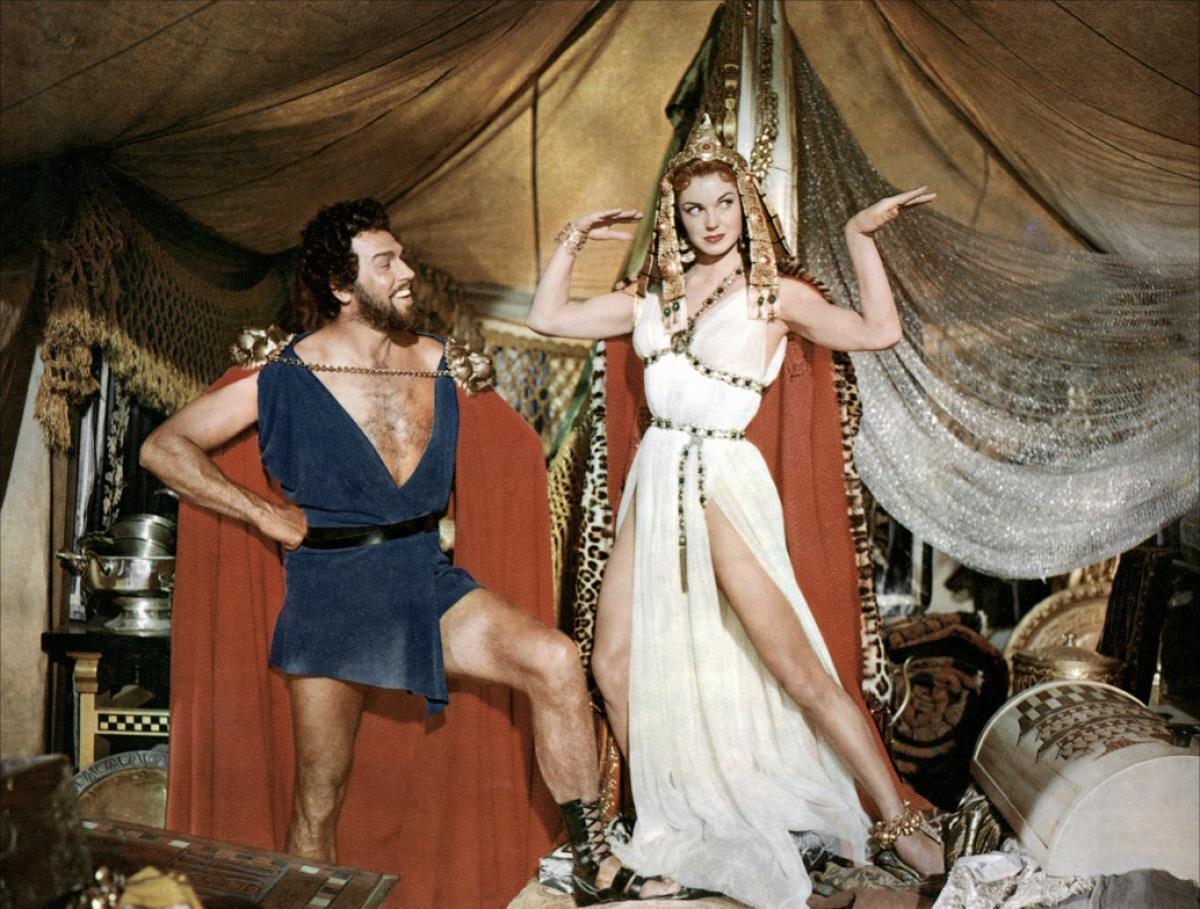
Amytis convinces Hannibal to spare their lives, promising to show him a break in the city’s walls. When Roman soldiers interrupt their romantic journey, Hannibal angrily accuses Amytis of luring him into a trap. Back at camp, the beautiful young woman uses her wiles to win her way back into his good graces and his heart. Soon, the Carthaginian chief is more interested in arraying his new lady in finery than attacking the city. Is Amytis just trying to distract Hannibal to save Rome, or is she genuinely smitten with him?
This soundtrack featured seven original songs by Burton Lane and Harold Adamson, and the style is much more theatrical than the previous films. Keel makes his entrance leading his troops on an elephant, singing the rousing “Hannibal’s Victory March.” He threatens Amytis with “Never Trust a Woman.” Later, he sings the passionate love ballad “Don’t Let This Night Get Away.”
Besides two incidental swimming scenes, this movie features one water ballet number. After Fabius presents her with an ultimatum about their marriage, Amytis doffs her stola and dives into the opulent pool in her palazzo’s courtyard to perform an elaborate water ballet amid underwater columns. She swims around several underwater statues of chiseled men, and they come to life and begin partnering with her. This is the only swimming routine in which Williams is partnered underwater so extensively. It’s amazing how much these male swimmers covered in white paint appear to be carved out of marble.
A Disappointment, a Hit, and a Flop
“Pagan Love Song” performed well at the box office. However, because it went $400,000 over budget, it only made a profit of $108,000, making it a relative disappointment for an Esther Williams film.
The unlikely blend of genres and an eclectic cast of “Texas Carnival” somehow clicked because of its talented stars, a smart collection of songs, and special effects swimming. At only 77 minutes, the film was relatively inexpensive to make, and turned a nice profit of $681,000.
“Jupiter’s Darling” was an unusual film in William’s catalogue because of its ancient setting and was her first film to lose money. Ironically, Keel called Hannibal his favorite role at MGM. He clearly is in his element as the bearded, sparsely clad conqueror. Keel and Williams shine with their singing and swimming. However, the unlikely supporting actors, including Marge and Gower Champion and William Demarest and some weak additional songs, undermined the film. The exorbitant filming costs, with lavish costumes and painted elephants, also made sure the film had no chance of making a profit.
These three movies show the wide range of these two stars and the MGM studio system in the 1950s. If you want to cool off this summer with aquatic musicals, dive on in!
What arts and culture topics would you like us to cover? Please email ideas or feedback to features@epochtimes.nyc