SEARCH


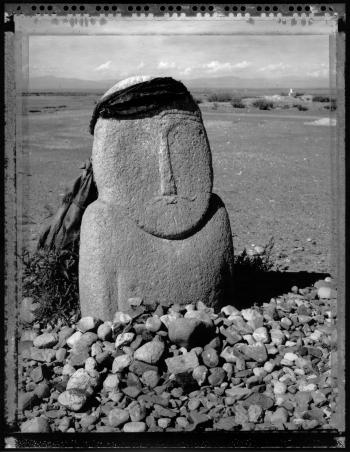
Her recently published photo book, "Land of the Deer Stones," takes a peek at several aspects of rural life in today's Mongolia, which, despite its growing capital city of Ulaan Baatar, still supports 2 million people living a nomadic lifestyle.
Ling photographs deserts, not for their sparse imagery, but for their surprising abundance of life. "Just when you think there's nothing happening, suddenly something happens," she said. It is often these moments of seemingly spontaneous activity that Ling captures.
"I'm standing there behind my camera with the [dark] cloth over my head, figuring out where to place the horizon in the frame, and all of a sudden three horsemen come into the frame-and I think, 'Where did you guys come from!'"
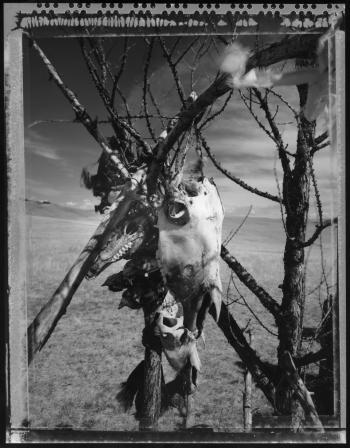
Ling's fascination with the desert began after several trips in the 1980s to the American Southwest, whose landscape contrasted sharply with her childhood experiences in Hong Kong before she moved to Toronto at the age of 9.
"Coming from Hong Kong, you feel constricted. You never see wilderness," Ling said.
Since visiting the Southwest, she has photographed deserts in Namibia, North Africa, India, South America, and Australia. The images in her latest book were produced during five trips between 2002 and 2008 to Mongolia's Gobi desert-an area of 500,002 square miles, making it the world's fifth largest desert.
In Mongolia, Ling and her team jostled around in a Jeep pursuing deer stones, which are ancient carved stone pillars that litter the landscape, each standing in honor of a warrior. Little is known of them outside of the research conducted by archaeologists at the Smithsonian Museum.
Photographs of deer stones comprise a small part of the book. The vast majority of the images present the people, land, housing, customs, and historical and religious influences that mark Mongolian nomadic life today. Showing through in many photographs are hints of how that traditional lifestyle is evolving to embrace modernity.

A Foray Into Nomadic Life
Visitors to Mongolia must put all notions of personal comfort aside, as well as all inhibitions.
First off, there's no washing available for person or garments since water is scarce or even unavailable, depending on which part of Mongolia you are visiting. In the Gobi, the jug of water you manage to bring with you is the all the water you will have.
Secondly, every meal will consist of dairy and meat. Don't expect to see anything leafy and green in your bowl. Because nomadic Mongols live on the animals they herd—primarily cows, goats, and sheep—and do not farm, animal products make up the bulk of their diet, supplemented by noodles.
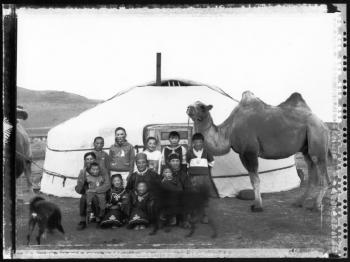
Thirdly, there's no privacy. An entire family and its guests sleep in the ger, or Mongolian felt tent, which is one circular space. That space is where sleeping, cooking, and all indoor activities must happen. “I would be sleeping and there would be a piece of meat hanging right [above me] in the rafters,” Ling said of life in a ger. “Everything smells like sheep. Even the money smells like sheep.” But in a land without privacy, hospitality is guaranteed. 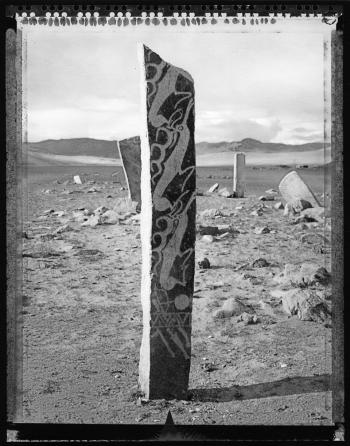
Because camps are so few and far in between, travelers depend on the hospitality of families they come across. Each household has an open ger policy. Visitors can drop in and expect to be warmed and welcomed with soup and milk candies. On her travels in search of stone relics, Ling and her company have often been the recipients of Mongolian hospitality, dropping in on strangers' camps at midnight for mutton, vodka, and storytelling. It is this all-welcoming attitude that Ling wishes to share with the world.
“I want to show the viewer the magic of discovering a culture in-depth, and what it's like living with the nomads.” said Ling.
The oversized book features several essays from leading cultural anthropologists, Ling's charming travel stories, and of course, 116 reproductions of her large black-and-white photographs. The book makes for great coffee table display, and the images inspire many questions about a lifestyle with which we in the West are not familiar.
For more information about the artist and her books, please visit www.ElaineLing.com. The book can be purchased at http://lodimapress.com/.