SEARCH


Torn between his duties and needs, Leo Tolstoy, one of Russia’s greatest authors, abandoned his aristocratic lifestyle. Later in his life, he put on threadbare sandals and set off on a pilgrimage. Its outcome illustrates the intimate link between spiritual fulfillment and simplicity.
Leo Tolstoy: Count, Soldier, Author
Count Lev Nikolayevich Tolstoy—anglicized as Leo Tolstoy—was born in 1828 near Tula, Russia. He traced his ancestry to a legendary man named Indris, who migrated to the Ukraine in the 1300s. Indris converted to Orthodox Christianity, and the faith remained part and parcel of his descendants’ lives.
Tolstoy’s parents died when he was very young, and relatives raised him with their own children. At age 16, he went to Kazan University to study law but was disappointed with the quality of education he received. His teachers thought him unwilling to learn, so he left in the middle of his studies, returned home, and began living the leisurely life of a typical aristocrat.
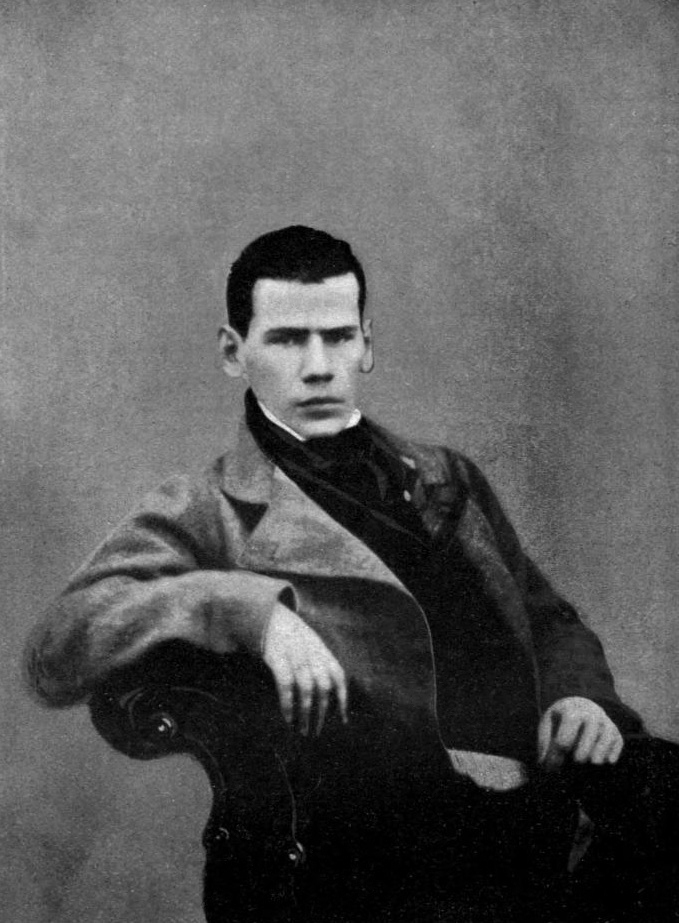 Lev Nikolayevich Tolstoy in 1848, aged 20. (Pavel Biryukov)
Leisure ended when he joined the army in 1851. He had recently begun writing, and his firsthand account of the Crimean War of 1853–1856 became a literary success. He wrote several other autobiographical works while a soldier.
Six years later, the now 29-year-old took his first of several trips to Western Europe. Grand-touring was common among young aristocratic intellectuals, including the English poet Lord Byron and German writer Johann Wolfgang von Goethe. Tolstoy became particularly interested in pedagogy, which he discussed extensively with the controversial socialist theorist Pierre-Joseph Proudhon and other like-minded thinkers.
Inspired by the possibility of using his wealth to alleviate poverty, Tolstoy started a network of 13 schools for the children of Russia’s poorest peasants as soon as he returned home. Suspicious of the count’s political leanings, the Russian imperial police quickly shut down the project. Although it was short-lived, it remains one of the earliest examples of democratic education in modern Europe.
A Crisis at the Height of Fame
During a visit to Paris, Tolstoy witnessed a public execution, something that he would have never imagined on his peaceful private estate. The experience scarred him. To him, the government was meant to protect its people, not kill them on a public stage. If it could do that, Tolstoy thought, it could easily eliminate all citizens. As he later wrote in an essay on patriotism, “A government, therefore, and specially a government entrusted with military power, is the most dangerous organisation possible.”
The following decades were fueled by vigorous reflections on the role of government, the duties of its citizens, and the responsibilities of a wealthy and noble landowner like himself. Tolstoy was a man of extremes, unwilling to find stability in middle grounds. He wondered whether he should continue living as an aristocrat despite the widespread poverty around him, or renounce his affluent lifestyle and retreat in search of a simpler and possibly more fulfilling life.
The turning point came in about 1880. By then, Tolstoy was one of the most celebrated authors alive. His two masterpieces—“War and Peace” and “Anna Karenina”—had brought him worldwide acclaim. Yet, behind the grandeur of his estate and the brilliance of his prose, the man was unraveling. Eventually, he decided to give away his possessions. He also declared that the public should own his published works. Worried about the financial stability of their 13 children, his wife, Sophia Andreevna Behrs, obtained the copyrights for all of his books published before 1880. Her decision avoided bankruptcy and saved the Tolstoy estate.
 The central conflict in “Anna Karenina” is Anna’s extramarital affair with a dashing soldier. (Public Domain)
In “A Confession,” written during this turbulent period, Tolstoy described his inner turmoil. The book opens with the Eastern fable of the dragon in the well. A man is chased into a well, where a dragon dwells. He clings to a small branch, which two mice are gnawing. The man will eventually fall into the dragon’s mouth. Before falling, he sees a few drops of honey on one of the branch’s leaves. He drinks them and feels content, despite his imminent death. In Tolstoy’s version, however, he no longer enjoys the honey, whose drops represent love for his family and his writing. “I try to suck the honey that once consoled me,” he wrote, “but the honey is no longer sweet.” Death frightened the count, making everything meaningless.
Tolstoy admitted that the path he took to address this existential dilemma was to simply hold on, “despite the absurdity of it.” However, he also realized that life is only hopeless and absurd “without God.” A world with God is a hopeful world, where life continues beyond mortality. But could Tolstoy ever be certain of God’s existence? To placate his doubting mind, the count set off on a life-defining pilgrimage.
Tolstoy’s Pilgrimage
A man with profound sensitivities, Tolstoy had always been interested in religion. However, since he became an atheist in college, his interest had remained passive. As he wrote in “A Confession,” “at the age of eighteen I no longer believed any of the things I had been taught.” He either thought about God intellectually or followed family customs blindly, without ever reaching a self-conscious affirmation of his faith. Evidently, the time for such an affirmation had come.
On June 10, 1880, Tolstoy began walking toward Optina Pustyn, a monastery and well-known pilgrimage destination 33 hours away. To avoid being recognized, he disguised himself as a peasant. Willfully deprived of all the comforts he was used to, he walked for days. He wandered into villages, where he spoke to unassuming farmers, beggars, and other pilgrims who, like him, were seeking to reinvigorate their spiritual lives.
He read the Bible, prayed, and broke bread with fellow human beings who embodied humility and simplicity, two traits he rarely witnessed in the ostentatious halls of his estate. At the monastery, he spoke to “starets,” spiritual elders with a deep knowledge of the Russian Orthodox tradition, who shared with him firsthand accounts of a truly devotional life.
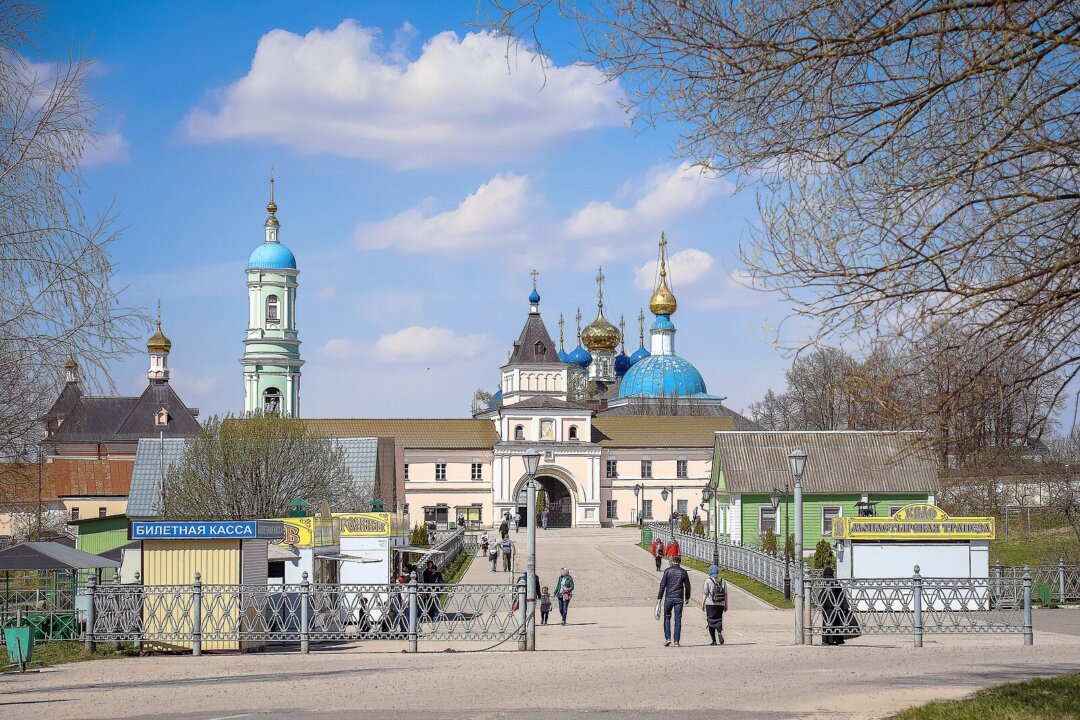 Tolstoy’s goal was Optina Pustyn, a monastery and common pilgrimage destination. (Svklimkin/CC BY-SA 4.0)
The pilgrimage wasn’t easy. Tolstoy had little food or water, and he suffered from awful blisters. Yet, as he engaged with ordinary people, the veil of privilege that had always hovered over him finally lifted. Walking had become a spiritual exercise, a way to cultivate discipline through self-imposed affliction. It allowed him to see that people were living meaningful lives despite abject poverty. He observed, “These people spent their lives at hard labor and were less dissatisfied with life than the wealthy.” They endured “sickness and tribulation without question or resistance—peacefully, and in the firm conviction that this is as it should be, cannot be otherwise, and is good,” he wrote. Although life on grand estates was infinitely easier, it completely lacked the sense of community that gave people purpose and true contentment.
Faith Renewed
At the end of this experience, Tolstoy came to believe that a religious community could thrive anywhere, with or without the official sanction of an institutional authority and the support of wealthy patrons. He distanced himself from the Russian Orthodox Church, believing that it had strayed too far from the original teachings of Jesus as articulated in the Christian Gospels. Yet he retained a staunch commitment to living a religious life.
Unlike the socialist thinkers he’d met in Western Europe, who denied God, reduced humanity to the body, and downplayed spirituality as a tool for political manipulation, Tolstoy thought that human beings are fundamentally religious, and that any community that seeks long-lasting autonomy must be grounded in a religious ethic. For Tolstoy and Christians like him, that ethic entailed, among other things, communicating with God through prayer and privileging the spirit over the body.
 Despite fluctuations in his faith, Tolstoy always returned to variations of Christianity. (Free-Photos/Pixabay)
In addition to disavowing organized religion, Tolstoy also vehemently opposed state authority and war. He took to heart the commandment to love one’s neighbor as oneself, and he became a champion of nonviolence. Again, these weren’t new commitments. But the pilgrimage gave him the conviction to finally make them integral parts of his private and social life. In “The Kingdom of God is Within You” (1894), Tolstoy shared a vision of a society built on nonviolence, compassion, and spiritual autonomy.
He wrote, “That this social order with its pauperism, famines, prisons, gallows, armies, and wars is necessary to society; that still greater disaster would ensue if this organization were destroyed; all this is said only by those who profit by this organization, while those who suffer from it—and they are ten times as numerous—think and say quite the contrary.”
His original combination of Christianity and avant-garde political philosophy made Tolstoy a target of the imperial court and the Russian Orthodox Church, which excommunicated him in 1901. Toward the end of his life, his mental stability faded and his inner turmoil returned. Aged 82, he fled from his home secretly on a cold winter night. He was suffering from ill health, and he died from pneumonia just a day later.
Tolstoy’s Reminder
Tolstoy was a Christian, but the value of his story is universal. When faced with a spiritual crisis, the troubled author didn’t limit his response to writing or intellectual contemplation. Those were essential, but he also believed that spiritual cultivation must involve active pursuits that involve the entire person: body, mind, and spirit.
 A portrait of Leo Tolstoy, 1873, by Ivan Kramskoi. Oil on canvas. Tretyakov Gallery, Moscow. (Public Domain)
During his pilgrimage, he wore threadbare sandals, walked with little food or water, and suffered willfully the hardships such a pilgrimage was bound to bring. He listened to men and women whose faith was simple but whole, unmarred by doubt and unencumbered by aristocratic conventions. Whatever the merits of his theological and philosophical commitments, Tolstoy reminds us that simplicity is often better suited to foster spiritual fulfillment.
What arts and culture topics would you like us to cover? Please email ideas or feedback to features@epochtimes.nyc