SEARCH


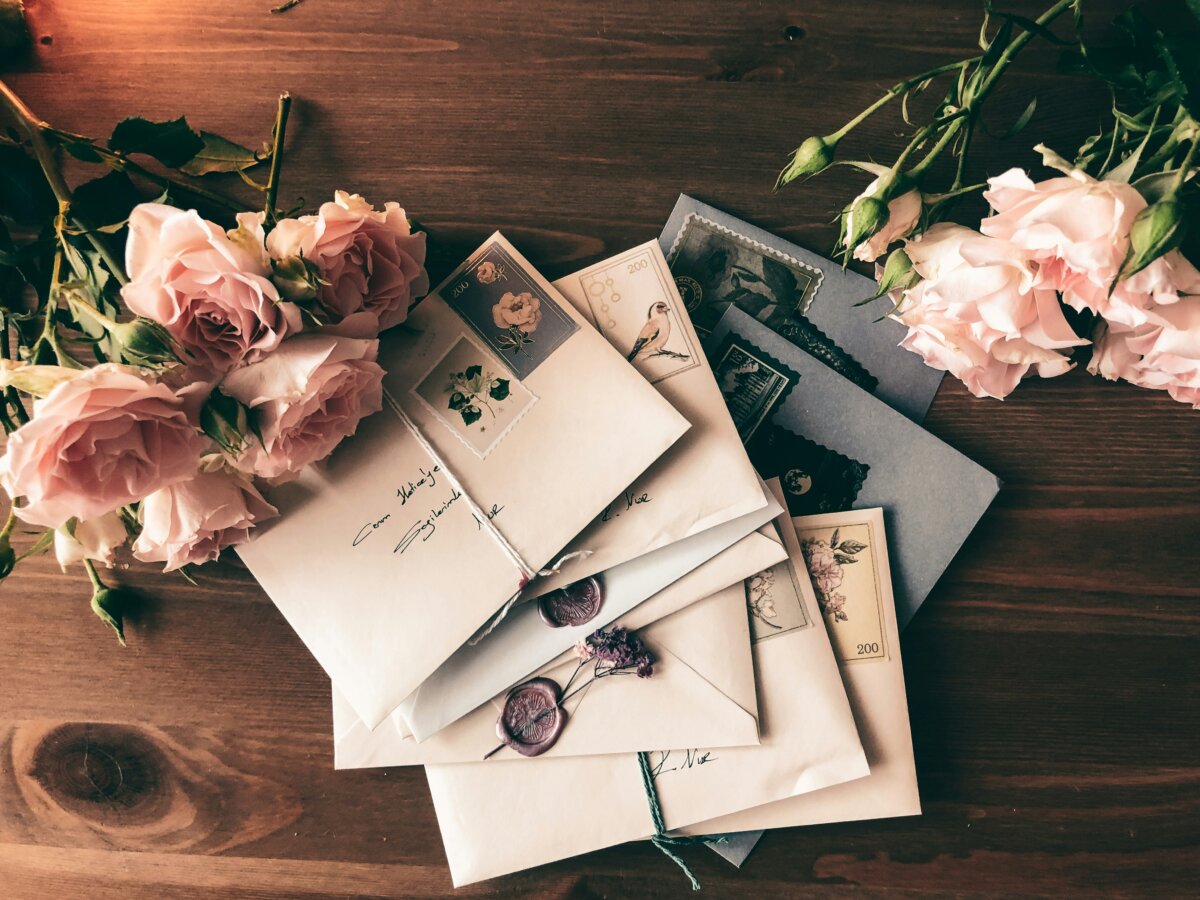
For years, the U.S. Postal Service operated a “dead letter office,” the repository for undeliverable mail and packages. These days, its official title is the Mail Recovery Center.
Ironically, when taken out of context, both terms come into play in regard to letter writing in the 21st century. Already in a downward spiral, from 2008 to 2023, the number of letters, postcards, and large envelopes sent through the mail declined by 50 percent, a decline that continues today. A 2021 poll revealed that 37 percent of Americans hadn’t written a personal letter in five years, while 15 percent of adults had never written a letter in their entire lives. The term “dead letters” these days might just as well apply to the art and practice of letter writing itself.
Meanwhile, some people are promoting the recovery of this little-practiced art, extolling the joys of paper, pen, stamp, and envelope, and the thrill of opening a mailbox to something other than advertisements and bills.
So let’s step up to the hospital bed and check out the condition of one of the world’s oldest forms of long-distance communication.
Vanishing Voices From the Past
In her article “Rediscovering the Lost Art of Letter Writing,” Morium Khan gives readers a brief history of letters, beginning with the first known mention of a letter, written by a Persian queen in 500 B.C. From there Khan quickly moves through history to the 18th and 19th centuries, when literacy and a standardized postal system made mailing a letter available to vast numbers of people. Khan’s reflections on letter writing include the enormous correspondence of World War II, when the sheer volume of letters and packages sent via ship posed serious logistical problems for the military.
Now, of course, those halcyon days of letters delivered by mail have vanished. The telegraph and then the telephone first chipped away at communication by post, but it’s texts and emails that almost overnight made a desert out of what was once an ocean of mailed correspondence. Ease, efficiency, and speed have won the day.
This break from a pen-and-paper past comes with an unseen cost. Material such as the John Adams–Thomas Jefferson correspondence and Abigail Adams’s thousand-plus letters, the musings of literary figures, and the casual drawings some artists penned along with their words will no longer be available to historians and biographers. The adolescent ruminations of some historically significant figures will vanish into the ether along with their emails. Once a gold mine for historians, the personal letter is now nearly extinct.
Their absence will have consequences. In their Introduction to “Letters of the Century: America 1990–1999,” for instance, editors Lisa Grunwald and Stephen J. Adler tell of an expectant mother who, in 1955, the day after Jonas Salk announced that he’d discovered a vaccine for polio, wrote to him expressing her deep gratitude mixed with relief and “an echo of recent pain.”
The editors then add: “The difference between knowing that Americans were grateful to Jonas Salk and reading this letter to him is like the difference between knowing the words of a song and hearing it sung. Letters give history a voice.”
Technology has silenced that voice. Before deciding to bid a final farewell to the handwritten letter, however, we might reflect on some of the benefits we’ll be losing.
Vitamins for the Brain
Researchers have discovered that writing by hand is cognitively healthier than typing on a keyboard. It enhances brain connectivity, in part because of the movement of the hand and the writer’s focus.
Professor Pamela Rutledge said, “The greater brain activity from handwriting compared to typing is thought to explain why handwritten notes are linked to increased learning among students.”
Some studies have also suggested that writing by hand, including letters, can help prevent or slow dementia.
By writing letters several times a week, we can incorporate this tool of memory and cognition into our daily lives.
Civility and the Complimentary Close
Many commentators and ordinary citizens have noted a steep decline in etiquette and civility in our new century.
This same trend holds true in our correspondence. Texts and even emails, often written in haste, can be a mess of misspellings, sloppy writing, and confused instructions. These are offenses not only against grammar and logic but also against manners. They signal that we’ve given little thought to the person we’re addressing.
The absence of a “complimentary close” in nearly all texts and many emails underlines this neglect. The complimentary close is that brief part of a letter or note just before our signature where we say our goodbyes, as in “Your loving daughter” or “All my best.” Judging by two textbooks in my possession—a 1914 “Essentials of English: First Book” and a 1962 “Voyages in English: 5”—students have long been taught the format of letters, including the use of the complimentary close.
Its frequent absence in emails is evidence of the sad triumph of expediency over etiquette. The handwritten note or letter reminds us to slow down a bit and mind our manners.
Romance
“Is romance dead?”
That’s a question frequently raised these days, particularly in podcasts and social media, and the answer is often yes. The affirmatives point to all sorts of reasons for the demise of romance, but they often leave out a key element: the love letter.
Love letters once came in all shapes and sizes, from a wrinkled homemade Valentine given by some fourth grader to the girl who captured his innocent heart to the passionate letter of a young woman writing to her Marine Corps fiancé somewhere in Vietnam and the husband who left a little note of love by the coffee pot for his wife, as my grandfather did on the day he died of heart failure in the barn two hours later.
In the arsenal of romantic gestures—flowers, phone calls, texts, little gifts—the love letter is the big gun, the heavy artillery that breaks through and wins the heart of the recipient. The handwritten declaration of love can be a work of art, however awkwardly done, a finger painting delivered to the heart.
To all of you looking for love: Instead of bemoaning the death of romance, be romantic. Start by writing a love letter.
Handheld and Heartfelt
Recently I’ve been going through several boxes of personal papers. Among the treasures and trash were a couple hundred letters, a few written by ancestors dating back to the Civil War, but most from my own life and days gone by. Here were letters from my mom and dad over the years, letters from friends dating all the way back to my college days, letters from my wife in our dating days, and letters and cards from children and grandchildren. Here too were letters I’d written to others and had photocopied before mailing.
These letters are more than just words, as they would be in an email. They’re physical recreations of love and dreams, of daily doings and big plans, my own and those of a score or more other people. When I hold in my hands the packet of letters from my dad, who was sometimes a bit distant from his children, I realize these letters were his acts of affection. A letter from my wife, dead now these 20 years, brings a smile of wonder that this woman so deeply loved me, for no reason I could ever discern. When I look over the letters I’d written to my parents from boarding school in the seventh and eighth grades, I laugh at their schoolboy prose and nonsense.
In the article mentioned earlier, Khan recounts the Roman myth of Acontius and Cydippe, during which Acontius attaches a letter professing his love for Cydippe to an apple and tosses it into a temple, where she picks it up. The scene is sweet, romantic, and humorous.
Khan then concludes her synopsis of this tale, “Letter writing is more than just a conversation, it is an act of love.”
It’s an act of love that, decades later, you can hold in your hands.