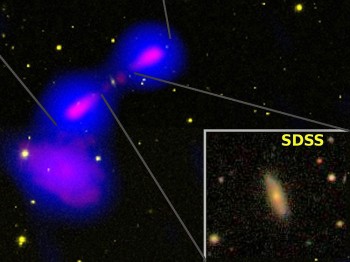

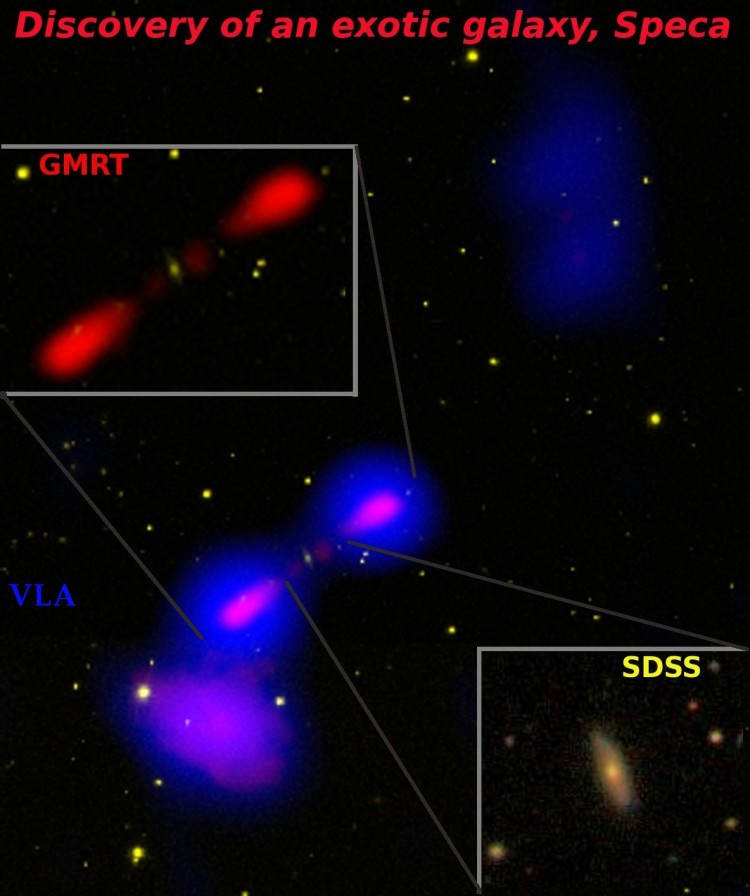
A peculiar galaxy called Speca, located in a galaxy cluster about 1.7 billion light-years away, is providing insights into what young galaxies and clusters probably looked like during our universe’s early history.
Speca (short for Spiral-host Episodic radio galaxy tracing Cluster Accretion) is the second known spiral galaxy found to be producing massive jets of subatomic particles at almost the speed of light. These jets emanate from a supermassive black hole at the galaxy’s center, but are usually only seen in elliptical galaxies.
An international team of researchers has been observing Speca using a variety of detectors to investigate the different wavelengths of radiation being emitted.
"This is probably the most exotic galaxy with a black hole ever seen,” said Ananda Hota at Taiwan’s Academia Sinica Institute of Astronomy and Astrophysics (ASIAA) in a press release.
“It has the potential to teach us new lessons about how galaxies and clusters of galaxies formed and developed into what we see today.”
Speca is showing evidence of various phenomena expected in the early history of the universe when galaxies would have been colliding with each other and accumulating material for star formation.
The array of data collected from across the electromagnetic spectrum has revealed three separate episodes of jet activity.
Large lobes of radio emission on the outside should have stopped producing energy, and are therefore providing information about the environment of the galaxy and its cluster.
"We think these old, relic lobes have been ‘re-lighted’ by shock waves from rapidly-moving material falling into the cluster of galaxies as the cluster continues to accrete matter," said Hota.
"All these phenomena combined in one galaxy make Speca and its neighbors a valuable laboratory for studying how galaxies and clusters evolved billions of years ago.”