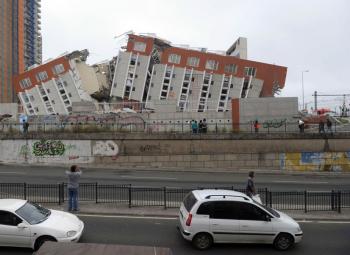

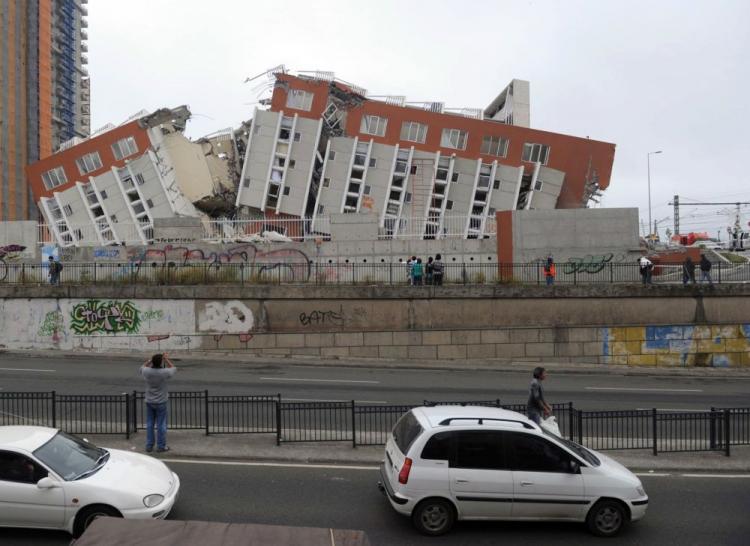
The quake epicenter was located about 200 miles southwest from the capital, Santiago de Chile. The hardest hit areas were the Maule and Bio Bio regions in the middle part of the narrow coastal country in South America. The Maule region has recorded 541 deaths so far with the city, Concepcion, in the Bio Bio region being the most affected. A 15-story building in Concepcion collapsed as soon as the earthquake began, and many other buildings caught fire.
Officials said up to 1.5 million buildings were damaged. Thousands of houses collapsed, and many roads and bridges were destroyed in the quake that is one of the strongest recorded in centuries. The quake also completely damaged historic centers of two cities in southern Chile.
According to local witnesses, the quake caused panic in many places, with people running out of their houses, crying and hugging each other with the joy of having survived the catastrophe.
The death toll is likely to rise, as some areas are disconnected with communication with local administration offices severed.
Rescue workers were busy Sunday trying to detect and reach people scattered in the rubble.
Police in Concepcion had to use water cannons and tear gas against looters who started to attack supermarkets, gas stations, pharmacies, and banks, local media reported.
Jacqueline Van Rysselberghe, the mayor of Concepción city, asked for the presence of military troops to re-establish order, claiming the situation was "chaotic." A curfew has been imposed on both the Maule and Bio Bio regions.
The Chilean government since reached an agreement with supermarkets to distribute free food and water to the affected areas.
After the main quake, about 90 other aftershocks followed of magnitude 5.0 or greater, with one being almost as powerful as the one in Haiti on Jan. 12, which killed more than 230,000 people.
The earthquake also produced tsunamis across the Pacific, causing several casualties on a Chilean island. Hundreds of thousands people were evacuated after tsunami warnings were issued in 53 countries, but little damage was recorded outside of Chile. The tsunami alerts were lifted on Sunday.
Many countries have expressed condolences to the Chilean people and offered assistance and aid.
The Chilean earthquake is the seventh strongest quake ever recorded. The most powerful quake was estimated at magnitude 9.5, also in Chile, about 120 miles south of the current one on May 22, 1960.
Eqecat, a U.S. company specializing in catastrophe risk modeling, estimated the total economic damage of the earthquake to be in the range of $15 billion to $30 billion, with more than 50 percent of the damage in the state of Santiago.
“Chile's widespread adoption and enforcement of modern, seismic-resistant building practices has mitigated the potential for devastation,” Eqecat said in their preliminary statement about the event.
With additional reporting by Carolos Morales.