
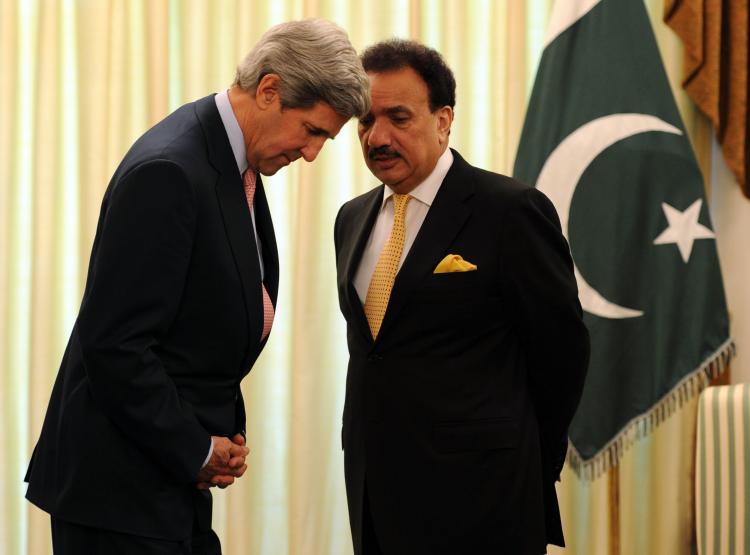
Kerry’s May 16 visit to Islamabad, Pakistan, marked the first major discussion with Pakistani officials since the May 1 mission that killed Osama bin Laden in nearby Abbottabad. Kerry met with leading officials including President Zardari, Prime Minister Gilani, and Gen. Pasha.
In the press conference just following the meetings, Kerry stated, “We’ve agreed on a specific series of steps that will be implemented immediately in order to get the relationship on track,” according to a Senate Committee on Foreign Relations transcript.
The meeting was part of “initial steps” to get relations back on track, according to Kerry, and additional meetings will be held with Pakistani officials soon “to work on the details of implementing and building on the initial steps of today.”
U.S. relations with Pakistan became tense following the secret mission that killed bin Laden—which was launched without knowledge of Pakistani officials. It also compounded on anti-American sentiments that flared up after CIA contractor Raymond Davis shot and killed two Pakistani men he claimed tried to rob him on Jan. 27.
The final location of bin Laden, meanwhile, fed standing suspicion that elements of the Pakistani military or government were colluding with al-Qaeda. Bin Laden’s secret hideout was right next to one of the country’s leading military academies, and situated near two Pakistani military bases.
“The entire episode exposes either complicity or incompetence by Pakistan’s military, especially its security forces,” states a report from the Center for Strategic & International Studies (CSIS), summarizing statements made by former Pakistani President Pervez Musharraf.
At least two leaked intelligence reports—one released by WikiLeaks on U.S. knowledge and another originating from a British Defense Ministry think tank—state government knowledge of Pakistan’s intelligence body, the Inter-Services Intelligence (ISI), working with or supporting terrorist groups. It was also common knowledge among experts that some extremist groups, such as the Haqqani network, enjoy relative safety within Pakistan.
Collusion with the al-Qaeda leader, however, would be a step too far for some. Kerry stated he informed Pakistani officials of discussion in Congress to cease U.S. funding to Pakistan.
Read More…United States gave more than $20 billion to Pakistan