
PIRAEUS, Greece—As Annika Barbarigos looked over the edge of the ferry gliding through the narrow Strait of Salamis, her mind was not on the battle that, in these same waters, helped ensure the rise of Western civilization more than 2,500 years ago.
She was still deeply aggrieved at the sight of a monumental wooden boat—“just a carcass now!”—that sat rotting portside as the ferry left the harbor.
As all Greeks, Barbarigos learned about the Battle of Salamis in elementary school.
After Persian invaders sacked and burned Athens in 480 B.C., Greeks were outnumbered at least two to one on the water. A cunning general, Themistocles, lured the enemy into the shallow straits between Attica and the island of Salamina, where his bronze-rammed ships outmaneuvered and ultimately clobbered King Xerxes’s fleet.
But first, Themistocles had to convince Athenians that a prophecy from the Oracle at Delphi promising a “wooden wall” that would protect them referred, not to one built around the citadel but to the wooden hulls of its navy’s fleet.
Today, Salamina is home to one of the last remaining boatyards that builds traditional wooden boats—a Greek art that spans thousands of years, from the early Bronze Age, Themistocles’s triremes, and the Byzantine dromon to the small wooden fishing boats that developed over centuries into the living symbol of Greek island life: the kaikia.
At the end of that long arc, there are but a handful of remaining craftsmen who make and repair traditional wooden boats, having learned from their fathers and grandfathers how to work from memory and sight alone.
Starting in the 1980s, the European Economic Community began incentivizing destruction of kaikia in an effort to curb environmental impacts of overfishing in the Mediterranean. Harsher mandates followed in the 1990s under the European Union, giving fishermen a choice: Sink the boat and make it a reef; relegate it to a museum; or smash it to bits. The latter option offered by far the highest compensation.
More than 13,500 kaikia, the vast majority of the country’s existing fleet, were demolished under this directive, according to the Traditional Boat Association of Greece.
Barbarigos began documenting the demolition in 2012.
“It was incredibly painful; I could only stand it by photographing it,” said the former art dealer, who routinely refers to the boats as living beings.
Witnessing their decline and preserving what’s left of the craft has become a crusade.
“You have to be crazy to care about these boats,” said Barbarigos, who runs a sailing charter company and serves as the Traditional Boat Association of Greece’s secretary-general.
The preservation work, she said, is “what I do with the money I make.”
At first glance, this may seem like a niche maritime passion, or a stubborn attachment to the past.
But the fate of kaikia in Greece reveals broader truths about human culture in the digital age, the impacts of globalization, and how preservationists across the world are responding.
It is a bitter irony that the country’s once plentiful and enduring wooden kaikia, eliminated in the name of ecological preservation, have been replaced in the last two decades by plastic and fiberglass boats which can’t be recycled and rely on a global supply chain overwhelmingly controlled by China.
Like so many other crafts remitted through human relationships across time, traditional boatbuilding is a fading remnant of pre-information-age culture. It represents an ancient mode of transmission and creation fundamentally at odds with the disposability and simulation of the present.
For Barbarigos, first and foremost, kaikia are works of art.
“They’re beautiful. And it’s a very ancient shape, built for the waves of the sea around here. It’s a kind of hull shape that’s ideal for traveling in these waters,” she said, referring to the boats’ broad, elegant curves and the short waves typical of the Mediterranean.
“Sadly,” she said, “It’s a dying art.”
‘The Craftsman’s Soul’
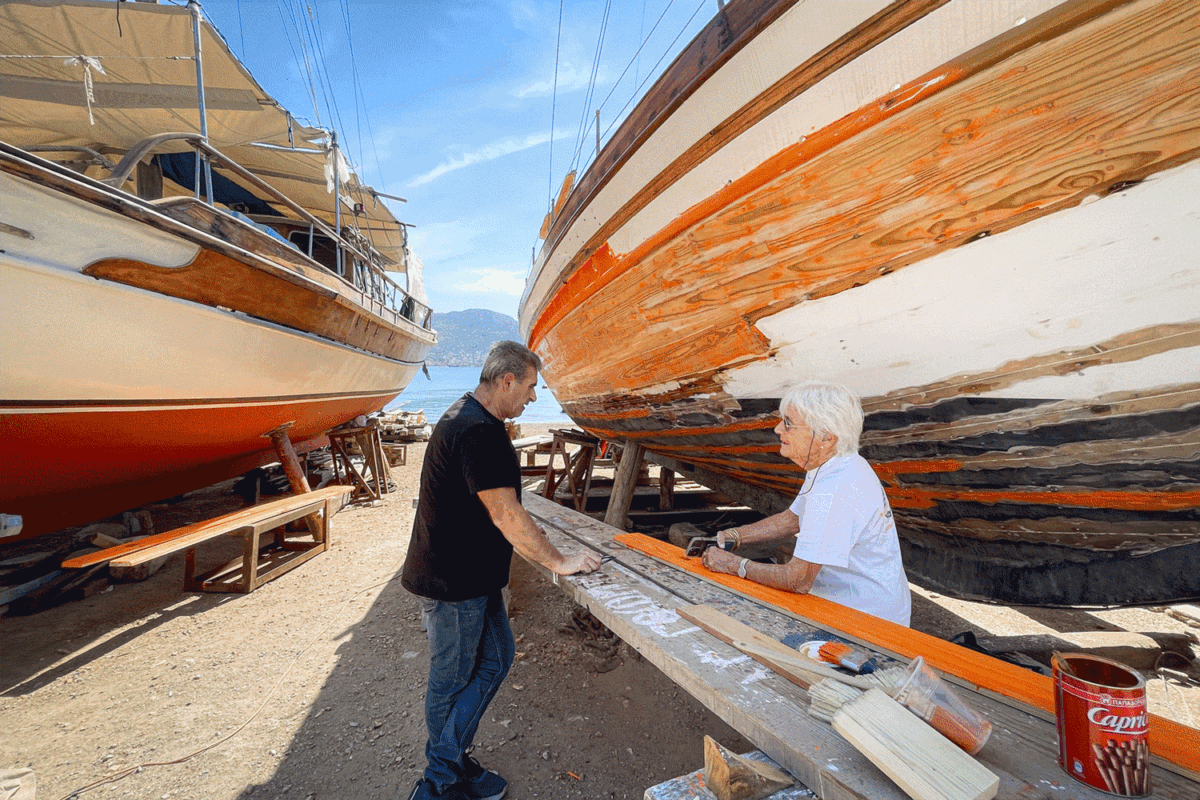
On Salamina, just a short ferry ride from the port of Perama outside Athens, Yiannis Prasinos is one of a handful of craftsmen who still make and repair traditional kaikia, continuing a shop his grandfather began here more than a century ago.
The rhythmic, hyper-local nature of the craft, refined over thousands of years of seafaring in these waters, was an almost esoteric endeavor. It involved harvesting indigenous timber at specific times of the year and moon cycle and treating the wood in saltwater to ensure its longevity.
“We cut the wood and we put it in the sea, maybe one or two months,” Prasinos said, standing alongside a repair job, its exposed skeleton painted with the telltale neon orange sealer used in kaikia construction. “All this time the wood is drinking the seawater, the salt, which kills the worms inside.”
Yiannis Prasinos, boatbuilder
He pointed to a Turkish gulet in the shipyard in lamentable shape.
“These ones, they just cut the wood and build it the same day. They’re not built to last, they’re built to work quickly.”
Properly maintained, kaikia can last a century or more and be endlessly restored, traditional craftsmen told The Epoch Times. This is a stark contrast with plastic and fiberglass fishing boats, which typically endure a fraction of that in salt water and are difficult to repair once cracked.
And, unlike contemporary boats, which are computer modeled or made from assembly-line molds, traditional wooden boats in Greece were crafted with techniques that were never standardized, but developed as proprietary secrets that varied from family to family and passed down through direct experience and oral tradition.
“You use the old lines, the traditional shapes. And tradition prohibited replication—we must destroy the model after it’s done,” Prasinos said. “Every boat in Greece before 1980—it’s unique. They’re all custom.”
He pulled an old model of his father’s he keeps as a memento down from a rafter in his sawdust-covered workshop and laid it out to demonstrate the monochnaro method in which builders use an adjustable template of three pieces to outline the boat’s frame, starting with the midsection.
The method, documented in Venetian manuscripts from the 15th to 17th centuries and discovered in Byzantine wrecks in the eastern Aegean, was a key to the secret art as it passed down from father to son, according to the Museum of Aegean Boatbuilding and Maritime Crafts.
Yiannis Prasinos, boatbuilder
“One could say they are the craftsman’s soul,” Manolis Zorzos, a shipbuilder on the island of Syros, said of the three pieces of wood used in the monochnaro method in a 2022 video portrait by Archipelago Network, a nonprofit foundation that documents and archives cultural traditions of the Cyclades islands.
Other approaches include creating a small model which is then scaled up to full size, or designing the boat without any model at all.
For larger boats, craftsmen developed a more precise method, incorporating skills learned in Ottoman and Venetian shipyards to create a “lofting” method, in which they draft the boat’s curved lines on a 1:1 scale and then create molds to cut the timber.
Makis Mavrikos, a fourth-generation boatbuilder on the island of Syros, described the precision and skill required for the latter method in an Archipelago Network video.
“Of course it was a guarded secret, and it was not taught,” Mavrikos said. “It was very rare for one to learn the secrets which were guarded by the old craftsmen.”
It was also the “surest” and most modern approach to boatbuilding, he added, in which craftsmen are striving to achieve the “ideal hydrostatic state, which is a water droplet.” Each family or workshop has their own way of doing it.
Manolis Zorzos, boatbuilder
As Prasinos condensed 100 years of generational knowledge into an afternoon tour of his shipyard, he said, “All that I tell you, I know from my grandfather and my father.”
Now he and the remaining craftsmen of his generation mostly do repairs and cleaning, or build small-scale models.
Rising costs, regulations, and waning demand has dried up business almost entirely.
‘A Living Organism’
Near the end of a slender boatyard that runs along the eastern side of the Greek island of Corfu, in the Ionian Sea, Konstantinos Avgerinos was up a ladder, tinkering away on an old kaiki.
Behind him, mega cruise ships towered over the port, and a few shafts of sunlight punched through the heavy canopy of clouds.
“There are no craftsmen now. It’s me and two others who work with wood,” Avgerinos told The Epoch Times.
“I loved this work. I’ve been at it since the fourth grade,” he said, recounting how he would come straight to the shipyard with his father after school.
“It’s difficult. Not everyone can just go and do it. It’s a passion and a way of working,” he said.
Avgerinos said most wooden boats you’ll find now are from before 1970, after which the European directive and the 2009 financial crisis decimated the existing fleet and all but eliminated new construction.
“To build these boats, you need a lot of love, and a lot of fatigue,” he said. “The good thing about building it is when you launch it in the water and your heart tells you that you’ve built one.”
Likewise, when a vessel is destroyed, he said, “if you know what you went through to build it, and to keep it, your heart breaks.”
“They are built from memory and based on technique and how each person wants it.”
Perhaps for a fisherman, he might make the stern more curved, or raise the bow, while a tourist boat might require a higher waterline.
“There is more of a connection with wooden boatbuilding. You can’t leave it in the sea for more than a year. It’s a living organism. You have to take it out, put it in. … And it’s got a better buoyancy and better design than the plastic boats.”
Avgerinos pointed northeast, toward an area of Corfu where they used to harvest pine, eucalyptus, and elm for different parts of the kaikia.
He recalls a boat he was working on recently, built 97 years ago. Its ribs were made of “crooked timber,” the term shipbuilders use for wood taken from naturally curving trees.
“It was cut by hand. It’s unbelievable,” he said. “It’s something else to work with this, to take a trunk from the forest and fit it into a boat.”
Craftsmen like Avgerinos and Prasinos used to work daily on new builds. Now, their time is taken up by maintenance, storage, and cleaning, and their future is uncertain.
“It’s finished, close the door,” Prasinos said. “I believe the next generation doesn’t know how to use the wood to close a hole, let alone build a boat.”
His son Dimitrios began learning the trade early but ultimately left to pursue other ventures. Today he buys and sells vintage motorcycles.
“The Greek traditional boats have already vanished, in my opinion,” Dimitrios said. “If someone builds the boat now, they won’t build it like before, they’ll build it to modern specs.”
Asked if he feels guilty for leaving the family business, he said, “I’m trying to be realistic. I don’t want to do something that will take me back. If I have the economic ability, I will help.”
Dimitrios said he doesn’t think anyone can really learn now.
“My father learned by building 20 boats per year and doing 50 repairs. Now it’s one per 10 years,” he said.
“My grandfather would look at the plank to change it, just by eyesight. He didn’t measure. And he didn’t know how to spell his own name,” Dimitrius said. “But he was a great boatbuilder.”
Cultural Heritage
In its current form, the kaiki is a totem of the 19th and 20th centuries. But as organizers of the Museum of Aegean Boatbuilding and Maritime Crafts point out, it is also “the last link in a centuries-long tradition that evolved gradually, assimilating the most recent technical advances which it borrowed from other regions, at least from the Middle Ages.”
Kostas Damianidis, an expert in vernacular boatbuilding and scientific director at the museum, told The Epoch Times that the evolution of wooden boats over the centuries for various uses—from sponge diving to fishing to piracy—left their mark.
“They had their influence on the shape and the propulsion of the boats. So they are parts of the heritage of this tradition,” he said.
For hundreds of years, Greek fishermen have used small kaikia to supply local tavernas with the freshest daily seafood.
In a tiny marina on the island of Aegina, many local fishermen still use small, well-maintained wooden boats, heading out each morning between four and eight.
Whatever they bring in is what fish tavernas lined along the marina will serve that day. Local restaurants prefer to buy from small boats rather than large trawlers, they told us, because they offer better quality catch from around the islands.
“We buy it here because it comes from our local area,” said a restaurant owner, pointing to the wooden boats docked less than 20 feet away. “The products are very fresh and delicious.”
Europe’s culling of small wooden fishing boats during broader efforts to reduce overall fleet size, critics contend, was misguided at best. It hastened what might have been a gradual decline due to pressures of modernization and globalization and did little to solve the environmental conundrum.
Overfishing in the Mediterranean, which intensified in the 1970s, has been driven more by commercial trawlers than small fishing boats. Trawlers and beam trawlers currently account for 17.4 percent of “landings,” or the catch brought ashore, in the Mediterranean and Black Seas, and are widely recognized as the most destructive culprit in ecological degradation in the region, along with plastic waste.
For preservationists and enthusiasts, destruction of Greek kaikia is not just about the boats, but the loss of an intangible heritage.
The government has been little help, Barbarigos said.
“It’s very frustrating because we have been going to the relevant ministry, and the government showed absolutely zero sensitivity to the issue. The only people who listened were the journalists.”
Meanwhile, while the laws haven’t changed, Barbarigos said destruction of kaikia has slowed.
“Is it because of a lack of money? Is it because they listened and slowed down? We don’t know,” she said.
‘An Antidote to the Future’
Avgerinos is facing imminent eviction as the government prepares to clear the shipyard where his workshop has been for more than four decades.
The plan, he said, is to relocate the yards on the other side of the bay, next to a municipal waste treatment plant.
“Everyone is getting pushed out. It’s a dying art. It’s very difficult to incentivize it, and now there’s nowhere for them to go, nowhere for these boats to be.”
Prasinos lamented that, aside from the few models he kept, there is no archive of his father’s work.
In 2021, Archipelago Network, a nonprofit organization, began doing just that—archiving audiovisual materials related to traditional boatbuilding, and documenting the remaining craftsmen in video portraits.
What began as a project focused on the historic shipyards of Syros, a historical epicenter of boatbuilding in Greece, soon expanded to other islands in the Cyclades archipelago.
Jacob Moe, the enterprising American expat behind the project, recounts a deep curiosity with Syros’s shipyards, inflected with early experiences working on boats with his grandfather in the United States.
Konstantinos Avgerinos, boatbuilder
He sees kaikia not as standalone artifacts, but as a living lineage of the millennia-long history of the craft, and the ways it is embedded in cultural, social, and economic life.
“Obviously, Greece has a huge maritime history. And if you think about where that history began and these steamships and the cargo ships of today that are navigating around Hormuz and other geopolitical obstacles, that all began from wooden ships on the Greek islands,” he told The Epoch Times.
While Archipelago Network focuses on documenting and archiving, Moe is thinking about what will be needed to actually reinvigorate the craft and propel it into the future.
“We are actively preserving that kind of audiovisual and photographic record, but the next step is very much around defining new innovative construction methods and economic models that allow wooden boatbuilding to evolve,” he said.
A new technical school at the Museum of Aegean Boatbuilding is hoping to do the same by preparing the next generation of craftsmen and reimagining artisanal boatbuilding in the 21st century.
The school will be under the aegis of the ministries of culture and education and run in conjunction with the museum, said Damianidis; he expects both to be open to the public soon.
While the museum is dedicated to preservation, the school, he said, will incorporate modern methods with traditional ones, like the use of non-electric hand tools that craftsmen have long used to achieve the elegant lines on a kaiki.
“We try to reuse and rethink traditional forms, but not necessarily with traditional techniques, because nowadays I don’t know how much we can use the traditional way of boatbuilding,” Damianidis said.
The trade won’t attract young people if it offers 20th or 19th century working conditions, he added, “so they will use some digital aids, for example.”
Some boatbuilders are skeptical.
“There’s a gap between theory and practice,” said Avgerinos. “It’s completely different, the theory you learn in school to the practice you learn in the shipyard.”
But Damianidis said they are trying to bridge that gap both with a hands-on approach—70 percent of the curriculum will be practice—and post-graduate internships with local boatyards.
Part of the key to reviving the artisanal craft, Damianidis said, is to make the boats affordable again, including by incorporating more contemporary materials and techniques.
“I hope this kind of approach with respect to the tradition and the heritage will be a good idea to save the trades—to give a new impetus,” Damianidis said.
He likens it to what’s happened in residential construction on many Greek islands.
“Most of the houses built are traditional forms—OK, with newer materials, but they respect the forms. We’re trying to do something similar in boatbuilding.”
For Moe, environmental concerns also inform the drive to replenish Greece’s fleet of wooden boats.
“These fiberglass and other kinds of plastic boats are some of the least sustainable things. They’re non-recyclable, they’re not biodegradable. … They have a useful life of between five and 10 years, sometimes less if you’re talking about a kind of touristic charter where people always want the latest models,” Moe said.
The best chance for artisanal boatbuilding to survive, he thinks, is a “market-oriented” and “entrepreneurial” approach; essentially a for-profit endeavor—an idea still in the conceptual phase, he acknowledges.
Moe doesn’t have exact answers about how the boats will look or function, or how international best practices can be applied within the Greek tradition.
But he knows it has to happen to save the history he has so meticulously documented.
“This is a moment of geopolitical transition, and from a technical perspective, there’s a kind of flattening—the result of all these technical innovations and market integrations is that a lot of the world is in communication, and there’s the locality and diversity of place that starts to be smoothed out,” he said.
Deeply rooted traditions like boatbuilding, he said, can be a key to understanding our future.
“To not sacrifice heritage and history in the name of this smooth and efficient and sort of all-encompassing idea of the future … there’s a direct relation between these more embodied practices that involve real communities, and physical places and materials, and then this other vision of the future that is very digital-first and artificial intelligence-first,” Moe said.
“I think that within these crafts and practices, we may have a kind of antidote to that.”