
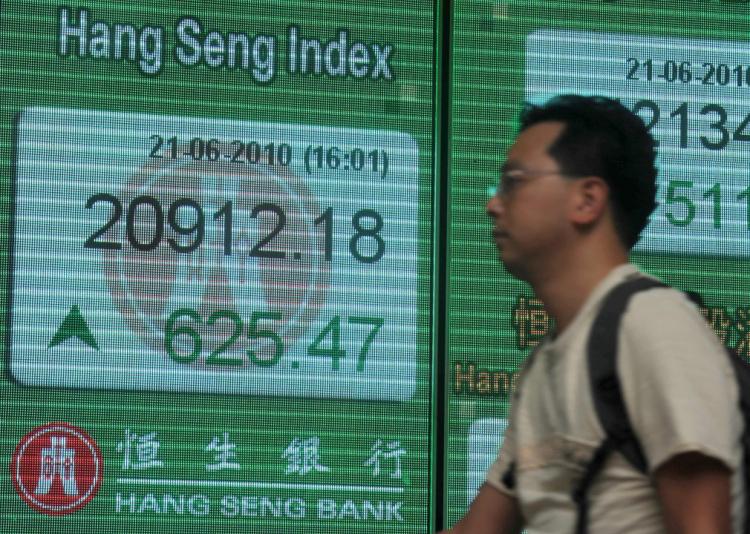
The move reverses the yuan’s peg to the dollar, instituted more than two years ago to protect China’s exporters during the global financial crisis. A stronger yuan could help curb inflationary pressure on the Chinese economy.
The yuan’s appreciation of more than 0.4 percent against the dollar on Monday is good news for U.S. and European exporters as foreign goods will become cheaper to both Chinese consumers as well as relative to Chinese exports in all major markets.
“Assuming a moderate appreciation (say 5 percent in the next 12 months) in the next few years, sectors such as airlines, banks, insurance, consumer, telecoms, coal, and cement could benefit either because of revenue/cost mismatch or earnings translation,” Credit Suisse wrote in an equity research note on Monday.
Credit Suisse analyst Andrew Garthwaite noted that the last time yuan was let floating in 2005, the currency appreciated 2 percent immediately and 20 percent over the next three years against the U.S. dollar.
European stocks on Monday were higher for the ninth consecutive trading session, with mining and energy companies—China is the world’s largest copper and second-largest oil importer—leading the way. Miners BHP Billiton and Rio Tinto both gained more than 4 percent, while Royal Dutch Shell Plc gained 1.4 percent on the London Stock Exchange.
The FTSE 100 Index in London increased 0.92 percent, while the DAX Index in Frankfurt gained 1.22 percent in Monday trading. Stocks in France (CAC 40) also increased by 1.33 percent.
Shares in Tokyo settled close to one-month highs on Monday, with the Nikkei 225 Index gaining 250 points to its highest level since May 18.
The yuan’s revaluation is considered a win for almost all foreign companies in a multitude of industries.
Globally, shares of automobile manufacturers jumped on the currency revaluation. BMW AG’s stock gained 2.7 percent in Frankfurt, while Nissan rose 2.8 percent. China is one of the world’s fastest-growing auto markets and a stronger yuan makes imports cheaper. Foreign-based makers of electronics, high-technology products, and heavy machinery/equipment could also benefit.
One industry which could suffer, according to analysts, is the garment industry, which purchases materials and inputs from Chinese firms. A stronger yuan would likely increase production, material, and labor costs for firms with extensive manufacturing facilities in China.
But in the United States, stock markets jumped at the beginning of the trading day only to run out of steam and stumbled toward the finish line as investors weighed the effects of a strong yuan on U.S. treasuries.
China’s insistence on pegging the yuan to the dollar in the past meant that it must buy large quantities of U.S. treasuries—to keep the market flooded with yuan and buy up dollar-denominated assets.
The Dow closed down 8 points after being up by more than 140 points earlier in the day. The S&P 500 index closed 4 points lower, while the Nasdaq Composite was off 20.7 points on Monday.
With more flexibility on the yuan, some traders felt that China would need fewer U.S. treasuries—pushing up interest rates and possibly derailing U.S. economic recovery.