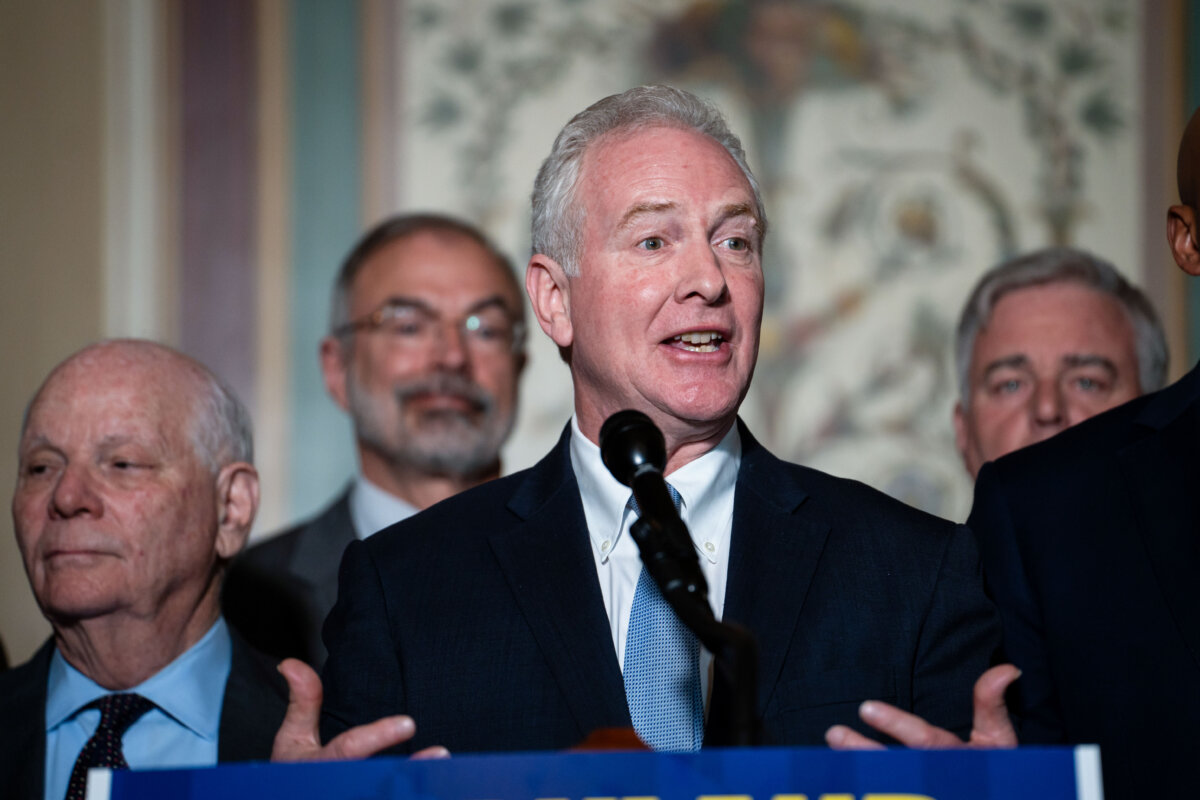

Sen. Chris Van Hollen (D-Md.) said this week that he would challenge Senate Minority Leader Chuck Schumer (D-N.Y.) to lead the Senate next year, throwing him onto the front lines of the burgeoning war in the Democratic Party between establishment-favoring moderates and the anti-establishment—and often, young—progressive wing of the party.
“In this election, Americans called on us to unrig an economy rigged against working people [and] fueled by political corruption,” Van Hollen wrote in a Nov. 13 post on X. “To deliver, we need new leadership. This isn’t about any one person – it’s about answering that call. That’s why I’m running for Senate Majority Leader.”
Van Hollen is relatively little-known outside of Washington, with a complex political history and role in the ideological divisions shaking Democrats.
Once a protégé of former Speaker of the House Nancy Pelosi (D-Calif.), Van Hollen is now the preferred choice of key progressives like Sens. Bernie Sanders (I-Vt.) Jeff Merkley (D-Ore.), and Sens.-elect Abdul El-Sayed (D-Mich.) and Peggy Flanagan (D-Minn.).
Here’s what to know about the Maryland Democrat.
Van Hollen began his legislative career in the mid 1980s as a staffer for former Sen. Charles “Mac” Mathias (R-Md.).
Mathias was ideologically aligned with the liberal wing of the 20th-century Republican Party, often clashing with more conservative members and opposing President Ronald Reagan’s influence on the party.
During his time working for Mathias, Van Hollen was completing a law degree at Georgetown University.
After Mathias left Congress in 1987, Van Hollen served on the staff of the Senate Foreign Relations Committee. He was admitted to the Maryland bar in 1990.
Between 1991 and 2003, Van Hollen served in the Maryland General Assembly, having been elected to the House of Delegates in 1990 before mounting a successful bid for the state Senate in 1994.
While in the state Senate, Van Hollen led efforts to raise the tobacco tax, ban Chesapeake Bay oil drilling, and increase state funding for education and healthcare.
In 2002, Van Hollen was elected to the U.S. House of Representatives, where he would gradually draw Pelosi’s attention.
In 2007, after Democrats’ sweeping victories in the 2006 midterms, Pelosi tapped Van Hollen to lead the Democratic Congressional Campaign Committee (DCCC), House Democrats’ campaigning arm.
He led the DCCC to more wins in the 2008 U.S. elections and led the defense during the tough 2010 campaign season, which saw major wins for Republicans amid the then-growing Tea Party movement.
After he left the post, Van Hollen served as the top Democrat on the House Budget Committee, where he sparred with then-Budget Committee Chairman Paul Ryan (R-Wis.).
In 2016, Van Hollen won Democrats’ nomination for U.S. Senate after longtime Sen. Barbara Mikulski (D-Md.) announced her retirement.
Van Hollen, backed by establishment heavyweights such as then-Senate Minority Leader Harry Reid (D-Nev.), faced a tough challenge from Rep. Donna Edwards (D-Md.) in a race that was seen by some as a microcosm of the ideological conflict between Sanders and former Secretary of State Hillary Clinton.
Edwards ran as a progressive outsider, echoing Sanders’ populist approach in his 2016 campaign. Van Hollen ran on his legislative record and establishment credentials.
Van Hollen ultimately won 53.2 percent of the vote to Edwards’s 38.9 percent.
When he first entered the Senate, Van Hollen took over as chair of the Democratic Senatorial Campaign Committee, roughly reprising his previous role in the House. Van Hollen served in the post between 2017 and 2019.
Since then, Van Hollen has increasingly drifted toward progressive positions, partly reflecting his Maryland constituents’ leftward shift during the Trump era.
He co-sponsored legislation introduced by Sanders to institute Medicare for All in the United States.
Van Hollen has led efforts to condition U.S. military aid to Israel on compliance with international law, breaking with the Washington mainstream of unconditional support for the Middle Eastern state.
When Democrats last held the Senate, Van Hollen also backed the progressive push to abolish the filibuster. Since entering the race for leadership, Van Hollen has said he remains opposed to the practice and would seek to abolish it if elected leader.
Schumer—seen as representing the more establishment wing of the Democratic Party—has expressed high confidence that he’ll be reelected for another term after the secret ballot vote Democrats will hold in December. To win the ballot, a candidate needs the support of a majority of the Senate Democrats who will serve in the 120th Congress.
“The issue is not me. I’ll be reelected as majority leader. But the issue is focusing on the American people and what they want,” Schumer said at a press conference.
Democrats in both chambers have reported receiving calls urging them to oppose Schumer and House Minority Leader Hakeem Jeffries (D-N.Y.), the heirs apparent for leadership roles in both chambers.
Several incoming Democratic senators—including Sens.-elect Annie Andrews (D-S.C.) and Adam Hamilton (D-Kansas)—have said they won’t support Schumer.
Andrews hasn’t endorsed Van Hollen, but she told Fox News in an interview that it was “time for a generational change on both sides of the aisle.”
Sen.-elect James Talarico (D-Texas) said he’s still deciding who to vote for.
“I’m going to meet with every candidate for any leadership position. … I’m going to ask tough questions,” Talarico said in an interview with CBS News.
Currently, this puts those openly opposed to Schumer in the minority.
—Joseph Lord
BOOKMARKS
President Donald Trump on Nov. 15 said Congress needs to provide more funding to the Federal Aviation Administration following an outage on Nov. 13 that snarled airline traffic over the weekend. “If Congress approves the desperately needed money for Air Traffic Control, we can get it built quickly and efficiently,” Trump said in a post on Truth Social. “It will be the BEST SYSTEM anywhere in the World. Much of our current air control system is 50 years old – RIDICULOUS!”
The shortcuts behind China’s auto manufacturing methods—which favor speed—are starting to show. Snapped brakes, failing axles, and skipped testing: Even the communist regime admits the problem.
Self-exiled Brazilian presidential candidate Flávio Bolsonaro said he plans to seek permanent residency in the United States, claiming concerns about political persecution if he returns to his home country. The Brazilian lawmaker is under investigation for alleged corruption, money laundering, tax evasion, and foreign-exchange violations and fled Brazil after losing last month’s presidential runoff.
A federal judge on Nov. 14 temporarily blocked the Trump administration from closing East Potomac Park and its historic public golf course in Washington. U.S. District Judge Ana C. Reyes issued the temporary restraining order a day before the scheduled Nov. 15 shutdown, noting that the National Park Service (NPS) cited safety concerns and the loss of the course operator as reasons to close the course and park area. Reyes said the NPS didn’t mention that Trump plans to redesign the course.