
Sponsored Content | Presented by LivDry
According to the National Institute of Diabetes and Digestive and Kidney Diseases, approximately half of women experience urinary incontinence. Yet even people using highly absorbent products can struggle with leaks, disrupted sleep, and irritated skin.
We asked Brooke Schmidt, RN, a geriatric nurse with more than 14 years of experience, to answer seven common questions about bladder leakage and share lessons from caring for older adults.
1. Why does my adult diaper leak even when it’s highly absorbent?
Brooke: Absorbency is only part of the equation. A product can hold substantial amounts of urine and still leak if it doesn’t fit properly, isn’t positioned correctly, or can’t absorb urine quickly enough during a sudden, heavy release.
I once worked with a plus-size patient whose incontinence underwear was the correct size, but the leg openings were getting caught in skin folds. Because the absorbent area wasn’t positioned properly, urine escaped before the product could capture it.
Before assuming you need more absorbency, check the fit, leg openings, and placement. You also want to make sure the product is appropriate for the amount of leakage you’re experiencing.
 Measuring according to a manufacturer’s sizing guide can help prevent gaps around the waist and legs that contribute to leakage. (AI-generated image; illustrative measurement)
2. Will wearing larger-sized incontinence underwear prevent leaks?
Brooke: Not necessarily. I’ve seen the opposite happen.
One patient experiencing nighttime leakage tried moving up a size, only to have even more accidents. After taking measurements, I discovered the original product was already too large. Sizing down helped resolve the problem.
A larger size doesn’t automatically mean greater absorbency. It may create gaps around the legs or waist that allow urine to escape.
I always recommend measuring your waist or hips according to the manufacturer’s sizing guide. This is particularly important for plus-size products, where body shape and leg fit can be just as important as waist measurements.
3. What’s the best protection for heavy bladder leakage overnight?
Brooke: Nighttime incontinence presents different challenges from occasional daytime drips. You may release a large amount of urine at once, change sleeping positions, or remain asleep long enough for a product to become saturated.
For heavier nighttime incontinence, I recommend considering high-absorbency protective underwear or adjustable tabbed briefs. The right choice depends on how much urine you’re losing, your mobility, and whether you can change independently.
A properly fitted overnight incontinence product, a consistent bedtime toileting routine, and a disposable bed pad can help reduce disruptions. Even high-capacity products need to be changed when wet or soiled.
4. Can I put an extra pad inside an adult diaper for more absorbency?
Brooke: Yes, but the type of pad matters enormously.
I’ve encountered caregivers placing ordinary incontinence pads inside pull-ups, then adding another brief over everything. It sounds like extra protection, but many pads have waterproof backing that prevents urine from reaching the absorbent product underneath.
The result can be overflowing urine, trapped moisture, and irritated skin.
A flow-through booster pad works differently. It’s designed to sit inside compatible protective underwear or a tabbed brief, absorb additional liquid, and allow excess moisture to pass into the outer absorbent layer.
Layering can help, but only when you’re using products designed to work together.
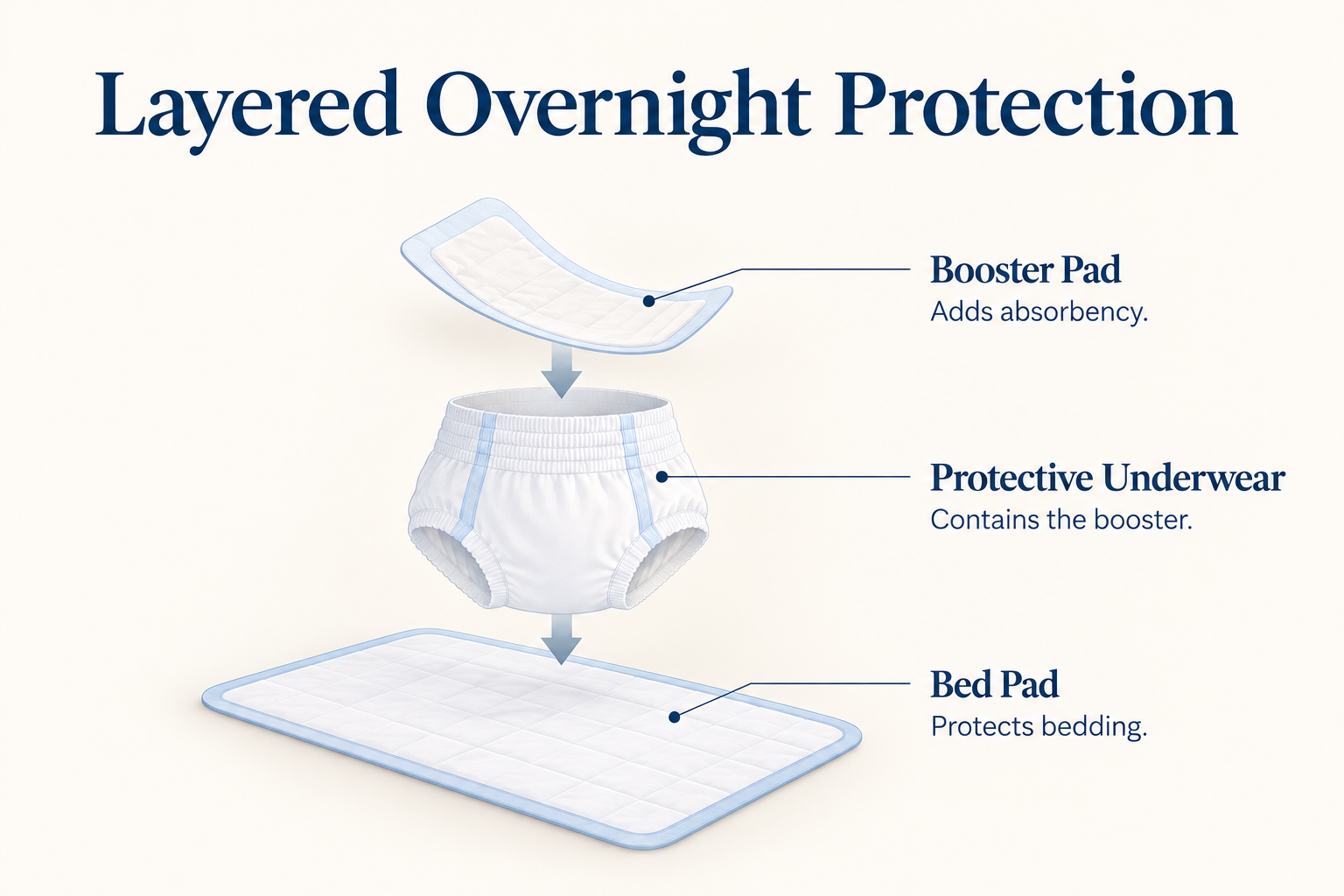 A flow-through booster pad can add absorbency inside compatible protective underwear, while a separate bed pad helps protect bedding. (AI-generated illustration)
5. Is it important to think about skin health when picking an incontinence product?
Brooke: Absolutely. Skin health is one of the first things I assess when caring for someone with incontinence.
Frequent exposure to urine, friction, heat, and trapped moisture can damage the skin barrier. I watch for persistent redness, tenderness, and skin that looks unusually shiny or moist. On darker skin tones, damage may appear as dusky grayish or purple discoloration.
Prolonged moisture can contribute to incontinence-associated dermatitis, which can become painful and lead to open wounds.
My advice is to choose well-fitting, breathable protection, change wet products promptly, and gently cleanse the skin. Appropriate barrier products may also help. If irritation persists or skin breaks down, consult a healthcare professional.
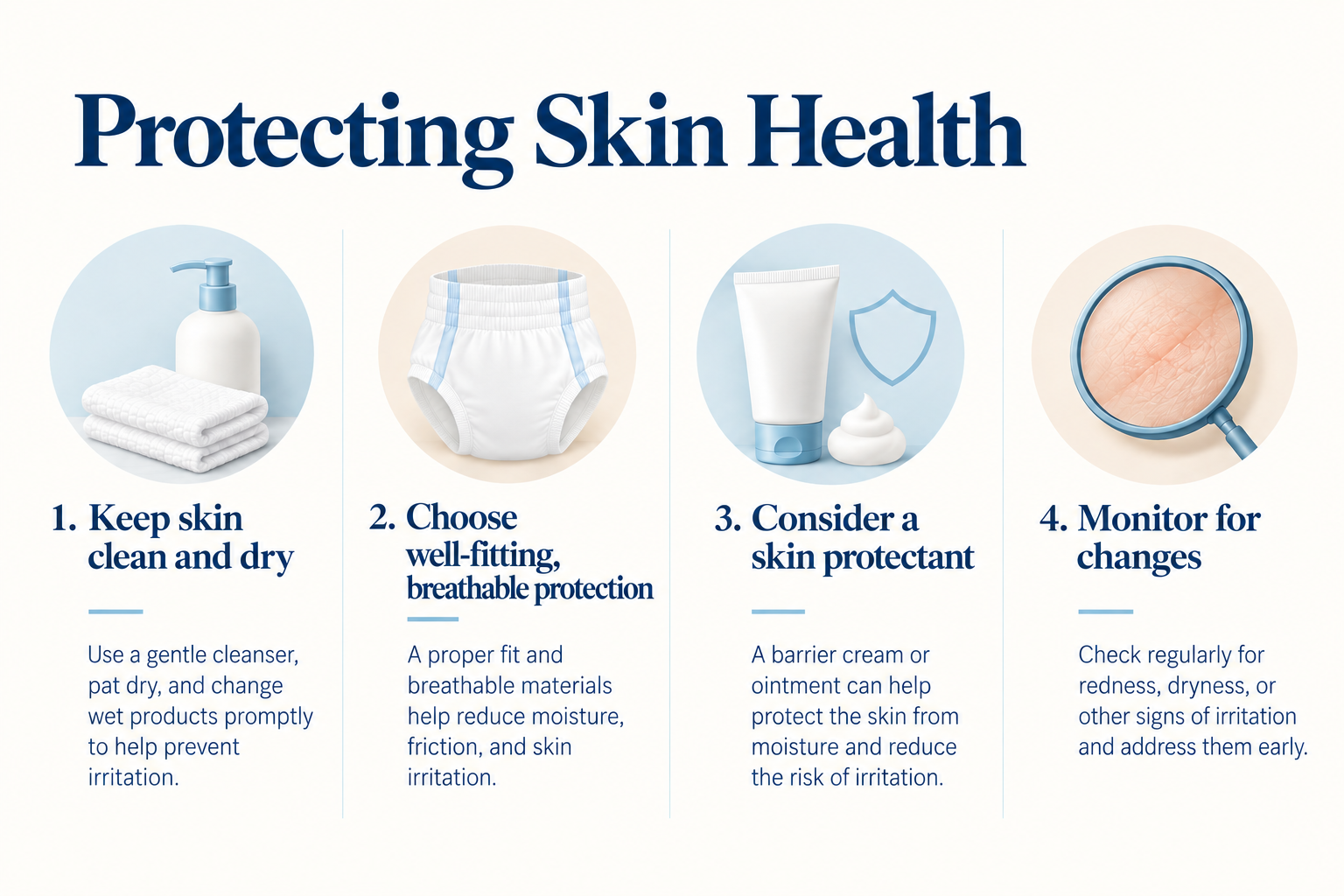 Well-fitting protection, prompt changes, gentle cleansing, and monitoring for skin irritation are important parts of incontinence care. (AI-generated illustration)
 Understanding an individual’s needs, mobility, and daily routines can help caregivers make more informed decisions about incontinence care. (AI-generated image)
6. What’s the biggest mistake caregivers make when managing incontinence with adult diapers and pads?
Brooke: Assuming there’s one solution that works for everyone.
I’ve seen families choose products based on familiarity, embarrassment, or convenience rather than the person’s actual needs. Someone experiencing full bladder loss may need very different protection from someone with occasional stress leakage.
Mobility matters, too. Pull-up underwear may work well for an independent adult, while adjustable briefs can be easier for someone who needs assistance changing.
I encourage caregivers to look beyond the leakage itself. Sometimes the earliest warning signs are changes in laundry, hygiene, or everyday routines that families don’t immediately recognize.
I discussed these subtle signs in more detail on Senior Living Guide’s What I See Before Anyone Talks About It podcast.
For practical help matching protection to someone’s needs, LivDryHealth also offers a guide to choosing incontinence products.
7. Why is my bladder control and incontinence getting worse?
Brooke: One of the most important things I tell patients is not to assume worsening bladder control is simply a normal part of aging.
There are many possible contributors, including diabetes, neurological conditions, prostate enlargement, pelvic floor changes, constipation, mobility limitations, and medication side effects.
For example, diabetes can affect bladder function through nerve damage and changes in urine production. Certain medications, including diuretics and sedatives, can also worsen leakage.
I’ve written about this for the National Association for Continence in How Aging Changes Bladder Control: What Most People Don’t Expect.
I encourage patients to pay attention to when symptoms begin, particularly after starting a new medication or experiencing a change in health. New or worsening bladder control problems deserve a conversation with your healthcare provider, not just a switch to a more absorbent product.