
The audacious theft of priceless jewels from the Louvre Museum in Paris on Oct. 19 has been called “the heist of the century” by several French newspapers. Commentators have quickly drawn parallels to similar headline-grabbing crimes over the years.
As special investigators scramble to catch those involved, here’s what to know about how the heist was pulled off in mere minutes, what was stolen, and why experts fear the jewels may never be recovered.
How It Happened
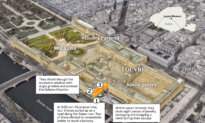
Thieves wearing balaclavas broke into an upstairs gallery on the morning of Oct. 19 using a truck-mounted basket lift known as a “cherry picker” to smash an upstairs window before looting precious objects from an area that houses the French crown jewels.
The robbers struck just half an hour after the museum opened its doors to the public, Paris prosecutor Laure Beccuau told French TV.
Although the thieves didn’t carry conventional weapons, they threatened the museum’s guards with the angle grinders they used to slice through the museum’s window, according to Beccuau.
Le Monde and other French media outlets reported that there were four thieves, two of whom wore reflective yellow vests intended to make them look like construction workers. Two rode in the truck, while two were on scooters.
The gang tried unsuccessfully to set fire to the crane as they fled the scene of the crime on motorbikes.
The museum was evacuated as the alarm sounded and remained closed through Oct. 20.
What Was Stolen?
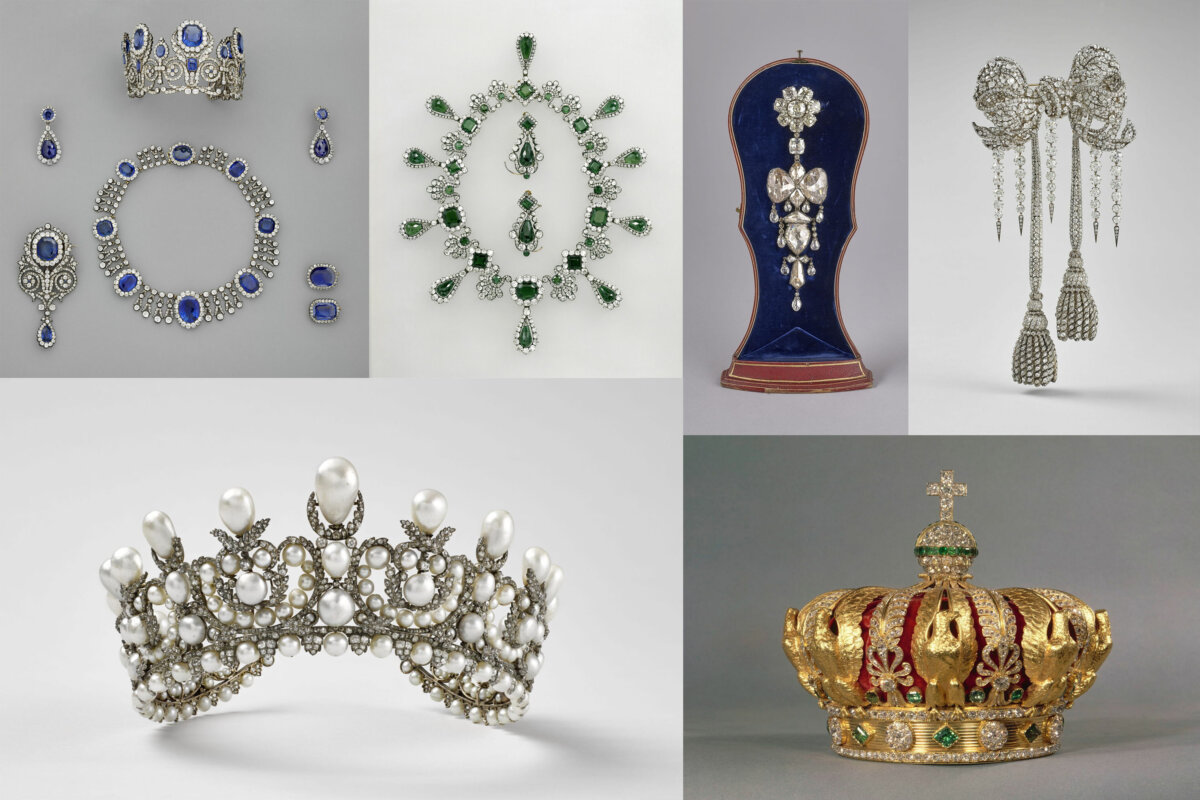
While nine objects were targeted, eight were successfully stolen. The thieves dropped the ninth, the crown of Napoleon III’s wife, Empress Eugénie, during their escape, the prosecutor said.
The piece is adorned with 1,354 diamonds and 56 emeralds, according to the museum’s website.
Drouot auction house president Alexandre Giquello told Reuters that experts would value the crown at “several tens of millions of euros,” noting that in his opinion, it was “not the most important item” in the targeted haul.
The Culture Ministry said the eight stolen items include: A tiara from a sapphire jewelry set belonging to Queen Marie‑Amélie and Queen Hortense, a necklace from the same sapphire set, an emerald necklace from the jewelry set of Empress Marie‑Louise (Napoleon I’s second wife), a pair of emerald earrings from the Marie-Louise set, and a tiara belonging to Empress Eugénie (wife of Napoleon III).
Mystery surrounds why the thieves did not also steal the Regent diamond, which is housed in the Galerie d’Apollon and has an estimated value of more than $60 million, according to Sotheby’s.
Who Could Be Behind It?
Beccuau said in the immediate aftermath of the crime that nothing was being ruled out and that all lines of inquiry were open—although foreign interference was not among the investigators’ main hypotheses.
She said it was likely that the robbery was either commissioned by a collector—in which case there was a chance of recovering the pieces in a good state—or carried out by thieves interested only in the monetary value of the jewels and precious metals.
“We’re looking at the hypothesis of organized crime,” the prosecutor said, noting that the culprits could be thieves working on spec for a buyer or seeking jewels that could be used to launder criminal proceeds.
What Will Happen to the Items?
Less than 10 percent of stolen artworks are ever recovered, according to international estimates.
The artworks have been described by experts as “completely unsellable” in their present form—meaning that they may be broken up and completely reconstructed to make it less risky to put the jewels and metal market.
“Ideally, the perpetrators would realize the gravity of their crime and the dimension they’ve entered into, and return the items, since the jewels are completely unsellable,” Giquello told Reuters.
Tobias Kormind, managing director of 77 Diamonds, told The Associated Press: “It’s unlikely these jewels will ever be seen again. Professional crews often break down and re-cut large, recognizable stones to evade detection, effectively erasing their provenance.”
—Rachel Roberts; Stacy Robinson
BOOKMARKS
A meeting between President Donald Trump and Russian President Vladimir Putin has been scrapped, following a phone call between Secretary of State Marco Rubio and Russian Foreign Minister Sergey Lavrov. That call was “productive,” according to a White House official, but the two presidents will not meet for now.
A group of European nations publicly endorsed Trump’s call for a ceasefire between Russia and Ukraine on Monday, while calling on the larger nation to halt its aggression. “Russia’s stalling tactics have shown time and time again that Ukraine is the only party serious about peace,” the statement read.
Trump is asking a group of nations in the Middle East to wait on their offer to “straighten out” Hamas. “I told these countries, and Israel, ‘NOT YET!’ There is still hope that Hamas will do what is right,” he said on social media.
The Supreme Court has a few interesting cases lined up, including a question about IQ and the death penalty. You can check out Sam Dorman’s report to learn more.
Rep. Thomas Massie (R-Ky.) will face a primary challenge by former Navy SEAL Ed Gallrein. “I served over 30 years as a Navy SEAL and military adviser—I’m ready to answer the call again,” the Trump-backed vet said on X.
—Stacy Robinson