It was always supposed to be a Florida storm, New Orleans resident Sherry Grace said of Hurricane Katrina.
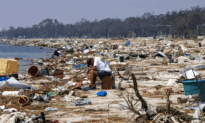
But 20 years ago, that tropical storm crossed the Everglades and grew over warm Gulf waters, becoming a catastrophe that is still considered one of the worst natural disasters to hit the Gulf Coast.
Nearly 1,400 lives and countless homes and businesses were lost, and some whole areas and industries have yet to fully recover.
Some of those who lived through the disaster shared their stories with The Epoch Times.
Grace, her husband, and her two children, Sam and Shaina, evacuated their home in Mid-City, New Orleans, on Aug. 27, 2005.
“We told the kids to look at the house because we weren’t sure if we’d be there, or if they would see the same thing when they came back,” she said.
On the beaches of Gulfport, Mississippi, Richard Valdez was moving his business’s equipment as rain and wind began to arrive on Aug. 28, 2005.
He told The Epoch Times a friend warned him that Katrina was set to be worse than Hurricane Camille in 1969.
He evacuated later that day at the request of his wife.
Outside Waverly, Mississippi, Todd Terrell, founder of United Cajun Navy, a nonprofit that helps with disaster relief, evacuated his fishing camp on Aug. 28, 2005.
“A lot of these, these fishermen, they waited till the last minute, because you never know if the storm moves,” he told The Epoch Times.
The eye of Hurricane Katrina made landfall in the early morning of Aug. 29, 2005, in southeastern Louisiana. But hurricane conditions were wreaking havoc across the shoreline hours earlier.
The next day, Valdez drove back to Gulfport with his family.
He and his wife both had city and county credentials that allowed them back into town. But, he had to sneak in his son JR and his mother past a checkpoint.
“My parents laid our luggage and belongings over us in the back of the vehicle, and we were told to lay still,” JR told The Epoch Times.
“It took forever to get back to my parents’ house due to the damage,” he added.
Their house was still standing, far enough from the water. But others were not so lucky.
“My aunt had lost her house. Tornado hit it,” Valdez said. “My mom had lost her home. A lot of my cousins have lost their homes. Everybody on the beach that I knew, their homes are gone.”
Meanwhile, Terrell was making his way into New Orleans.
“We took a route with the National Guard and the military, and we got in,” he said. “And then from that point on, there was a handful of volunteers.”
The actions of this core group of volunteers laid the foundation of what would be known as the United Cajun Navy.
In Shreveport, Louisiana, the Grace family began to realize it was best to stay away. The decision was made to drive to her mother’s house in Topeka, Kansas.
“People on the street … we’re calling the radio station saying what’s happening,” she said.
“We knew something was happening,” she said. “We didn’t really know exactly what. We didn’t really realize that the levees had been breached or broken.”
Terrell said those first days in New Orleans were “apocalyptic,” recalling days without food or water, nights filled with gunshots and screams. He helped establish triages and had to run airboats over corpses floating in the water.
He said the eastern side of town was “decimated,” and they were told to stay clear of the Superdome.
“I was really devastated,” Grace said after hearing more news come in. “I was in tears.”
“My sister … said, ‘Get it together. We’re enrolling your kids in school.’”
Sam and Shaina stayed in Kansas for the rest of the semester, returning home at Christmas.
Over in Gulfport, Valdez dealt with Katrina’s devastation.
“The whole town was just unbelievably destroyed,” he said. “Everything that you can imagine, that you remember growing up as a kid … was gone.”
Terrell would also come to find his camp in Mississippi was gone.
“There was no building, there was no slab. It was gone,” he said. “So at that point, you just help somebody else that is better off than us, and that’s what we did.”
The power of community became a clear driving force in all three stories shared with The Epoch Times.
“There were just people helping people along the coast, you went out and you helped your neighbor,” Valdez said.
“Everybody had people living with them,” Grace said. “They stayed friends once they were able to get back into their home.”
While a lot of the Gulf Coast has yet to come back, the residents pointed to many moments where they saw life return, such as celebrating Mardi Gras and the Saints’ Super Bowl victory in 2010.
“As we’re walking in the French Quarter, you could pick up your feet and you would just be carried,” Sam said. “I think that was the moment … when the city finally kind of hit its full stride again.”
–T.J. Muscaro
BOOKMARKS
U.S. District Judge Kathleen Williams refused to pause her previous order to dismantle Alligator Alcatraz this week, while the government pursues an appeal, saying the government would probably not win. She had previously ruled that Florida violated the National Environmental Policy Act when it built the facility earlier this year without an environmental impact review.
The first case of the plague in New Mexico for 2025 has occurred in a 43-year-old male from Valencia County. He was hospitalized, but has since been released.
The Trump administration is calling on Illinois’ Naval Station Great Lakes to support local operations by the Department of Homeland Security (DHS). The request comes after a dispute between President Donald Trump and Illinois Gov. J.B. Pritzker over the need for government intervention to control crime in Chicago.
Trump reiterated this week that he would defend social security, even as GOP lawmakers look for ways to trim the budget. “One thing I said and I gave my word—we’re not going to hurt anybody on Medicaid, Medicare, or Social Security,” the president told reporters in the Oval Office.
Trump suggested on Thursday that he may ask the Republican National Committee (RNC) to hold a national convention ahead of the 2026 midterms, as a way to highlight his administration’s plans. Such conventions are usually held every four years, just before the presidential election.
—Stacy Robinson