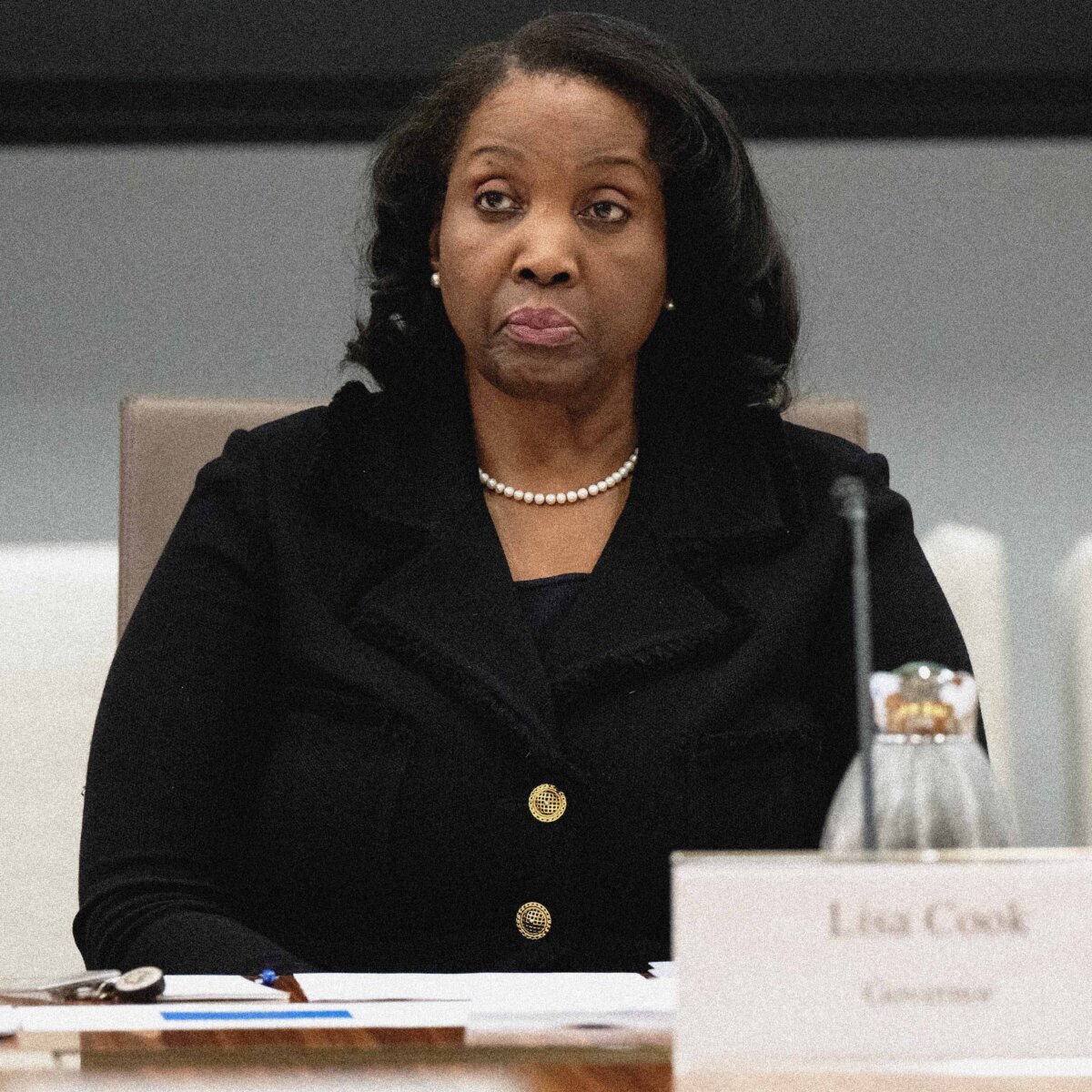

Federal Reserve Governor Lisa Cook is expected to sue President Donald Trump over her recent firing, refocusing attention on persistent questions about his authority and the protections Congress has instituted for particular federal entities.
Trump fired her in an Aug. 25 letter that said he had sufficient reason to believe she may have made false statements on one or more mortgage agreements. “At a minimum, the conduct at issue exhibits the sort of gross negligence in financial transactions that calls into question your competence and trustworthiness as a financial regulator.”
Abbe Lowell, an attorney for Cook, said a lawsuit was forthcoming and that Trump didn’t have authority to fire her.
Congress passed the The Federal Reserve Act, which allows the president to remove members “for cause” but it’s unclear what would constitute a legitimate cause under law. Georgetown University Law Professor David Super told The Epoch Times that Trump’s allegations “could force the Supreme Court to decide what level of justification is required for a ‘for cause’ firing of a Federal Reserve board member.”
Trump’s removal authority has been a recurring point of contention in his second term as multiple agency heads sued him over their terminations. Courts have been wrestling with the question of how much power the Constitution grants to presidents and how the Supreme Court has ruled on the issue in previous cases.
A key constitutional question in these cases is how much executive authority the officials themselves wield. That’s partly because of a Supreme Court decision called Humphrey’s Executor v. United States, which held that Congress could limit firings for officials whose duties were “quasi-legislative.”
In 2020, the Supreme Court built on this precedent in a case called Seila Law v. Consumer Financial Protection Bureau. The court held that Congress’ limit on firing the bureau’s director was unconstitutional because of how much executive power the director exercised.
The success of Cook’s expected lawsuit could depend on how courts apply those cases, as well as their views of Cook’s responsibilities and the structure of the Federal Reserve.
In May, the Supreme Court temporarily allowed Trump to remove two heads of federal labor boards who had sued him despite lower courts ruling in their favor. The Supreme Court’s decision was limited but indicated a majority supported Trump’s view that these boards exercised “considerable executive power.”
The majority also offered some insight into the Federal Reserve, which the agency heads said could be threatened if Trump won in his appeal to the Supreme Court. The court disagreed and said that “the Federal Reserve is a uniquely structured, quasi-private entity that follows in the distinct historical tradition of the First and Second Banks of the United States.”
—Sam Dorman
BOOKMARKS
Li Yunhai, a former researcher at University of Texas MD Anderson Cancer Center, has been accused of stealing government-funded cancer research for China. Li had downloaded about 50 gigabytes of research, and was preparing to board a plane to China when he was detained.
Democrat Catelin Drey has won a special election for Iowa’s Senate District 1, breaking a GOP supermajority in that state. The Democratic Legislative Campaign Committee posted on X that the win will give them more leverage, and allow them to block “controversial gubernatorial appointments” by Gov. Kim Reynolds.
Trump wants to scrap a rule that allows senators to block appointments of judicial nominees headed to their state—but some Republicans are resisting it. Find out more in Jackson Richman and Joseph Lord’s latest report.
The federal government will take over management of D.C.’s Union Station, Transportation Secretary Sean Duffy announced. The transportation hub is run by Amtrak, but the government has owned Union Station since the early 1980s, and is the controlling shareholder in Amtrak itself.
—Stacy Robinson