
On Nov. 4, Californians will go to the polls to vote in a referendum that would authorize replacing the state’s current congressional map with one designed to favor Democrats.
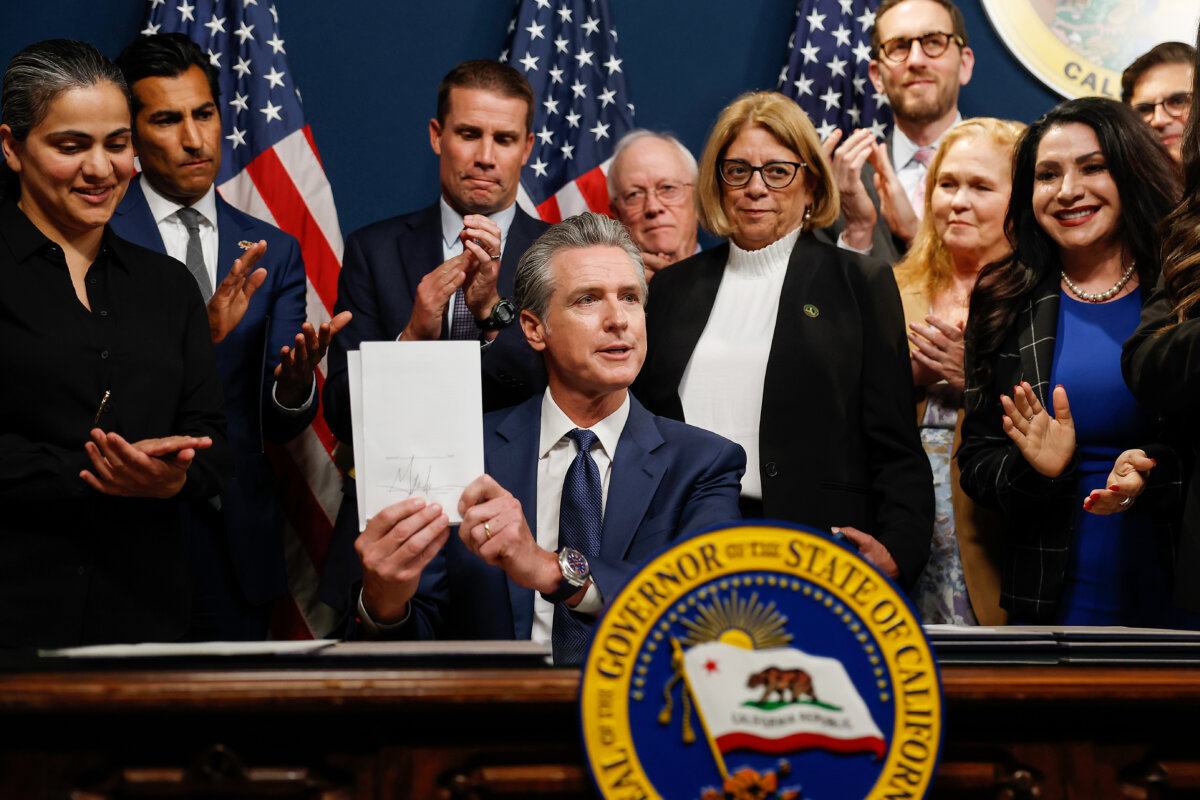
California Gov. Gavin Newsom signed a bill to authorize the referendum on Aug. 21. Democrats say the measure is meant to “fight fire with fire” as Texas moved forward with redistricting favoring Republicans.
The California state legislature rushed the bill forward during a special session called by Newsom after Texas Gov. Greg Abbott convened the Texas state legislature to carry out a redistricting of the state’s map, favoring Republicans.
Critics have condemned the measure as unconstitutional, pointing to a current provision in the state’s constitution that removes districting powers from the legislature and governor.
Here’s what to know.
California’s current congressional maps were adopted following the 2020 census. These maps, drawn by the politically neutral California Citizens Redistricting Commission, went into effect in 2022.
In a 2008 referendum, California voters approved a constitutional amendment that moved control of redistricting in the Golden State to the independent commission.
Democrats currently control 43 seats in the U.S. House delegation, while Republicans hold nine.
Under the amendment, the California legislature and governor are largely written out of the process of redistricting.
To get around that, voters will be asked to give their consent to approve new maps, which will last for a limited time, dubbed Proposition 50 for the 50 U.S. states.
The maps voters are asked to approve by Prop 50 would redraw the boundaries for five GOP-controlled districts, moving Democratic voters into the districts to increase Democrats’ chances of taking the seat. The changes to the map would last through the 2026, 2028, and 2030 election cycles.
At that point, following the 2030 Census, control of the process would be returned to the Citizens Redistricting Commission, with new maps going into effect in 2032 and beyond.
The text of the ballot measure cites a goal to “neutralize” efforts by Republicans to redraw the congressional map in their party’s favor in Texas.
“It is the intent of the people that California’s temporary maps be designed to neutralize the partisan gerrymandering being threatened by Republican-led states without eroding fair representation for all communities,” it reads.
While Republicans are already a minority in the Democrat-dominated state, they could lose as many as five more seats in the high-stakes 2026 midterms if the revised maps are approved.
Three California Republicans—Reps. Kevin Kiley, Doug LaMalfa, and Ken Calvert are particularly endangered by the changes to the map, as their districts are on track to be inundated by voters who backed Vice President Kamala Harris in 2024.
Kiley, whose seat is most at risk of being flipped under the redrawn maps, has criticized both California and Texas for their redistricting efforts.
A bill introduced by Kiley would ban mid-decade redistricting entirely.
Two other GOP seats, currently held by Reps. Darrell Issa and David Valadao will face tougher reelection bids under the redrawn maps, but could still stay under GOP control, according to The Cook Political Report.
The 2008 amendment to the state’s constitution has long been popular with voters, and Newsom and other California Democrats will still need to campaign for the measure to push Prop 50 over the finish line.
Primarily, voters will need to be assured that the changes to the map are temporary and that the independent commission will remain in effect for future redistricting.
A Politico/Citrin Center/Possibility Lab poll conducted between July 28 and Aug. 12 asked Californians whether they would “support keeping the independent redistricting commission” or “support returning congressional redistricting authority to state legislators.”
It found that 64 percent backed the independent commission, and only 36 percent backed changes. California Democrats were split approximately evenly, with 51 percent favoring state legislature control. Independents backed the independent commission by 71 percent.
However, that poll didn’t ask voters about the temporary change being proposed under Prop 50.
The text of the ballot measure emphasizes the temporary nature of the changes.
It says that the redrawn maps will “temporarily be used for every congressional election for a term of office commencing on or after the date this subdivision becomes operative and before the certification of new congressional boundary lines drawn by the Citizens Redistricting Commission.”
It also emphasizes that the Citizens Redistricting Commission “shall continue to adjust the boundary lines” of federal and state-level districts “in 2031, and every 10 years thereafter.”
A more recent poll by UC Berkeley IGS found more favorable signs for Democrats. It found that 48 percent of voters approve of the new map, 32 percent oppose the redistricting effort, with 20 percent undecided.
A Politico/Citron poll found that nationally, 63 percent of Democrats supported California’s redistricting effort, 18 percent supported the independent commission, and 19 percent were undecided.
—Joseph Lord
BOOKMARKS
American homeowners are shopping for more than just open floor plans, granite countertops, and curb appeal these days, The Epoch Times’ Autumn Spredemann reported. According to experts, many Americans are instead prioritizing home purchases and upgrades to include features that resist extreme weather events.
As the world fixates on how and when Beijing will make its move against the democratic island of Taiwan, inside the nation, the battle is already on without a shot fired, The Epoch Times’ Eva Fu reported. Confronted with infiltration and coercion tactics from the Chinese regime, Taiwanese society is fighting back.
Geoffrey Hinton, the pioneering computer scientist called the “godfather of AI,” has once again sounded the alarm that the very technology he helped bring to life could spell the end of humanity as we know it, The Epoch Times’ Tom Ozimek reported. He said that humanity risks being sidelined—and eventually replaced—by machines far smarter than ourselves.
Attorneys for Kilmar Abrego Garcia, a Salvadoran national currently facing federal human smuggling charges, allege that U.S. authorities are now threatening to deport him to Uganda, The Epoch Times’ Ryan Morgan reported. They say the threat comes after he declined an offer to plead guilty to the charges and be deported to Costa Rica.







