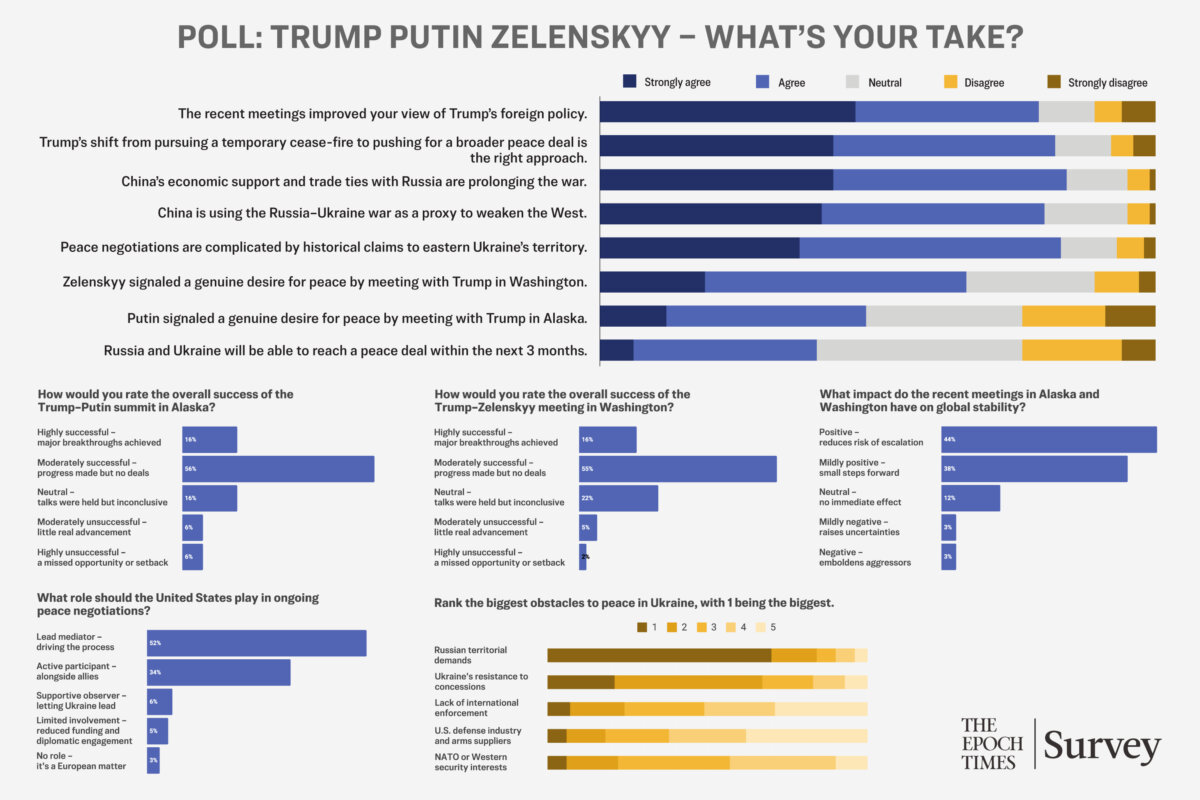

A survey of Epoch Times readers shows they support President Donald Trump’s handling of negotiations to end the war in Ukraine. Generally, they favor his approach and think the United States should play a leading role in the peace process.
At the same time, readers strongly believe that China, Russia, and even Ukraine may provide obstacles to ending the war.
Here’s the background and a breakdown of reader opinion.
Historic Meetings
Trump and Russian President Vladimir Putin met in Alaska on Aug. 15 for talks on ending the Russia–Ukraine war. The summit ended without a deal, but both leaders described the discussions as productive.
Days later, Trump met with Ukrainian President Volodymyr Zelenskyy and European leaders in Washington. While no specific commitments were made, the back-to-back meetings underscored Washington’s central role in shaping possible pathways to peace.
In February 2022, Russia invaded Ukraine. After three and a half years of fighting, Russia now holds about 20 percent of Ukrainian territory.
Here’s how our respondents see the prospects for peace.
Trump Handling Negotiations Well
Respondents think Trump is doing well in handling negotiations, with more than 80 percent believing his recent shift from seeking a cease-fire to pushing for a broader peace deal is the right approach. Forty-two percent strongly agreed.
Also, the great majority either strongly agreed (46 percent) or agreed (33 percent) that the recent summits improved their view of Trump’s handling of foreign affairs.
Strong US Role
The meeting with each leader was successful, most readers said. However, the agreement was tempered a bit.
Sixteen percent of respondents strongly agreed that both meetings achieved a major breakthrough.
However, the majority, 56 percent for the Putin meeting and 55 percent for the Zelenskyy meeting, were only mildly positive, seeing the outcome as positive but not indicative of a major agreement.
On the broader question of global security, more readers saw the meetings positively. Forty-four percent said they reduced the risk of escalation, and 38 percent saw them as small steps forward.
Just 6 percent of respondents thought the conferences would embolden aggressors.
A majority of respondents (52 percent) said the United States should act as the lead mediator, driving the peace process. Another 34 percent envisioned the United States as an active participant in the process, acting alongside its allies.
One reader opined, “At last, the United States is the peacemaker and not supplying continuing streams of war materials which prolong the war.”
Mixed Views on Putin, Zelenskyy
The generally positive feeling about Trump’s meeting with the leaders did not translate into strong optimism for a peace agreement in the near term.
One reason for that, readers said, was a lack of confidence in Putin and, to a lesser degree, in Zelenskyy.
Fewer than half of respondents (48 percent) believed Putin signaled a genuine desire for peace by meeting with Trump. A larger share of readers (66 percent) believed Zelenskyy demonstrated a genuine desire for peace.
Even so, just 39 percent expressed any agreement with the idea that the two countries would reach a peace deal within the next three months. A plurality of respondents (37 percent) were neutral on the question, and 24 percent disagreed.
Attitudes toward both leaders were more direct in respondents’ written comments.
One reader said “Putin’s trustworthiness” was the greatest obstacle to peace.
Another wrote, “I am not so sure that Putin or Zelenskyy want peace as much as they now want an out that will allow them to save face.”
Many Obstacles to Peace
Readers identified other obstacles to peace, chiefly the involvement and suspected motives of China in its ties to Russia, and Russia’s claim to historical ownership of territories in Eastern Ukraine.
Regarding China, 84 percent of respondents agreed that China’s economic support and trade ties to Russia are prolonging the war—the highest level of agreement on any survey question.
And 80 percent of respondents agreed with the idea that China is using the war as a proxy battle to weaken the West.
“If not for China, I believe peace would have a better chance,” one reader said.
Beyond that, Russia’s territorial claims were seen as the number one obstacle to peace, selected by 70 percent of respondents.
Related to that is Ukraine’s resistance to making concessions to Russia, which was seen as the second-most important obstacle to peace.
Other issues ranked well below those two choices.
One reader summarized the situation this way: “None of this is easy. Anyone expecting a resolution in the next 90 days is too optimistic.”
This reader poll was taken via email and social media on Aug. 20–21, 2025, and received 18,989 responses.







