
The United States leads in wealth and technology, yet U.S. children (ages 1 to 19) face an 80 percent higher risk of mortality than those in many developed nations, according to a study in the Journal of the American Medical Association.
Chronic illness is also a problem among U.S. children. According to a 2020 Centers for Disease Control report, nearly 13 percent of children ages 2–5 and 21 percent of children ages 6–11 were obese.
Robert F. Kennedy Jr., secretary of Health and Human Services, has advocated changes aimed at making Americans healthier. Some of Kennedy’s ideas have been acted upon by states.
For example, Indiana Gov. Mike Braun, a Republican, recently took action to bar the use of food assistance program dollars to purchase soda and candy.
In New York, state Sen. Brian Kavanagh, a Democrat, has introduced bills to require restaurants to label items that have high amounts of added sugar or salt.
We asked readers to give their opinion on the trends, suggested causes, and proposed solutions for America’s childhood health crisis.
We discovered a high level of concern about children’s health and nutrition, and some suggested factors that were not included in the survey.
Child Health Is a Concern
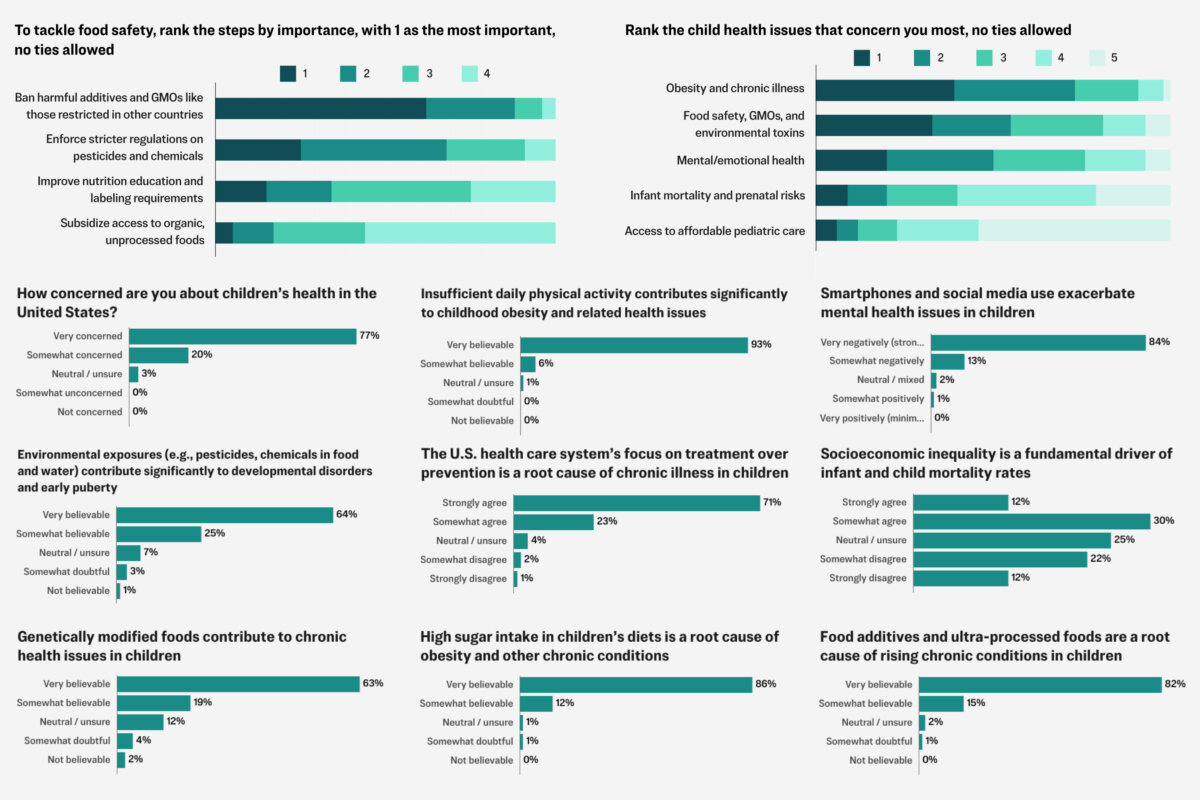
More than three-quarters of respondents (77 percent) said they are very concerned about children’s health in the United States. Another 20 percent said they were somewhat concerned, making a near-unanimous agreement on the issue.
Less than 1 percent of respondents reported having little or no concern over this issue.
Reader opinion widened a bit when comparing Americans’ state of health with that of those in other developed nations.
A clear majority (71 percent) said Americans’ health was either very weak (32 percent) or somewhat weak (39 percent) compared to others.
Even so, that fell short of the 97 percent of readers concerned for children’s health.
Some 32 percent said Americans’ health was very weak compared to others, and 39 percent said it was somewhat weak.
Readers Generally Agree on Root Causes
Readers mostly agreed on the root causes of poor health among U.S. children, with one exception.
A whopping 93 percent said insufficient daily physical activity is a driver of childhood obesity.
For context, a 2024 report from the University of Kansas found that only 20 percent to 28 percent of children ages 6 to 12 years engaged in the recommended daily minimum of 60 minutes of daily physical exercise.
Among Epoch readers, 84 percent said the use of smartphones and social media exacerbates mental health issues in children. There was virtually no disagreement on this, with just 3 percent of respondents being unsure (2 percent) or thinking the devices might have a positive impact on mental health (1 percent).
According to the Centers for Disease Control, half of children ages 12 to 17 had four or more hours of daily screen time from July 2021 through December 2023.
Of those, 27 percent reported symptoms of anxiety and 26 percent reported having symptoms of depression in the two weeks preceding, according to the study. Readers also found it highly believable that high sugar intake is a root cause of childhood obesity and other chronic conditions (86 percent), that food additives and ultra-processed foods are driving the rise in chronic conditions in children (82 percent).
Readers also believed in high numbers that exposure to environmental factors such as pesticides or chemicals in food and water contribute significantly to developmental disorders and early puberty (89 percent said either very or somewhat believable).
Also, 82 percent found it either very or somewhat believable that genetically modified foods contribute to chronic issues in children.
However, opinions were mixed on the impact of socioeconomic inequality on child mortality rates. Though 30 percent somewhat agreed that this is the case, readers strongly agreed and strongly disagreed in equal numbers (12 percent each).
Readers Say
“The tremendous pressure on children is exacerbated with the advent of social media, such that the pressure continues around the clock.”
“[We need] access to affordable, healthy, fast food in more places, and the publicity of the importance of eating the colors of the rainbow in healthy foods!”
“[The biggest problems are] all the harmful chemicals in foods, sprayed on crops, environmental hazards, and vaccines in the United States.”
Top Concerns and Solutions Are Mixed
While readers were united in concern over children’s health, opinions varied as to which factor is the greatest threat.
Asked to rank them, no single factor claimed the top spot with a majority of respondents. However, a plurality of readers, 39 percent, said obesity and chronic illness concerned them the most.
Two issues ranked relatively close in the second and third spots. Overall, more readers (55 percent) ranked food safety matters such as genetically modified foods and environmental toxins as either their top or second concern, landing it in the number two spot.
Close behind was mental and emotional health, rated as the first or second concern by 50 percent of respondents.
Fourth was infant mortality and prenatal risks, followed by access to affordable pediatric care.
Although food additives and genetically modified foods did not rank as the number one concern, a majority of readers (62 percent) said banning such additives or modifications was the most important step in improving child health.
Societal Issues Are Also a Factor
Though not mentioned in the survey, many readers commented on the societal factors that affect both nutrition and overall health.
Some 50 percent of respondents mentioned parenting in written responses about children’s health, often citing the demands on family life, especially for single parents.
Others pointed out the pervasive influence of advertising in recommending medications and processed foods. Others advocated for more advertising as an educational tool.
Readers Say
“[There are] too many stresses in daily life for the majority of parents to take the time to educate themselves on this topic.”
“With both parents working, it’s challenging for parents to not resort to fast, microwaveable, highly processed foods.”
“Advertise, through ads and billboards, what healthy eating is.”
“If food commercials included the same warnings as pharmaceutical ads, it may help concerned parents make good decisions.”







