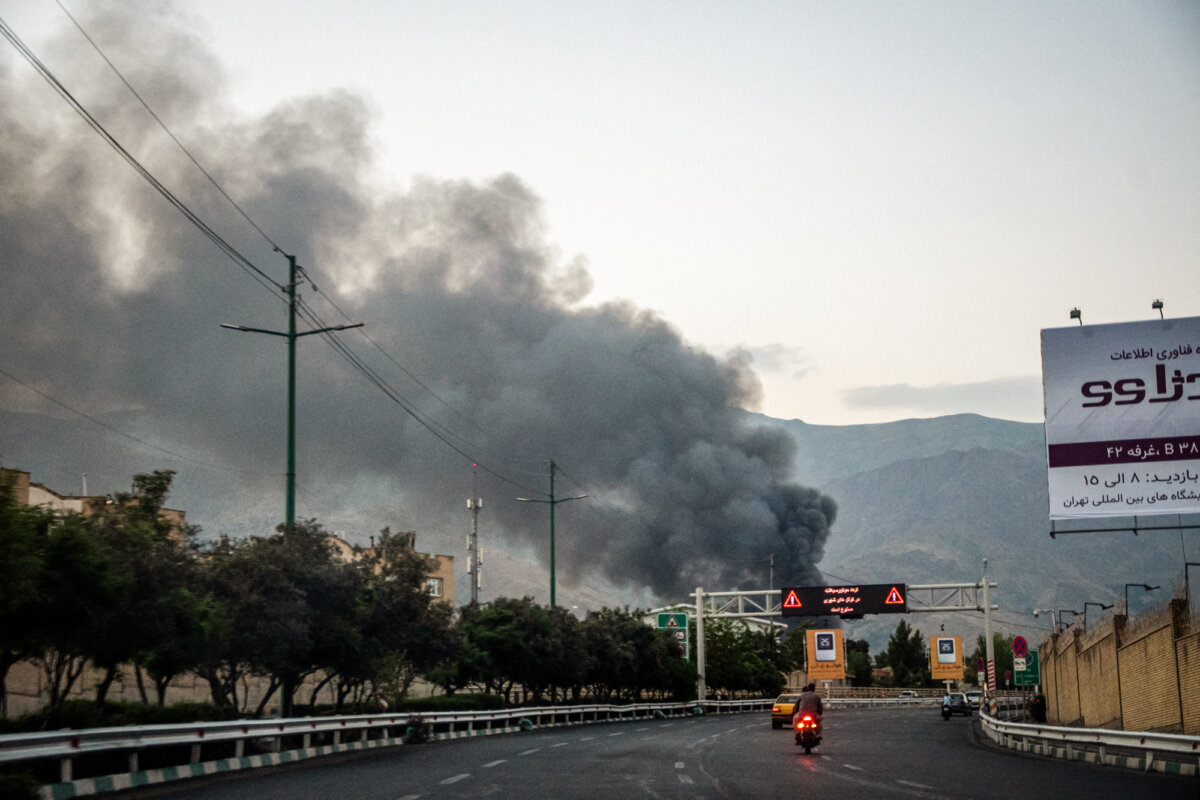

A cease-fire between Israel and Iran has gone into effect, marking an expected end to hostilities in a conflict that some feared could have escalated into a wider war.
The cessation of hostilities began at midnight on June 24, ending more than a week of fighting that saw airstrikes, ballistic missile attacks, and U.S. intervention.
President Donald Trump announced that he had negotiated a peace between Iran and Israel on June 23, in the wake of a U.S. strike on three Iranian nuclear facilities—Isfahan, Natanz, and Fordow—designed to cripple Iran’s capacity to produce enough fissile material for a nuclear weapon.
Trump said the cease-fire would be phased in over 24 hours from midnight on Tuesday, with Iran first halting its attacks and Israel then stopping offensive strikes.
In the hours leading up to the cessation of hostilities, both sides accused the other of violating the agreement, leading Trump to call for both Iran and Israel to “calm down.”
Ahead of the cease-fire, fresh Israeli airstrikes on Iran allegedly prompted retaliation from the Islamist regime, which launched a rocket that failed to land. Tehran denied that it had violated the agreement, state-aligned media in Iran reported.
Trump expressed frustration with both nations after the incidents, saying that they had each violated the fragile cease-fire.
“They [Iran] violated it, but Israel violated it too,” Trump told reporters at the White House before departing for a NATO summit at the Hague. “I’m not happy with Israel.”
Israel responded to the alleged violation with an attack on an Iranian radar before pulling back at Trump’s urging.
“Israel is not going to attack Iran. All planes will turn around and head home, while doing a friendly ‘Plane Wave’ to Iran. Nobody will be hurt, the Ceasefire is in effect!” Trump wrote in a Tuesday morning post on Truth Social.
Later, Israeli Prime Minister Benjamin Netanyahu said Israel would refrain from further attacks.
Netanyahu nevertheless praised Israel’s military operations in the conflict, saying that Iran’s nuclear capabilities had been significantly harmed by the strikes.
“For dozens of years, I promised you that Iran would not have nuclear weapons and indeed … we brought to ruin Iran’s nuclear program,” Netanyahu said in a televised address Tuesday.
After Israel withdrew its planes, no additional violations took place on Tuesday by either side, as the international community—including the United Nations, Turkey, China, the European Union, Pakistan, and others—expressed their backing for a truce, and urged both sides to uphold it.
Israeli Minister of Defense Israel Katz said he spoke to U.S. Secretary of Defense Pete Hegseth, offering a promise to “respect the cease-fire, as long as the other side does.”
The minister of defense, in a post on social media platform X, said he also thanked Hegseth for Trump’s decision to take part in Israel’s war against the Iranian nuclear threat.
U.S. strikes on June 21, authorized by Trump, came after the International Atomic Energy Agency on June 13 said that Iran had enriched Uranium-235 to 60 percent, closing in on the 90 percent enrichment needed for weapons-grade uranium.
It’s currently unclear whether the U.S. strikes substantially set back Iran’s nuclear program.
Eyal Zamir, chief of the general staff of the Israel Defense Forces (IDF), said that while Israeli forces successfully set Iran’s nuclear program back years, he believed that “the campaign against Iran is not over.”
“Despite the phenomenal achievement, we must keep our feet on the ground,” he added, praising the IDF and Israeli Air Force’s actions in the conflict. “Many challenges still lie ahead.”
He said that Israel’s focus will now shift back to Gaza, dismantling Hamas, and bringing all the hostages home.
Vice Admiral Brad Cooper told the Senate Armed Services Committee Tuesday that Iran still has “significant tactical capability,” even after the destructive strikes on three of its nuclear sites over the weekend by American B-2 Spirit stealth bombers.
When asked if Iran still presents a threat to U.S. military personnel and Americans worldwide, he said, “They do.”
—Joseph Lord, Savannah Hulsey Pointer, T.J. Muscaro, Jacob Burg, and Jackson Richman
BOOKMARKS
Immigration and Customs Enforcement (ICE) arrested 11 Iranian migrants living in the United States on Tuesday, along with one American. Those held included former Iranian military personnel, suspected terrorists, and one U.S. citizen who threatened ICE agents.
House Democrats joined the GOP in rejecting a bid to impeach Donald Trump on Tuesday. The impeachment play, brought by Rep. Al Green (D-Texas) following Trump’s missile strike against Iran, failed in a 344–79 vote.
The Department of Homeland Security is seeking clarification from the Supreme Court on whether or not it can deport illegal immigrants to a country other than their native land. The court appeared to temporarily block a lower court’s ban on such deportations, but the lower court judge insists that his block remains in effect.
Alaskan GOP Sen. Lisa Murkowski is sometimes a swing vote in the upper chamber of Congress, but she says she isn’t planning on joining the Democratic Party. “As challenged as I think we may be on the Republican side, I don’t see the Democrats being much better,” she said.
Senate Parliamentarian Elizabeth MacDonough has rejected some energy-related provisions of Trump’s reconciliation megabill, including a rule bypassing environmental review studies for offshore drilling projects. MacDonough said these provisions violate the Byrd Rule, which requires reconciliation bills be related to the federal budget, revenue, or the national debt.
—Stacy Robinson