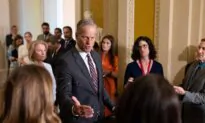

Following its passage by the House of Representatives, the One Big Beautiful Bill Act—the legislative package to implement President Donald Trump’s agenda—is facing scrutiny in the Senate.
Several controversies around the House-passed package, including its potential impact on the deficit, its increase to the debt ceiling, and others, remain. The Senate is expected to make substantial changes to the House’s version of the bill, leaving the ultimate shape of the package uncertain.
Because the legislation is being considered under the reconciliation process, Senate Majority Leader John Thune (R-S.D.) will only need a simple majority to pass the final version he brings to the floor. That means he can spare no more than three defections in his 53-seat conference.
But as it stands, the House’s bill has seen skepticism from several key players in the Senate—and senators say it would fail if brought to the floor as-is.
“I think there are four of us at this point,” Sen. Rand Paul (R-Ky.) said during a June 1 appearance on CBS News’ “Face the Nation” when asked by anchor Margaret Brennan whether other senators shared his objections to the legislation.
Sen. Ron Johnson (R-Wis.), another critic, has said the same.
Here are the senators to watch as the process moves forward.
Paul, a longtime budget hawk, has been outspoken in his opposition to the legislation in its current state.
Paul said that his primary hold-up to the bill in its current state was its provisions to raise the debt ceiling by $5 trillion—the planned Senate modification to the House’s proposed $4 trillion increase.
“I’ve told them, if you take the debt ceiling off the bill, in all likelihood I can vote for whatever the agreement is on the rest of the bill,” Paul told CBS.
During a May 25 appearance on Fox News Sunday, Paul made similar statements, but made clear that he wasn’t thrilled with other components of the bill either.
Paul said that the cuts included in the proposal were “wimpy and anemic” and that it would “explode the deficit.”
“It’s just not a serious proposal,” Paul said.
Johnson has been one of the staunchest opponents of the legislation in its current state in the upper chamber, insisting that Republicans must use this moment to change course on the deficit.
“This is our moment: We have faced an unprecedented moment of increased spending—58 percent—since 2019. … This is our only chance to reset that to reasonable, pre-pandemic spending,” Johnson told CNN on May 25.
During a June 1 appearance on Sunday Morning Futures, Johnson added that he also had reservations about the debt ceiling increase, saying he would prefer a one-year extension rather than a blanket cash amount increase.
He pointed out that the U.S. was on track for a deficit of as much as $2.2 trillion.
“That’s completely unsustainable,” Johnson said.
Sens. Lisa Murkowski (R-Alaska), Thom Tillis (R-N.C.), and John Curtis (R-Utah), who are often described as moderates, have also given indications that they’re unhappy with at least one major aspect of the House Republican plan.
Namely, the bill passed by the House moves to phase out clean energy tax credits initially included in the 2022 Inflation Reduction Act by 2028—a core demand made by House conservatives.
In an April letter to Thune, the three senators said that retracting these credits would be a mistake.
“The United States produces some of the cleanest and most efficient energy in the world, and an all-of-the-above approach—including support for traditional and renewable energy sources—has long been a hallmark of our energy strategy,” the senators wrote.
Curtis’s colleague, Sen. Mike Lee (R-Utah), meanwhile, has expressed opposition to the Inflation Reduction Act in its entirety, and particularly to its energy credits.
Sen. Josh Hawley (R-Mo.), who’s long shown a pro-working class streak in his politics, has expressed reservations to the bill’s efforts to change Medicaid, describing this issue as the crux of a Republican “identity crisis.”
The House plan imposes stricter work and volunteer requirements on able-bodied adults, and would increase states’ burden in funding Medicaid.
In a May 12 op-ed for the New York Times titled “Don’t Cut Medicaid,” Hawley said that a “Wall Street wing” of the party “wants Republicans to build our big, beautiful bill around slashing health insurance for the working poor. But that argument is both morally wrong and politically suicidal.”
Hawley said, “If Congress cuts funding for Medicaid benefits, Missouri workers and their children will lose their health care. And hospitals will close. It’s that simple. And that pattern will be replicated in states across the country.”
Sen. Susan Collins (R-Maine), facing a potentially difficult reelection campaign in 2026, has also expressed caution towards the bill’s changes to Medicaid.
“I am looking very carefully at the Medicaid provisions in particular,” Collins told a local Maine-based outlet.
BOOKMARKS
U.S. Treasury Secretary Scott Bessent said Trump and Chinese Communist Party leader Xi Jinping may soon have a call regarding China’s alleged violation of tariff agreements, The Epoch Times’ Catherine Yang reported. It comes after Trump revealed alleged violations on May 30.
Doctors and residents across China continue to report more infections and deaths as the latest wave of COVID-19 continues, portraying a far more severe situation than the Chinese regime is letting on, The Epoch Times’ Alex Wu reported. Schools in various provinces are reportedly suspending classes and placing students in quarantine, leading to growing concerns among the public of a return of lockdowns.
Ukraine launched a massive drone strike on June 1, hitting multiple Russian airbases, according to the Russian Ministry of Defense. It was Ukraine’s first strike more than 2,670 miles from the front lines, The Epoch Times’ Jacob Burg reported. The series of attacks took place just one day before the U.S. government had brokered for both sides to sit down for face-to-face negotiations.
Three White House Cabinet officials plan to visit Alaska this week to open oil drilling in the Arctic National Wildlife Refuge and push forward a natural gas project that has stalled for several years, The Epoch Times’ Jacob Burg reported.