

A civil liberties watchdog says some bylaw changes put in place for the 2010 Winter Olympics will curtail freedom of expression and infringe on people’s democratic rights.
To facilitate a safe and smooth-running Games, Vancouver city council recently passed a package of temporary changes to bylaws governing things such as licensing, noise, graffiti, vending, zoning, and the distribution of publications.
Effective from Jan. 1 to March 31, 2010, the new bylaws will be effective in areas that include the various Olympic venues and city sites. Implementation dates for items such as street closures, however, will occur closer to the Games which start on February 12.
The B.C. Civil Liberties Association (BCCLA) estimates that restricted areas span more than 40 downtown residential and commercial blocks that include community centres, a school, public facilities, and public spaces such as sidewalks and parks.
“These are the areas, the residential areas, the businesses, that will be most affected by the new city bylaws that restrict freedom of speech,” says BCCLA executive director David Eby.
“We’re very concerned that the city will be closing large sections of the downtown to free speech and free assembly of citizens and other people who want to be critical of the Olympic Games, countries participating, or their sponsors.”
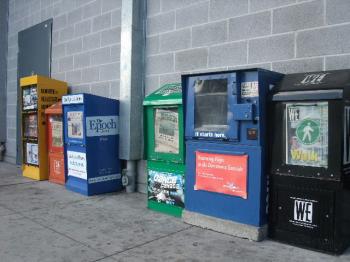
The bylaws allow the removal of garbage bins and newspaper boxes from within 100 metres of some Olympic venues for fear that bombs could be planted in them. While free newspapers can be given out by hand, distributing other printed materials is prohibited. This is to keep litter down, the city says.
The changes also allow for airport-style security measures at the city sites, including closed circuit TV monitoring and body and bag searches, and prohibit any activity causing a disturbance that could affect people’s enjoyment of an Olympic event on city land.
Because they are deemed a “nuisance and an eyesore,” the low-cost posters found on construction hoardings and utility poles will be eliminated, according to the BCCLA. Only signs licensed by the city that are “celebratory in nature” are allowed at city sites.
Eby is concerned that, although the city removed a provision that said, “a sign that conveys an idea is illegal,” the rules around “signs” and “creating a disturbance” remain ill-defined.
Commercial signs are prohibited in order to prevent “ambush marketing” by companies that aren't Olympic sponsors, says City Councillor Kerry Jang.
“Coca Cola has paid a lot of money to advertise and we don’t want people advertising Pepsi at the same time. It’s not free speech—its controlling advertisers,” he said.
While there will be designated “free speech areas” near the venues, Jang says people are not limited to these and may protest “anywhere in the city” except in the security zones.
“There’s only one place where you can’t protest and that is in the security area around an Olympic venue. There are performances that happen within that security zone, so if you hold up a sign it will block somebody’s view.”
Eby says the contract the City of Vancouver signed with the International Olympic Committee in 2003 “gave away the constitutional rights of Canadians” and that the bylaw changes violate the Charter of Rights and Freedoms.
“It’s just inexcusable for a sporting event to take precedence over Canadians’ rights of free expression,” he says.
City Councillor Geoff Meggs defends the bylaw changes, saying the city has been “very sensitive” to concerns around free speech and civil liberties.
“The city manager gave very clear undertakings about the application of the bylaws and we worked hard with the Vancouver Police Department and the security planners to make sure that free speech is part of their consideration every step of the way,” he says.
“The critics are inverting reality here. We will do everything we can do to support free speech. We will also do everything we can to ensure it’s a safe and secure Games.”
Rachel Marcuse, executive director of the Coalition of Progressive Electors which has two members on Vancouver City Council, says COPE has “a whole bunch of concerns” with the bylaw amendments.
These include vague language that “could in the process impact issues around freedom of speech,” and the lack of public consultation in such changes as extending closing times for bars and restaurants.
In addition, says Marcuse, the bylaws give city manager Penny Ballem “pretty unprecedented power” to make any new rules she sees fit during the Games without approval from council.
“All of those decisions should be going through the elected representatives of council,” she says.