
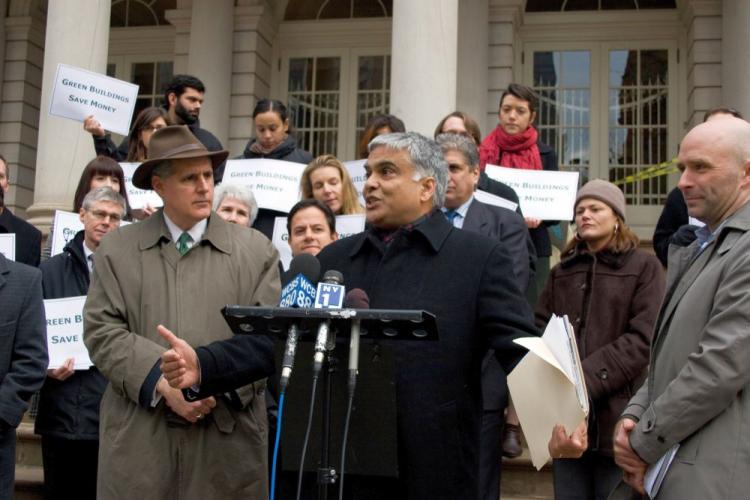
NEW YORK—Council members joined environmental leaders and civic activists on the steps of City Hall on Monday to support the passage of a package of legislation called the Greener, Greater Buildings Plan. The plan, if passed, will create New York’s first energy code, and includes other initiatives to improve energy efficiency in existing buildings, reduce greenhouse gas emissions, lower energy costs, and create jobs in the construction sector.
Mayor Bloomberg introduced the plan along with Council Speaker Christine Quinn on Earth Day in April; the ambitious plan to cut carbon emissions from existing buildings, has since been revised and refined to include four new bills.
Buildings account for 80 percent of New York City’s carbon emissions, and energy costs are estimated at $15 billion a year. The plan aims to reduce emission as well as lower consumer costs.
The goals of Mayor Bloomberg’s PlaNYC and the requirements of Local Law 55 require that carbon emissions be reduced by 30 percent by the year 2030.
The Greener, Greater Buildings Plan aims to reduce greenhouse emissions by nearly 5 percent, save New Yorkers more than $700 million annually in energy costs, improve conditions for tenants, and create more than 17,000 construction related jobs in the coming years.
Ashtok Gupta, director of Energy Policy for the Natural Resources Defense Council said in a statement issued on Monday, “Improving the energy performance of buildings is the best way to lower energy bills, make the buildings we live and work in more comfortable, create badly needed jobs, and reduce pollution.”
The bills before council include three that pertain only to large buildings of 50,000 square feet or more. The Audits and Retrocommissioning Bill will require large buildings to conduct audits of energy efficiency every ten years to optimize building efficiency.
The Benchmarking Bill will make buildings’ energy efficiency more transparent by requiring lare buildings to “benchmark” their energy and water consumption annually, making use of online tools provided by the U.S. Environmental Protection Agency.
The Lighting Bill will require that large buildings upgrade to more efficient lighting technology by 2025. Lighting accounts for almost 20 percent of electricity used in New York’s buildings and 49 percent of New York’s carbon emissions.
A fourth bill, the New York City Energy Code Bill, would create a local energy code and require that new equipment installed during a renovation must meet current efficiency standards.
Mary Barber, New York Campaign Ddrector for the Environmental Defense Fund said of the new bills, “This package of legislation addresses the single largest part f New York City’s greenhouse footprint, and takes a major step toward transforming the market for energy efficiency.”