
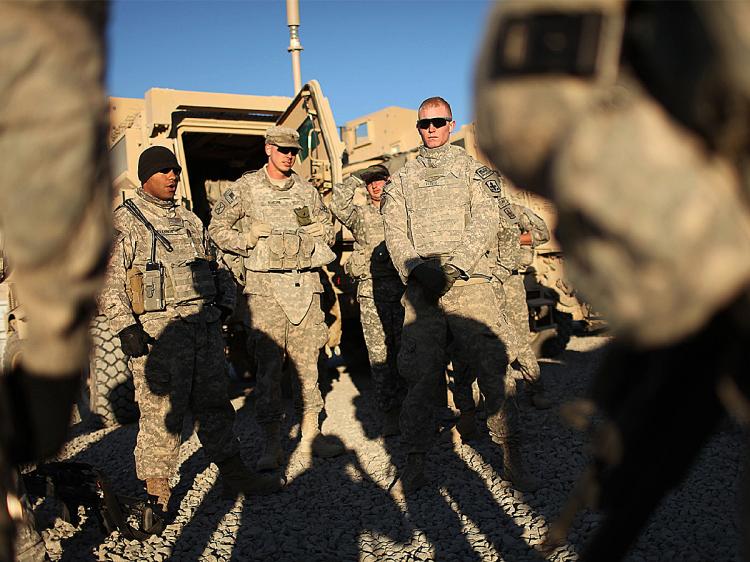
Facing a troop presence of 43 countries, the Taliban is relying on guerrilla tactics to maintain influence over the civilian populace.
In Afghanistan, victory will rest on who wins over the Afghan civilians. The U.S. and its allied countries are setting out to build a government and security force in Afghanistan that is capable of fighting the Taliban by itself. The Taliban, meanwhile, is trying to maintain control over the Afghanis by appearing to remain powerful while facing heavy opposition.
The Taliban's attack on Kabul, Afghanistan, on Monday, Jan. 18 was a display of the group's tactics of maintaining influence without obtaining actual victory.
A group of Taliban fighters stormed Kabul's capital killing five people and injuring more than 70 through the use of suicide bomb vests and firearms. At least 10 Taliban fighters were killed in the attack. Their attacks targeted government buildings. The Taliban claimed 20 suicide bombers took part in the attack on targets including the Presidential Palace, the Ministry of Justice, and the Ministry of Finance.
Suicide attacks such as the one witnessed on Monday serve to make it appear that the Taliban remains unfazed by heavy opposition.
The Taliban's strategy is "not necessarily about winning every battle, but rather making it appear as if their forces have the ability to attack at will from all side," says a report from geopolitical intelligence company Stratfor.
The attacks serve as ploys of intimidation to try and win control over civilian populations in cities currently in favor of the allied forces, such as Kabul.
"The ultimate aim is to replace governance structures affiliated with the Karzai government with the Taliban’s own mechanisms," says a report from the Institute for the Study of War.
"Taliban intimidation has succeeded in convincing much of the population of Southern Afghanistan that the Taliban maintain the capability to carry out their threats and that neither the Afghan government nor the coalition can protect them," says the report.
Obama's 2011 deadline for troop withdrawal is used in one of the Taliban's propaganda slogans, saying “The West has the clocks … but the Taliban have the time," according to a report from retired Four Star-General Barry McCaffrey.
A challenge to the Taliban is that they cannot just lay low in the meantime. During a House hearing, U.S. commander in Afghanistan Gen. Stanley McCrystal said that the Taliban "really cannot afford to wait" since the U.S. and its allied countries will be building an Afghan security force and government in Afghanistan to fight the Taliban.
Building Forces
Many of the suicide bombers used by the Taliban are foreigners, often recruited from Pakistan's madrassas, refugee camps in Baluchistan, and reportedly as far east as Miram Shah in Pakistan’s Federally Administered Tribal Area (FATA), according to a report from the Institute for the Study of War.
Foreign fighters are often used by the Taliban in its suicide bombings, since "their deaths will not be mourned by local families and relatives, potentially eroding public support for Taliban operations and will not start the vicious cycle of retributive justice that is part of the Pashtunwali code," according to the report.
Recruitment by the Taliban pulls from more than just Islamic extremism, many fighters join for tribal identity, out of anger toward international forces, or for financial gain. According to the report, the average Taliban fighter is paid between $100 to $150 a month, while cell commanders make around $350 a month.
In the face of well-equipped international forces, the Taliban's troop tactics are closer to guerrilla war than a head-on war.
Taliban military commander in Zabul Province Abd al-Qahhar described the group's tactics to Al-Aumed, a Taliban publication, on Dec. 23. His tactics were specific to the control of Zabul, yet shine a light into the overall tactics of the group.
Zabul rests to the west of Kandahar, along the border with Pakistan. Al-Aumed said the Taliban must control Zabul, with the exception of "district capitals where the enemy forces have their posts," according to a report from The Jamestown Foundation.
The tactics he propagated include the use of Improvised explosive devices (IED) and launching ambushes on enemy units.
Other common Taliban attacks include destroying cell towers to knock out communication lines, launching suicide attacks on various targets to instill fear, and assassinating those who speak against them.







