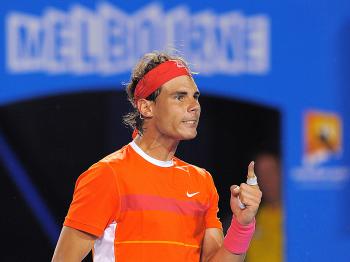
Nadal took three-and-a-half hours to defeat 27-ranked Philipp Kohlschreiber, a player Nadal had beaten with relative ease in their three prior meetings. Despite rigourous pre-season preparation, Nadal simply wasn’t on form for this match.
“I made mistakes in the first game, when I served, in the first set,” Nadal explained. “Those are the important games because if you stay ahead in the first games especially when you are winning two games to love, the normal thing is you will have half a chance to win the match.
“He started well and after that it was difficult to come back.”
Despite temperatures over 100 degrees and equally high humidity, both players ran hard throughout the four-set match. This answered any questions about Nadal’s physical condition, and the condition of his knees, which had been troubling him last season. However, the intense exertion might affect Nadal later in the tournament.

Nadal tightened up his play in the second set, but still had to play long rallies for most points, as his serve was not sharp (he served only 61% for the match.)
Kohlschreiber’s forehand was not working early on, and Nadal took advantage whenever possible, particularly on the serve. Also, Kohlchreiber’s one-handed backhand was imprecise and a bit underpowered. Nadal hit short, high returns to Kohlshchreiber’s backhand side, trying to tire Kohlschreiber’s shoulder.
By the end of the second set, the temperature had dropped 11 degrees, and the humidity by 23%. Still, both players were drenched with sweat, running the corner-to-corner and baseline-to-net. Kohlschreiber was so soaked he had to change his shirt midway through the final set.
Nadal showed his old form on the final shot of the second set, bending a forehand from well outside the court to hit the sideline in Kohlschreiber’s court. The ball never actually crossed the net; it curved a dozen feet in its flight to bounce off the line, giving Nadal the set.
Kohlschreiber started strong the third set, winning a service break. He upped the power on his serve, while Nadal seemed a less aggressive, perhaps fatigued by the constant exertion. Kohlschreiber capitalized by driving Nadal back behind the baseline and running him even harder. Nadal fought hard, at one point earning three break points, but Kohlschreiber fought back, saving his break and winning the set.
The Deciding Set
Kohlschreiber opened the fourth set strong, hitting the forehand returns that he had been missing in the earlier sets. But Nadal stepped up both figuratively and literally; he moved onto the baseline and defended there, rather than letting Kohlschreiber drive him deep and run him. 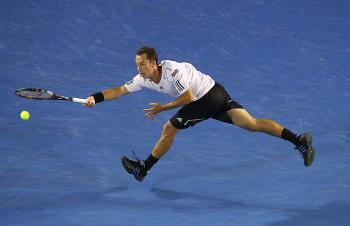
The fourth set was dead even. Nadal couldn’t hit his serves and Kohlschreiber simply played excellent tennis. (Kohlschreiber hit twice as many aces in the match.) Finally, with the set tied three games each, Raphael Nadal dug deep to win a service break with a pair of powerful forehand winners.
Nadal hit a similar blazing forehand passing shot in the next game, but it wasn’t enough. Kohlschreiber broke back, tying the set at four games apiece, and then went ahead 5–4.
That was the high point for Kohlschreiber. Kohlschreiber lost control of his forehand, missing a series of shots to give away the next two games. Nadal tied at five and went on to take the match. But Nadal didn’t ereally beat Kohlschreiber; Kohlschreiber lost the match more than Nadal won it.
If he has any hope of defending his Australian Open title, Raphael Nadal will need to cut his unforced errors, and get his first serve in about a third again as often.
Nadal showed that he is once again physically fit. His legs are strong, he is quick, and he certainly showed that he has endurance. But Nadal’s tennis was lacking. Merely being able to move well won’t get him far against the field he faces in the next rounds.
Raphael Nadal will play big-serving Croatian Ivo Karlovic in the next round. “I expect a really tough match,” Nadal replied when asked about his next opponent. “I know he is a very big server, so I have to be very concentrated with my serve. I can’t make mistakes with my serve.”