It is impossible to compare the scale of the Olympics to anything else. NBC alone has sent 2,000 people to man its mobile broadcast unit.
Olympic sponsors have swallowed up available ad space so completely that finding a billboard or transit ad that doesn’t feature a skier flying through the air or a speed skater blurring down the track could become a sport in itself. But if there is one thing the people of Vancouver know, it is that the Olympics has sponsors.
It's a circus, but without the dancing elephants and car-pooling clowns. These five rings move like the gears of a clock, ticking away hundredths of a second that separate bronze from gold, ticks that measure fractions of a point where dreams are made or broken.
Plagued by tales of corrupt officials and doped-up athletes, media coverage before the Games has explored the dark underbelly, but as Vancouver 2010 begins, the sunny face of this global celebration is impossible to ignore.
Canadians are lining the streets as the torch winds its way around the Lower Mainland to its final destination, and there is a feeling here that for the next few weeks, something is happening that belongs to all Canadians, something that we can all embrace.
This is not Beijing, where there were legitimate concerns that the Olympics were being used to validate a ruthless regime. This is Vancouver, a city where you can enjoy warm ocean breezes and look at snow-capped mountains. As the Olympics begin, it seems more and more like the city was made for this.
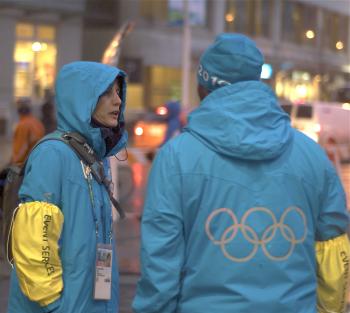
For those in the media, covering the Olympics is like being spoon-fed a chocolate sundae. You show up and you get a backpack full of treats, including a pedometer to track your travels. You sit down to work in a media centre flanked by a food court of help desks on either side ready to answer questions, fix your camera, or give you directions for the media-only bus system that carts reporters around to the venues.
And just to be safe, there’s a real food court in the building too, complete with a McDonald’s that we get a coupon for in our backpack.
For those wandering the streets and taking in the sights, there is a lot to do beyond attending the actual competitions. And for those who do have tickets, VANOC (Vancouver Organizing Committee) is working to make sure they are used, harassing corporate sponsors to return unused tickets and setting up an official website where ticketholders can resell tickets that they can't use—and buyers are guaranteed they are the real deal.
VANOC chief executive John Furlong told reporters on Tuesday that the 2010 Olympics is about Canada, not about Vancouver alone. It is why the symbol of the Games is an Innuit inukshuk representing northern native peoples, and every province and territory has a pavilion to show itself off and attract tourists and investors.
“We are telling a great and whole Canadian story through the Olympics and Paralympics,” Furlong said.
The torch toured within an hour’s reach of 90 percent of the country, he said. Fortunately for Furlong, 90 percent of Canadians live not much more than an hour from the U.S. border, which makes the circuitous route the torch took look a lot more complicated than it needed to be. But then again, it never would have made it to the northern territories if this was only about the numbers.
But in a certain way, numbers have dominated the Games. Construction began during an economic boom that made materials and labour especially expensive. Luckily for Vancouver, the Games have had the support of the whole country, part of VANOC’s strategy.
The Games couldn't be just about Vancouver, explained Dave Cobb, VANOC's deputy CEO and VP of marketing. That's because, like most Canadians, most of Canada's businesses—and money—are in southern Ontario.
As Vancouver stands poised to step onto the world stage in a way it never has before, the words “once in a lifetime opportunity” are tossed around frequently by politicians and VANOC officials. This is Vancouver's chance to attract investors and visitors, and with the economy still struggling, it couldn't have come at a better time.