

The 27-year-old from Cambridge set a new track record of 53.68 seconds in her third run on Friday prior to taking gold on the fourth and final run with a total time of three minutes and 35.64 seconds, achieving her gold with a happy and easy-going mindset.
“At the top I just kind of smiled at myself, saw my coaches and friends on the side, and you know, I just thought I've got nothing to lose and I was happy with how I performed,” said Williams, who won a silver medal at the 2009 world championships.
“I just went down and I mean half the track's a blur, I can't even remember what I really did. I just got to the bottom and saw a smile and knew I had done well.”
On a track scarred by last week's death of Georgian luger Nodar Kumaritashvili and marred by crashes from bobsleigh training, Williams steered four almost perfect runs, defending her victory.
Britain hasn’t gotten an individual gold at the Winter Games since Robin Cousins won men’s figure skating in Lake Placid 1980.
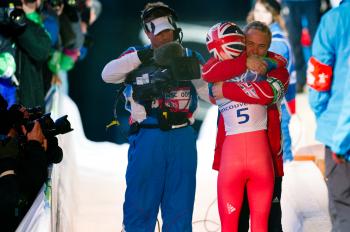
Germany received the country’s first medals in skeleton when Kerstin Szymkowiak scored second with three minutes and 36.20 seconds, 0.56 seconds behind Williams, and Anja Huber took bronze with three minutes and 36.36 seconds.
Yet enormous disappointment was brought to Canada’s Mellisa Hollingsworth, who dropped from second to fifth after a portentous mis-steer at the sixth corner. She could have done very well for she had the fastest starting speed in the final run.
In a sledding-like skeleton, the starting speed can affect the entire race. The athletes are trained much like sprinters, where powerful legs are used for “explosions” at the start line. Aside from speed, the athletes also need to find the best line and steer smoothly through each turn.
"It doesn't surprise me, as soon as someone is quick, people want to slow them down," Williams said.