

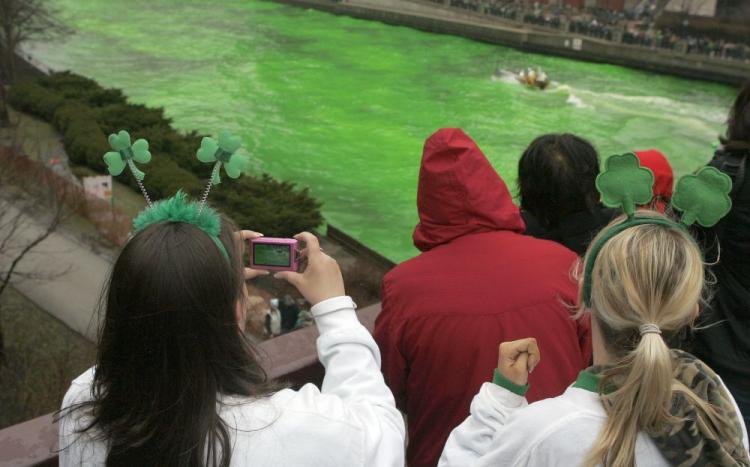
Saint Patrick’s Day as we know it was created by Irish immigrants. The holiday has become a secular homage to Gaelic life with parades, dancing, shamrocks, drinking, and at least one river dyed green. The United States holds nine times more people of Irish descent than Ireland itself, according to the U.S. census.
In 2008 there were 36 million Irish Americans, while the population of Ireland was 4 million.
A few more are coming, spurred by the desire for jobs. After a period of high-tech prosperity, Ireland has an overall unemployment rate of 12 percent, and even higher for young people. Civil servants have taken across the board pay cuts.
But immigration barriers and economic problems in the United States are leading some young Irish people to choose New Zealand or Australia instead, according to Sheila Gleeson, executive director of the Coalition for Irish Immigration Centers in Massachusetts.
“I would say there is a slight increase. For a few years nobody was coming,” said Gleeson.
Post-9/11 immigration policies have meant a dearth of visas, she said. It is harder than before to come to the United States legally, and authorities are tougher on people who stay here illegally.
Before Sept. 11, 2001, people could come to America as tourists or students and overstay the visa, with little consequence, she said.
“Now they have no opportunities. They could have had a life here but now they are living in the shadows.” She added that such immigrants would be reluctant to talk to a reporter, lest they expose themselves.
Gleeson described a woman from Ireland who came to America before 9/11 and overstayed her visa, then had a child. Trapped in an abusive relationship with the father of her child, the woman was threatened with deportation to control her. She had no recourse. Had she gone to the authorities, she could have been detained and deported, separating her from her child.
“I hope there will be some kind of reasonable reform,” said Gleeson.
Her own nieces and nephews in Ireland graduated from college, had trouble finding jobs, and went to New Zealand and Australia for work. She lamented how far away that is. “I would love to see some opportunities for them to come here.”
Sister Marguerite Kelly works with Irish immigrants at the Irish Pastoral Center in Quincy, Mass., where she is the executive director. She too notes a dearth of young Irish immigrants to America.
"I've only seen one of these new arrivals,” said Sister Kelly. “I don't know where they are."
She added she knows the economic conditions in Ireland are tough, but she thought coming to America would not be the best way for an Irish person to find work. "I know the jobs here are terrible. We try to get the message to them over there."
Yet Gleeson adds, "The situation in Ireland is a whole lot worse. It's quite depressing when you go there. But what are you going to do?"