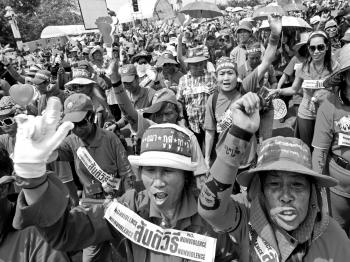

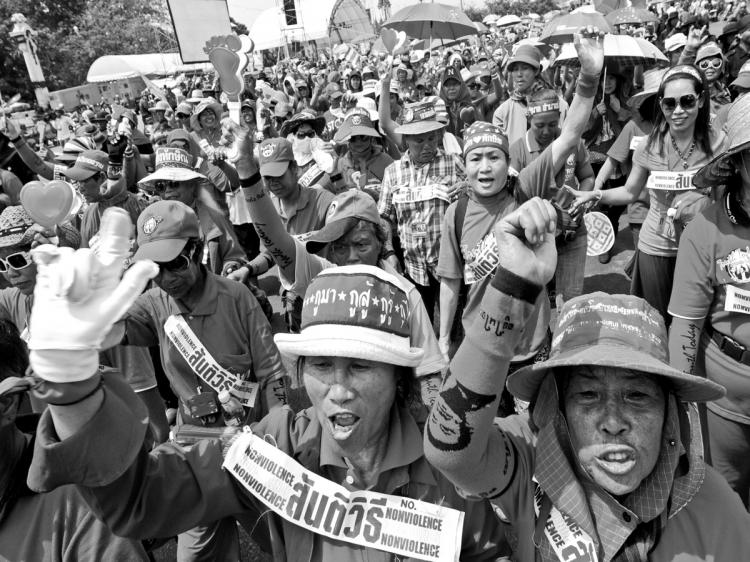
The Thai coalition government has voiced their concerns that the “class war” rhetoric coming from red shirt protest leaders could push Thailand into further chaos similar to when the Kingdom fought a communist insurgency decades ago.
The red shirts, formally known as the United Front for Democracy against Dictatorship's (UDD), is a loose coalition of supporters of the fugitive former Prime Minister Thaksin Shinawatra, pro-democracy activists and ex-communists. Their leadership have used language describing their conflict with the government as a class war between Thailand's ruling elite and the rural poor.
During their Bangkok protests, which kicked off in earnest with a mass rally on Sunday March 14, Thaksin has phoned-in speeches to his supporters from abroad , using phrases like “divisions of class and aristocracy,” “the war of class,” “aristocrat” and “commoner”.
The possibility of a return to a period of communist conflict in the Kingdom as experienced during the cold war was flagged last week by a government minister in response to Thaskin’s rhetoric. Satit Wongnongtoey, the minister in the prime minister's office who supervises state media, warned that Thaksin’s speeches to thousands of red-shirted protesters “could lead to a serious conflict.”
Satit said that Thaksin was using such terms to mislead the public and that a “war of class,” does not exist in contemporary Thai society.
The government of Prime Minister Abhisit Vejjajiva, Satit said would be making efforts to inform the Thai public of its programs aimed at assisting the poor. It would also seek to clarify words like “aristocrat” and “commoner,” which they say have been abused by Thaksin, a billionaire businessman living in self-exile abroad whose elected caretaker government was ousted by a military coup in 2006.
Satit asked academic institutes for “cooperation to study these matters, including jointly clarifying them to the public,” to help avoid conflicts that could return Thailand to an “age of communist war.”
While calling for “class war,” Thaskin and his red shirt leaders have insisted their massive rallies in the Thai capital will remain peaceful in a bid to gain public support for their effort to force the government to call an early election.
Pitch Pongsawat who teaches modern Thai politics at Chulalongkorn University in Bangkok said that Satit’s response was overactive.
“The minister is trying to provoke the royalist sentiment because in the old days the communist war [was considered an] anti-royalist movement,” he said.
During the cold war period, Thailand suffered a low level communist insurgency, which peaked during the late 1970s with communist forces having an estimated 12,000 guerrilla fighters in its ranks.