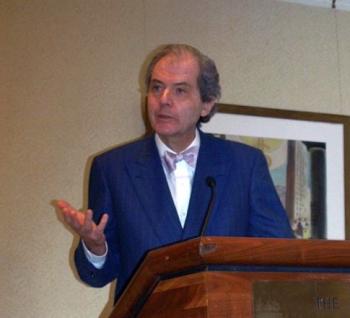


Palmer discussed the Diplomat's Handbook on March 23 at the Women's National Democratic Club. Originally conceived by Palmer, the book is a project of the Council for a Community of Democracies, of which Palmer is a vice president on the board of directors. He sought to create a handbook for diplomats to encourage them to aid human rights and democracy movements in mission countries. The book provides case studies of diplomats taking action to support movements for democracy around the world. The organization decided to use case studies to encourage diplomats, because, as Palmer put it, "bureaucrats like precedent, they want to know that something has been done by somebody—and that person hopefully didn't get fired."
"When the monks go into the streets of Burma and an embassy tries to think, 'Well how do you respond to be helpful to the monks?' What do they pull off the shelf?—Well there wasn't anything," Palmer said, explaining the need for a handbook.
Ambassador Palmer himself took action to help end communism in Hungary while he was the U.S. ambassador to the country from 1986 to 1990. He supported dissidents who were persecuted by police. He is a long-time supporter of democracy and champion of human rights. He served in policy positions in the State Department between 1964 and 1990 and wrote speeches for six secretaries of state and three presidents. During that time he served in communist countries and was deputy assistant secretary of state for the Soviet Union and Eastern Europe. After the Berlin Wall fell, Palmer invested in the former communist countries and established the first national independent commercial television stations in six countries. He also serves on the boards of several democracy and diplomacy organizations.
Palmer said the image of the diplomatic corps is not wholly positive, but the foreign service is a "noble profession." He said he hopes that when young people think about what they want to do, they will "think of the foreign service, of diplomacy, as a cause, as something you can devote yourself to with a good conscience." Palmer said there is great potential in the diplomatic services of democratic nations. He said there are still 43 dictatorships in the world today, down from 46 five years ago, but with a generous definition of democracy, there are 124 democratic nations. These democratic nations have embassies in closed countries. But often diplomats are unprepared to help civil society activists when they ask, and so this potential source of help doesn't get utilized. That is how the Council of the Community of Democracies explained the rationale for the handbook on its Web site.
Palmer shared some of the case studies used in the handbook. One was a case of young Japanese diplomats aiding Ukrainian demonstrators during the Orange Revolution of late 2004 through early 2005. Japan, he said, has one of the most conservative foreign services—least likely to get involved in the movements of other countries. But several young Japanese diplomats went to the square every day of the demonstrations and brought sandwiches, taking care of the demonstrators day after day. Palmer commended their "remarkable display of solidarity" and said that from his experience in movements, it can be scary and "you need solidarity from legitimate outside figures." He said he believes that, "the fact that the Japanese diplomats were doing this was wonderfully important for young Ukrainians."
Another case study Palmer shared from the book was a case from Chile during the time of dictator Augusto Pinochet. During that time many dissidents were in prison or had disappeared. Palmer said American diplomat Harry Barnes made an important statement shortly after he arrived in Santiago, Chile. With the support of then Secretary of State George Schultz, Barnes first called on the opposition, the Christian Democratic Leadership, rather than on Pinochet's government. "He was saying on behalf of Washington, on behalf of the president, President Reagan, and George Shultz, 'I am here, accredited to the Chilean people, not to Pinochet,'" Palmer said.
Ambassador Palmer also looked to the future and the current potential democratic countries have to affect dictatorships. He spoke specifically of China, saying all the embassies and consulates in China could be proactive. He said embassies and consulates could advertise to Chinese citizens about software that enables them to go around China's online censors and how to gain access to the free Internet. He also said he thinks embassy staff should go to Tiananmen Square with national flags and practice the exercises of the peaceful spiritual movement Falun Gong. "The diplomats ought to go down and bear witness, they ought to show solidarity by doing the exercises, it would be good for their health also."