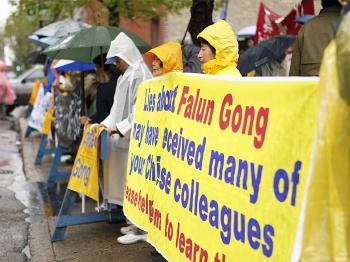
“At that time at a superficial level we practitioners went to appeal for Falun Gong, but in actuality we were giving the Chinese regime an opportunity to make a choice. We gave them an opportunity, and let them choose right or wrong. It is a huge event in Chinese history,” said Ms. Cui Zijing, one of the participants in the April 25 appeal who spoke at the rally.
Looking for the Appeals Office
The event in 1999 had been triggered by the arrest of 45 practitioners in Tianjin, a city 70 miles southeast of Beijing. When practitioners in Tianjin went to the municipal authorities there and asked for the release of those arrested, they were told that the Tianjin authorities had received orders from above. The practitioners needed to take their case to the central authorities.
According to Mr. Yang Qing, who also took part in the April 25 appeal and spoke at the Chicago rally, the practitioners in Tianjin spread the news of what the municipal authorities had said. Falun Gong practitioners not only from Beijing but throughout China decided to go to the State Appeals Office—the office whose stated purpose is to allow Chinese citizens to complain of wrongdoing by the authorities and seek redress—in Beijing on April 25.
In fact, as the crowd began to grow, they were not allowed by police to go to the Appeals Office. The Appeals Office is a few hundred yards, up Fuyou Street, from Zhongnanhai. This ancient compound houses the offices and living quarters of the top leaders of the Chinese Communist Party (CCP).
Mr. Xu Yen, who also spoke at the Chicago rally, was a professor at Tsinghua University, commonly known as “China’s M.I.T.” He arrived very early that morning on Fuyou Street.
“The police at first had the street going to Zhongnanhai blocked,” Mr. Xu said. “They should have kept the streets blocked. But instead of keeping people away from Zhongnanhai they opened the streets and then began directing practitioners to the streets around Zhongnanhai. They directed them to stand so that eventually practitioners surrounded Zhongnanhai.” The Chinese regime’s propaganda would later claim that the practitioners “surrounded” and “laid siege” to Zhongnanhai.
Tens of Thousands Appear
Mr. Yang, now retired, was a mechanical engineer in China and has spent a lifetime making precise observations. He walked the road leading to the Appeals Office and calculated there were 40,000 people there on both sides of the road.
“But there were many, many more practitioners there. Changhai Street was blocked to me, but on the other side of the blockade were many practitioners.”
“At the time, the international media based in Beijing estimated that between 100,000 and 150,000 practitioners gathered. The Chinese regime’s state-controlled media, however, said there were 10,000. Ever since, the media have reported 10,000. It is not true,” Mr. Yang said. 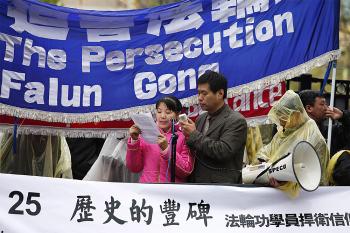
Besides those practitioners who made it to the vicinity of the Appeals Office or Zhongnanhai, there were many more who were trying to come to Beijing who could not make it, according to Mr. Yang.
Mr. Yang mentioned two female practitioners he knew who lived in northeastern China. They tried to buy a train ticket to Beijing but the police would not allow train tickets to Beijing to be sold to Falun Gong practitioners. So, the two women bought tickets to Xinjiang, in China’s west. They then hired a taxi to drive them to Beijing, a trip of 500 miles. The taxi was stopped by police in Tong County, which is a 30 minute drive from Beijing. The police tried to order the taxi to take them back to Xinjiang. The women would not accept that, got out of the taxi, and then walked to Beijing.
According to Mr. Yang, all of the main roads to Beijing were blocked by police, and Falun Gong practitioners were not allowed to enter. Throughout China, police at train stations tried to stop practitioners from going to Beijing.
Telling the Truth
Asked why the practitioners went to appeal on April 25, Ms. Cui told of an 80-year-old man she met that day. She began chatting with him and he told her how he had formerly been an invalid.
“Before practicing Falun Gong he could not live independently and had to get help from family members. After practicing Falun Gong he was so changed he can live independently, and not only that he can help other family members. And so this 80-year-old man felt he should tell the truth about Falun Gong and not allow other people to defame Falun Gong,” said Ms. Cui.
“In fact, I was like this man,” Ms. Cui said. “I had been very weak with all kinds of diseases in my body. After I practiced Falun Gong, I did not have to take medicine or go to the hospital. I could resume my normal life and walk normally.”
“I heard practitioners at Tianjin had been arrested. Then I felt very sad. This is such a good practice, why are practitioners being arrested? So I felt I should go appeal for Falun Gong,” Ms. Cui said.
Before he began practicing Mr. Yang had endured monthly visits to the hospital where doctors would remove precancerous flesh from his stomach. He had become so weak he could not climb stairs. After he began practicing, these problems cleared up and he became vigorous. Moreover, Mr. Yang says, his morality improved.
Mr. Xu spoke of his concern for the regime’s officials. “This is such a good practice, but some members of the CCP may have had the wrong idea about Falun Gong and made a wrong decision. That might not be good for them. As a citizen and also as an intellectual I feel I had a responsibility to let the government know the true situation of Falun Gong,” he said.
Braving Risks
After the persecution of Falun Gong began, Mr. Xu was eventually arrested and spent two years in a labor camp, where he was tortured. While in the camp, he was forced to make the wrapping paper used for gift boxes given to V.I.P.s at the 2008 Beijing Olympics.
On April 25, Mr. Xu admits he had some concerns about going to the Appeals Office. “Zhongnanhai is the most sensitive place in China, and this is the CCP we were dealing with. I wondered whether after going I would lose my job.”
Ms. Cui said of her actions on April 25, “I only went there. I did not have too many thoughts. After I came back home, and my family members heard what I had done, they said, what kind of place is that, and you dare to go there? In the past that was the emperor’s place, how can you go there?”
Mr. Yang Sen (the son of Mr. Yang Qing) helped organize the rally in Chicago. He said he hoped the rally would help people “be aware of the human rights violations in China, and let people know we will keep doing this as long as the persecution of Falun Gong continues. Hopefully, that will not last so long because people are losing their lives. If even one life is saved by our efforts, it is worth it.”