RESTREPO: Winner of the Sundance Grand Jury Prize for Documentary, 'Restrepo' chronicles the deployment of a platoon of U.S. marines in Afghanistan's Korengal Valley, one of the most dangerous postings in the U.S. military. This is war, full stop. The conclusions are up to you. Screening times: June 18, 2010 9:30 p.m., June 20, 2010 4 p.m., June 21, 2010 4 p.m. (National Geographic Films)NEW YORK—The 21st annual Human Rights Watch Film Festival in New York City kicked off last Thursday at the Walter Reade Theater, turning New York’s attention to human rights issues around the globe.
The first and oldest of its kind, the Human Rights Watch Film Festival will show case 30 films—the great majority documentaries. For the first time, the films will be grouped thematically. Themes range from accountability and justice to development and migration.
IRAN: VOICES OF THE UNHEARD: The untold story of Iranian secularists through three fascinating characters—each from a distinct social, economic, and educational background but all sharing a love for their motherland, and a need for a country free from political repression and theocracy. Screening times: June 12, 2010 4:30 p.m., June 14, 2010 8:30 p.m., June 15, 2010 4 p.m. (Courtesy of Human Rights Watch Film Festival)“We wanted the audience and the people who are looking through the program to understand Human Rights Watch better,” said festival director John Biaggi during a recent conversation. “I think, moving forward, it’s going to help people to find films that are of interest to them.”
Biaggi has been working on the film festival for the past 14 years. He says he is happy the festival has not grown too large in terms of its programming. “It has also helped us keep the quality of what we show very high."
HONEYMOONS: Two young couples leave their respective countries—Albania and Serbia—to realize all their dreams in Western Europe, but their dreams quickly disappear in the face of the harsh realities. Screening times: June 19, 2010 9:15 p.m., June 21, 2010 9 p.m., June 22, 2010 3:30 p.m. (Courtesy of Human Rights Watch Film Festival)The majority of the films screened will be followed by a question and answer session with the directors. Biaggi notes this is especially important for documentaries detailing human rights abuses. “The filmmakers in documentaries are most often very connected with that subject matter and they often give updates on the characters in the film … as well as an update on that situation in particular,” said Biaggi. “They are invested in that topic.”
MOLOCH TROPICAL: Master filmmaker Raoul Peck takes us to a hilltop fortress in Haiti where we watch the nation�s President disintegrate before our eyes—destroyed by a combination of his own paranoia and an increasingly absurd political situation. Screening time: June 20, 2010 7 p.m. (Courtesy of Human Rights Watch Film Festival)Biaggi spoke about the importance of using film to highlight human rights abuses throughout the world.
“We expose these human rights issues that are important to Human Rights Watch in a larger way, through film. [Film is] the main media of our time, so it’s a way beyond our reports of really reaching a wider audience,” said Biaggi.
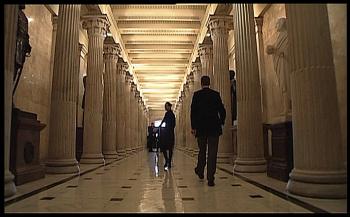
MOUNTAINS AND CLOUDS: With unprecedented access to some of the most powerful members of the U.S. Congress, 'Mountains and Clouds' revisits a seminal moment in the push for immigration reform, with implications for the immigration battle currently brewing (Courtesy of Human Rights Watch Film Festival)In addition to selecting high quality films, an important part of the screening process is checking for factual accuracy.
”We send [the films] onto whoever the person is that knows that subject matter, and they tell us whether it’s factually accurate. That’s something the internal vetting picks up. Over the past few years there have been a lot of films that we have not shown because of that,” he added.
For the festival, the film selection process starts in September with the festival organizers scoping out various acclaimed film festivals. The organizers have also been involved in a great deal of outreach in promoting the films.
“That’s pulled in a different audience,” says Biaggi. He said the organizers try to target certain groups from different communities and organizations as they relate to the films.
“What’s really rewarding is when you’re at the theatre on an evening where you have a film for a particular country, and you see that people from that country are showing up.”
The Human Rights Watch Film Festival will run from June 10 to June 24. For more information, please visit www.hrw.org/en/iff