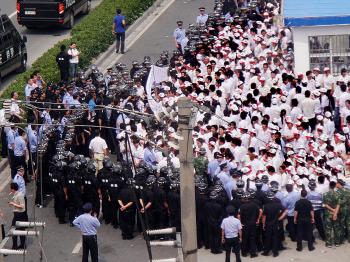


The workers demanded a raise and even asked to organize their own union. The strikes soon spread to another part of Guangdong Province, and among other places, to Shanghai, in Jiangsu Province, and to Jiangxi Province, where World Cup soccer balls happen to be made.
Foreign Companies Targeted
Most of the companies with labor trouble are manufacturers of world-famous brands—Apple, Honda, and others. Those companies are sole-owned or joint-ventured by foreign companies, especially companies from Taiwan, Japan, and South Korea.
These companies’ wages and working conditions are much better than those of many local Chinese companies, whether state- or private-owned.
In China, the labor rights movement, like any other rights movement, is strictly forbidden. Yet in a short span of time, many workers for many different companies in several provinces got involved in the strike and had a big impact.
In order for a strike in China to achieve something, some criteria need to be met. First, the company targeted has to be a normally operated business; it has to meet a product deadline, and the skilled workers cannot be easily replaced by new recruits.
Second, most of the workers must not have much to lose and must be willing to join a strike, even without a formal organization like a union.
Third, the owners of the business must be based in a democratic country, and thus be more or less under the monitoring and pressure of the media, the law (not the law of China but the law of the country where the headquarters are located), and rights groups.
Finally, the owners or the management must be authorized to negotiate and reach a settlement.
Most workers in China’s state-run enterprises, should they go on strike, would encounter big obstacles and have much less chance to have their demands met. The most difficult part is that the management has no authority to negotiate with the workers or to reach a settlement. Moreover, in the case of state-run enterprises, the state is more likely to intervene with police suppression and retaliation afterward.
Official Unions Uncertain
Ironically, part of the reason that the strikes could even start is the lack of any official union presence. The official union in China is the tool of the communist regime. The formal function of the union is “the bridge between the party and the workers.” In other words, the union’s job is to make sure that the workers’ activity is in line with the Party’s policy and interests.
In a state-owned enterprise, the union’s job is very clear: to help the state monitor the workers and stop any strike before it happens.
Out of instinct, the regime forced foreign businesses in China to accept the official union unconditionally. Even Wal-Mart, which doesn’t allow unions in its operations all over the world, had to accept a union in China.
Foxconn was assigned five union members from the Shenzhen General Union in 2006 to set up a Foxconn Union. However, since the business owner was not the state, the union was confused about what its position and function were. The union’s job is probably monitoring the owners, not the workers, of the business.
During the strike at the Honda transmission factory, the only physical conflict was between the workers and the union staff. When the workers and the managers couldn’t agree on the conditions for returning to work and had an argument, the staff sent by the local township union started to film the workers.
Being afraid the filming would lay the groundwork for “collecting the debt after the autumn harvest,” the workers asked them to stop filming. That’s how the physical conflict started.
Views expressed in this article are the opinions of the author and do not necessarily reflect the views of The Epoch Times.







