[ Canada Spy Agency Head’s Remarks on CCP – NTDTV ]
OTTAWA, Canada—Canada’s spy boss Richard Fadden said he regretted the candidness, but not the substance of his controversial remarks regarding foreign influence of Canadian officials and stood his ground during his hearing before the Standing Committee on Public Safety and National Security on Monday.
For the first part of the hearing, committee members divided clearly on the nature of their questions. Opposition MPs hit Fadden with questions regarding the chain of communication regarding his remarks and their fallout, while government MPs asked Fadden about the legality of his remarks under laws governing Canadian Security Intelligence Service (CSIS).
MPs from the Liberals and Conservatives both eventually raised the substance of his remarks, referencing the example of a Russian ring recently broken up in the United States.
That spy ring included undercover Russian agents posing as Canadians. The U.S. Justice Department says the group was instructed to “search and develop ties in policymaking circles in [the] U.S.”
The group worked to ingratiate itself with former politicians, financiers, government officials, and others in positions of power and influence, a phenomena remarkably similar to that laid out by Fadden in remarks that have brought some MPs to call for his resignation.
In his testimony before the questions began, Fadden said the intelligence agency decided to voice concerns over foreign influence because the issue is too often overlooked.
“We do not as a country often reflect on threats relative to espionage, terrorism, and foreign interference. I would argue it is good public policy for Canadians to be more attuned to the threats the country faces.”
While the director said he did not agree with the all the criticism being leveled against him, he did regret the distress his more specific comments caused, including that the agency suspected two provincial cabinet ministers were under the influence of a foreign regime. He said he “would not provide such detail again.”
“Having said this, I stand by my general message on foreign interference. It is a concern and a threat, it is more common here and elsewhere than many think and it is desirable that this threat should be known and discussed.”
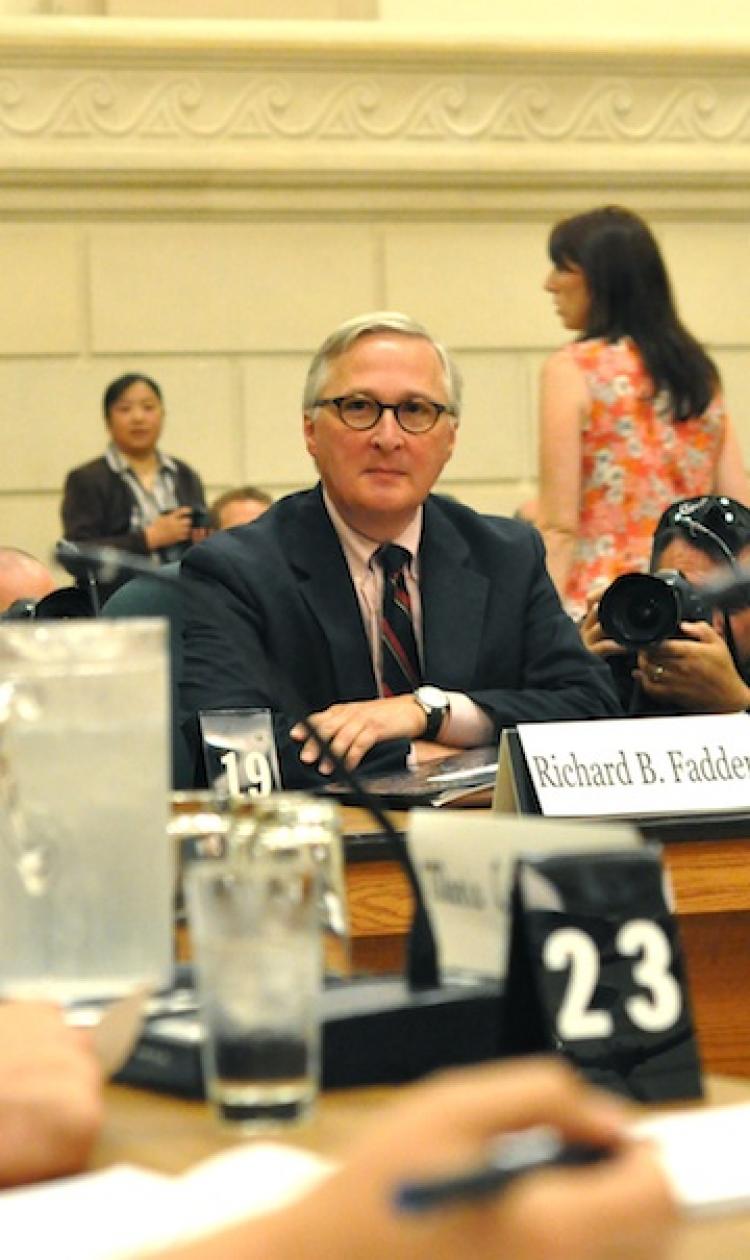
CBC had been granted special access to tape the event and later asked Fadden to elaborate on the issues of foreign influence he mentioned there.
“I felt I had little choice but to address them in a forthright manner,” said Fadden, referring to the televised CBC interview that later brought the issue to national headlines.
His comments have raise particular ire among some politicians of Chinese decent because of comments Fadden made in the interview that some politicians are invited back to their homeland for a trip as a way to begin influencing them.
"You invite somebody back to the homeland. You pay [for] their trips and all of a sudden you discover that when an event is occurring that is of particular interest to country "X," you call up and you ask the person to take a particular view," Fadden said in the interview.
He has also pointed to China as the most aggressive country in trying to recruit political prospects at the university level.
When asked if he thought he owed an apology to the Chinese community, Fadden replied “no” saying cases were extremely rare and those people being used to gather intel were the victims.
“I don't think they are the problem, I think the foreign power is the problem.”
But some MPs, notably those from the Bloc Quebecois and New Democratic Party didn't find Fadden contrite enough and have said he should be fired for the comments. Others said the issue would need further review. Liberal MP Andrew Kania wanted more details about how and when Fadden communicated with the Prime Minister's Office, Privy Council, and National Security Adviser about the comments and the substance of what he raised.
Fadden said he would not step down and thought some people were exaggerating the impact of his comments by suggesting he had tarnished the reputation of the entire political class.
He also said it is serious for any Canadian to be under the influence of a foreign state, a concern shared among the security and intelligence community, which is why after discussion with his colleagues at CSIS he went forward with the comments.
Fadden also said that the agency’s investigation of the provincial cabinet ministers was wrapping up and that it had already finished collecting evidence and would be submitting its report to the government in a matter of weeks.
In a press conference following the hearing, reporters were told of specific examples of foreign influence from the Falun Dafa Association of Canada (also known as Falun Gong). Lucy Zhou listed a string of occurrences where politicians seemed to advocate on the Chinese regime's behalf after returning from a trip to China.
She said that the group faces constant attacks from the Chinese regime relating to its activities in Canada, encountering interference for everything from participating in parades to getting routine proclamations from city governments. Falun Dafa is the most severely persecuted group in China today, say human rights groups.
“Every move we have here, the embassy gets us,” said Zhou, referring to the efforts of Chinese foreign missions to stifle the activities of Falun Dafa across Canada.
Wenzhuo Hou, a one-time visiting fellow at Harvard Law School, has testified as an expert witness before the U.S. Congressional Executive Commission on China. At the press conference, Hou said that the regime recalculated its foreign policy strategies following the 1989 Tiananmen Square Massacre, using an often hidden and multifaceted approach to establish long-term infiltration program in countries around the world.
“This is a long-term project called 'transforming by raindrops,' meaning change the West by subtle and imperceptible means," she said.