
Spain became the eighth team to win soccer’s greatest prize in the 19th time the tournament has been held. Netherlands now has lost in the final match three times (1974, 1978, 2010).
The match-winner was Man of the Match Andres Iniesta. The superb midfielder put the finishing touch on a counterattack led by substitute Jesus Navas who took the ball down the right wing and into the heart of the Dutch defense. Another substitute Cesc Fabregas then threaded the pass to Iniesta who fired a right-footer past Maarten Stekelenburg in the Dutch goal in the 116th minute.
“I’m just happy I managed to do my bit and score such an important goal for the national side. It’s a game to remember and to celebrate,” said Iniesta on FIFA.com.
Spain is now the holder of the European championship and World Cup. There can be no doubt that they are the best soccer nation in the world. They also became the first team to ever win the World Cup after losing their opening game (1–0 to Switzerland).
“It’s hard to put it all into words and the way the players feel goes way beyond words. The satisfaction people feel goes way beyond sport and this is a reward that’s richly deserved,” said Spain coach Vicente del Bosque.
“Obviously, we’re devastated by the result. We were down to 10 men but almost made it to penalties. You have to say the better team won, but losing the World Cup Final is hard to take,” said Dutch coach Bert van Marwijk.
Match in Review
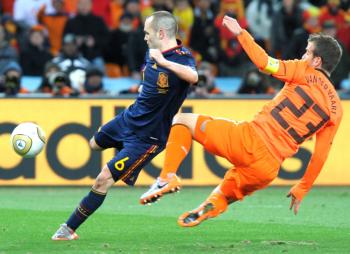
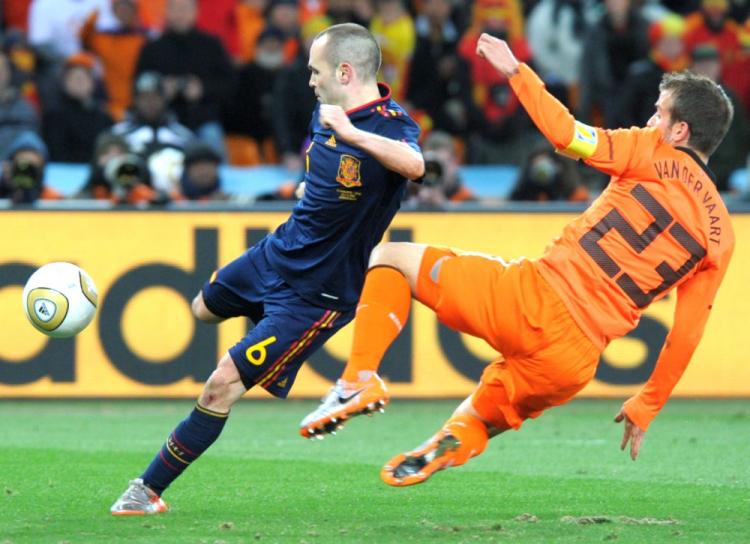
The first half was disappointing. English referee Howard Webb handed out five yellow cards, four of which came in the first 22 minutes. Spain and Netherlands did not bring their “A-game.” Instead, they combined for 20 fouls.
Both teams did effective jobs at closing down spaces, pressuring the goalkeeper and defenses who seemed to have no answer for the pressure.
Nigel De Jong could have easily been sent off for a studs-to-the-chest foul on Xabi Alonso just before the half-hour mark.
The best scoring chance of the first half came in the fifth minute as Spanish full back Sergio Ramos got a point blank header on target but Maarten Stekelenburg came up with a great reaction save.
Arjen Robben was the main threat for the Dutch. His speed was the key to unlocking the Spanish defense. But he was unable to finish his chances and never hesitated to complain bitterly to referee Webb.
“Spain created far more chances, but Arjen Robben twice came within inches of scoring for us. If he had, I think we’d have been world champions,” said van Marwijk.
Spain goalie Iker Casillas capped a terrific tournament with his fourth straight shutout. His denial of Robben on a breakaway early in the second half was enormous. Stekelenburg was also outstanding all tournament long but he could not be faulted for Iniesta's goal.
The match actually became quite scrappy as the fouls continued into the second half. In the end, Netherlands accumulated seven yellow cards and Spain racked up six. John Heitinga also saw red for getting two yellow cards.
The plan for the Dutch seemed to be to stifle the Spanish possession game. They attempted to break it up with fouls and physical play. This threw off Spain who were unable to play the way they wanted to and they became guilty of some foul play as well.
The introduction of diminutive winger Jesus Navas on the hour mark gave Spain an additional attacking edge and it was his counterattacking run in the end that settled the score.
Fernando Torres made his appearance at the start of the second extra time. He had a small part to play in the game-winning goal but unfortunately, the snake-bitten striker pulled up with a leg injury late in the game.
The 84,490 fans in attendance may not have enjoyed the best display of soccer but the monumental nature of this game won’t be forgotten by anybody.